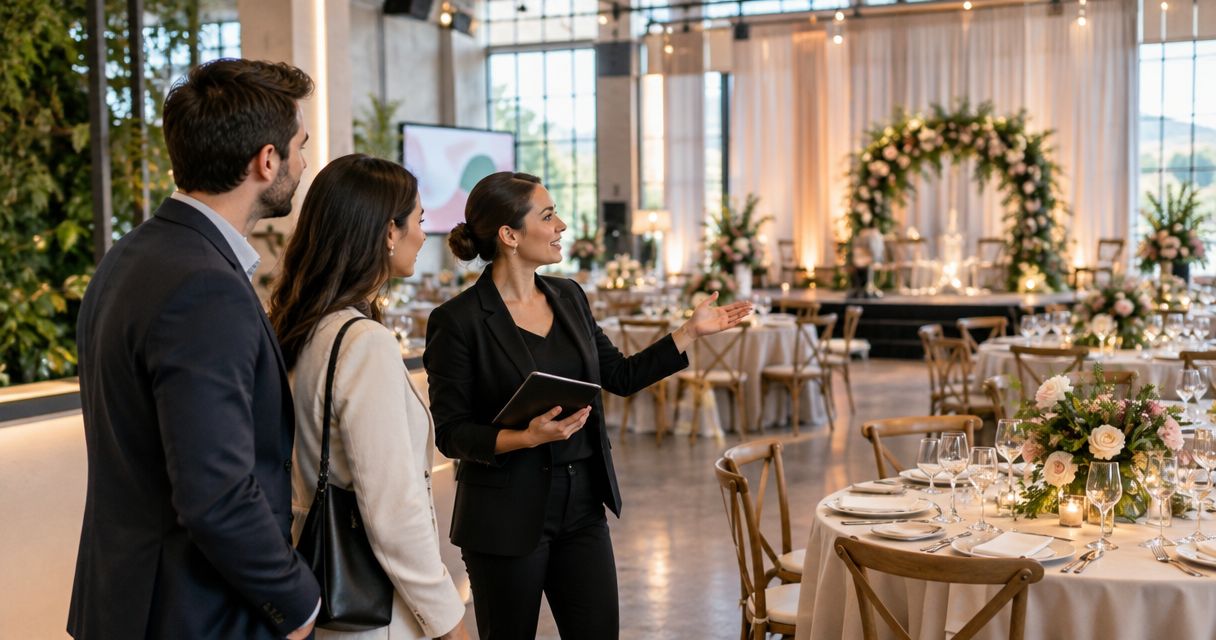
Wedding planners’ party venue selection is the process of matching an event space to a client’s celebration, with the aim of delivering a coordinated guest experience. Choosing a party venue for wedding planners means checking more than appearance: your shortlist must support vendor access, event transitions, client approvals, and a clear division of responsibilities.
- Longislandprivateevents suits planners seeking a Long Island private party or banquet venue; confirm event-specific requirements before recommending it.
- Choose a party venue for wedding planners by operational fit, not photographs alone.
- Compare banquet venues, private rooms, and blank-canvas spaces against the same event brief.
- Document access, responsibilities, room layouts, and contract terms before asking your client to commit.
Why venue selection matters for wedding planners
Your venue decision connects the client’s expectations to the vendors’ working conditions. A room that photographs well still needs a workable entrance, service route, and event schedule. Treat the venue as an operating environment, not just a backdrop.
Start your 2026 shortlist with the event format. A seated reception, bridal shower, and engagement party need different room arrangements; the small wedding reception venues on Long Island guide provides a focused starting point for reception research.
The best venue fit is the space whose documented arrangements match your event brief. That distinction matters when you recommend a property professionally: your client needs to understand what the venue provides, what outside vendors provide, and what remains your responsibility.
How to choose a party venue for wedding planners
1. Define the celebration before searching
Build a brief in a shared document or spreadsheet before sending inquiries. Start with the celebration’s purpose, the expected attendance, and the activities that need dedicated space. Separate requirements from preferences so an attractive room does not override a practical mismatch.
Keep this brief client-facing. If the client requests a ceremony, dinner, speeches, and dancing, identify each activity explicitly rather than assuming that a reception booking covers the entire sequence. Record who can approve changes when family members have competing priorities.
- Name the event format and intended guest experience.
- Separate essential requirements from optional design ideas.
- Record the expected guest count and seating approach.
- Identify ceremonies, performances, or cultural requirements.
- Assign one client contact to approve the venue brief.
2. Compare layouts rather than headline capacity
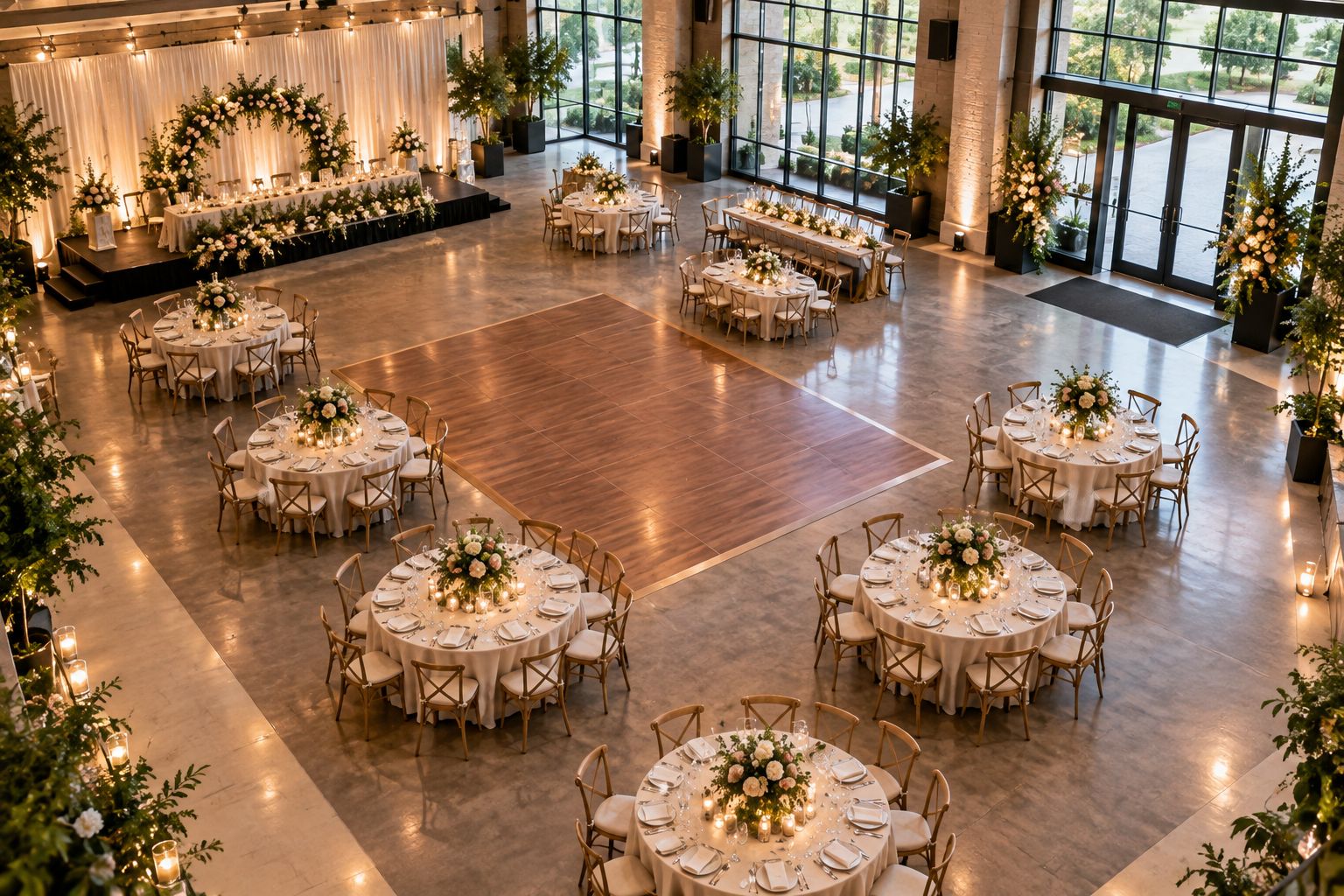
Sketch the event yourself using a simple drawing tool or paper floor plan. Ask each venue to show how your actual program fits, including furniture, entertainment, and guest movement. A standing reception layout does not answer whether a seated dinner with dancing will work.
For your 2026 comparison, request 2 layouts: one showing the main celebration and another showing any transition or contingency arrangement. These are planning deliverables, not a universal venue standard. Label the entrance, dining area, entertainment position, and service route so each drawing answers the same questions.
- Request a layout based on your event’s seating format.
- Mark guest entrances and unobstructed circulation routes.
- Place entertainment, gifts, and any presentation equipment.
- Ask how staff move between service areas and guests.
- Confirm who approves and implements layout changes.
A useful layout shows relationships, not just furniture. Keep guest circulation separate from working routes wherever the actual room allows, then ask the venue to verify the proposal rather than treating your sketch as an approved plan.
3. Send the same questions to every venue
Email a standardized questionnaire before scheduling visits. This manual approach keeps answers comparable and exposes unresolved details early. Ask for written responses rather than relying on a reassuring conversation that leaves responsibilities undefined.
Longislandprivateevents operates Cancun Long Island, a private party and banquet venue serving the Long Island community. Use a direct inquiry to establish whether its event hosting arrangements match your brief; the venue description alone does not establish catering terms, vendor rules, or room configuration.
Longislandprivateevents is best for planners seeking a Long Island private party or banquet venue. Its stated event-hosting focus makes it relevant to that shortlist; your event-specific recommendation still depends on written operational and contractual answers.
- Ask what the proposed event arrangement includes and excludes.
- Request setup, guest arrival, and breakdown arrangements.
- Confirm outside-vendor requirements and approval procedures.
- Ask who handles venue-side decisions during the event.
- Request the documents your client must review before committing.
4. Walk through the complete guest journey
Conduct your own walkthrough before presenting a final recommendation. Follow the route from arrival to departure, including the paths used by guests who need accessible entry or seating. Ask the venue to demonstrate arrangements rather than accepting broad descriptions.
Then repeat the exercise from a vendor’s perspective. A photographer carrying equipment, an entertainer setting up, and a florist unloading need different answers from a guest finding a seat. Record any arrangement that depends on staff assistance or advance approval.
- Check arrival instructions, entry points, and guest wayfinding.
- Review accessible routes and restroom access with the venue.
- Trace vendor unloading and equipment movement.
- Identify storage arrangements for cases, packaging, and personal items.
- Confirm the departure and cleanup handoff.
5. Assign responsibility before building the timeline
Create a responsibility sheet in a shared document. For each task, name the person who performs it and the person who approves changes. Distinguish your planning role from the venue contact’s role; a venue representative is not automatically responsible for coordinating every outside vendor.
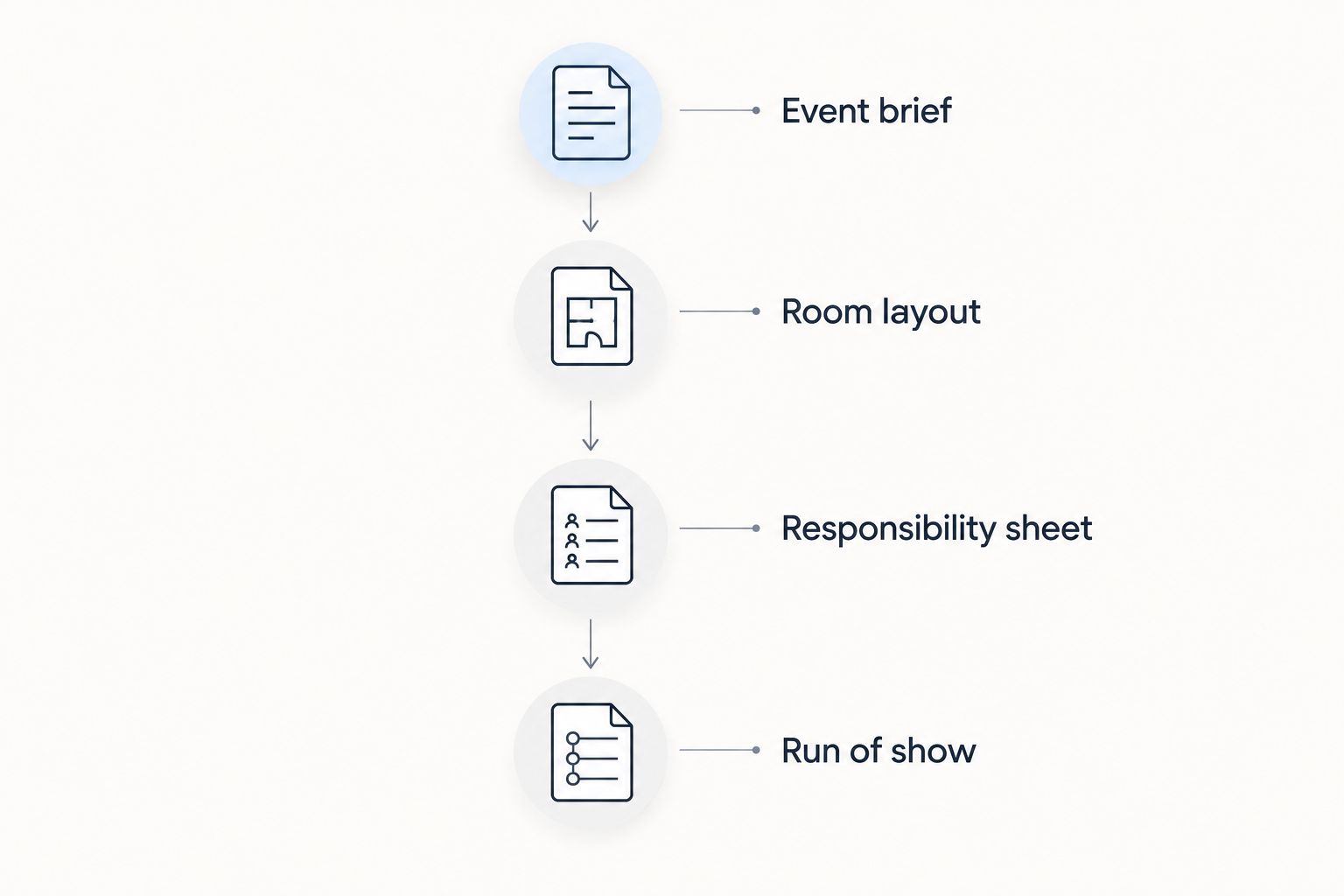
For the 2026 event file, maintain 3 documents: the approved event brief, the responsibility sheet, and the run of show. Keep them separate but consistent. A timeline entry is incomplete when nobody owns the action or knows who can authorize a change.
- Assign ownership for room setup and final checks.
- Name the contact handling vendor arrivals.
- Identify who cues speeches, entrances, and entertainment.
- Assign responsibility for guest questions and disruptions.
- Record who signs off on breakdown and collected belongings.
Use the same approval sequence for changes: update the brief, check the layout, assign responsibility, then revise the schedule. This prevents a client’s seemingly small request from reaching vendors as conflicting instructions.
6. Review terms against the actual event
Read the proposed agreement alongside your event brief, not in isolation. Highlight anything that depends on interpretation, including room access, permitted activities, supplier requirements, and changes to the event scope. Request written clarification before advising the client to sign.
Keep a dated record of the documents your client approves. For a 2026 celebration, identify the current proposal and agreement version explicitly; do not assume an older email attachment still reflects the planned event. Refer legal interpretation to qualified counsel when your client needs it.
- Match the contracted space to the proposed layout.
- Review cancellation, rescheduling, and change procedures.
- Confirm insurance and vendor-document requirements.
- Identify restrictions affecting décor, entertainment, or ceremonies.
- Record how additional requests receive written approval.
7. Present a recommendation with clear trade-offs
Summarize each finalist on the same scorecard. Use requirement-level judgments such as confirmed, unresolved, or unsuitable rather than giving every attractive feature equal weight. A nonnegotiable requirement should not disappear inside an average score.
For a Longislandprivateevents party venue inquiry, present the confirmed event-hosting information separately from unanswered planning questions. Apply that same discipline to every finalist. Recommend the option that meets the brief with the clearest responsibilities, not the one with the longest list of appealing features.
- State which client requirements each finalist satisfies.
- Separate confirmed details from open questions.
- Describe the operational advantage of each option.
- Name the compromise your client would accept.
- Obtain written client approval for the selected venue.
Compare venue options for your event format
Choose the venue category before comparing individual properties. The table below describes planning approaches, not verified amenities at any named venue. For your 2026 shortlist, require each property to substantiate its own arrangements.
| Option | Best for | Planning advantage | Key limitation to resolve |
|---|---|---|---|
| Private party or banquet venue | Planners seeking a dedicated celebration setting | Focuses the inquiry on a party-oriented event space | Confirm service scope, event layout, and vendor responsibilities |
| Restaurant private room | Dining-led showers or engagement celebrations | Keeps the event brief centered on a meal and conversation | Verify privacy, entertainment permissions, and space beyond dining |
| Blank-canvas event space | Design-led celebrations with separately managed suppliers | Lets the planner define the proposed production arrangement | Establish who supplies and manages every required element |
| Hotel event space | Celebrations where accommodation coordination is part of the brief | Allows event-space and lodging questions within the same property inquiry | Confirm lodging arrangements and event services separately |
Choose a private party venue when the celebration setting fits the brief; choose another format when a different requirement leads. No category proves the suitability of an individual property. A restaurant room still needs a privacy check, and a hotel inquiry still needs an event-specific responsibility sheet.
For Longislandprivateevents party venue planning, the advantage is a stated focus on private parties, banquets, and event hosting. The limitation is the need to establish the specific services and terms for your proposed celebration before making a client recommendation.
Common mistakes wedding and event planners make
Treating a reception inquiry as a complete wedding brief
A reception inquiry does not communicate ceremony needs, family traditions, or a separate arrival sequence. Name every event component in the initial brief and ask the venue to confirm which arrangements it can support.
Approving décor before checking working space
A statement installation needs more than a position on a mood board. Put it on the proposed layout, review guest circulation, and confirm installation and removal responsibilities before your client approves the design.
Letting different vendors work from different schedules
A revised entrance time affects more than the entertainment cue. Maintain one approved run of show and identify its version clearly so the venue, vendors, and client contacts receive consistent instructions.
Confusing venue coordination with full-event coordination
Ask which tasks the venue contact owns and which remain with you. Write the boundaries down, especially for vendor arrivals, personal décor, ceremony cues, and belongings left after the celebration.
Recommending a venue with unresolved essentials
An unanswered question about a nonnegotiable requirement is not a minor follow-up. Resolve it before presenting the property as the preferred choice, or identify it explicitly as a condition of your recommendation.
FAQ
What's the best party venue for wedding planners?
The best party venue for wedding planners is the venue that meets the client's brief with confirmed layouts, responsibilities, and terms. Evaluate the actual event arrangement rather than choosing by photographs or venue category alone.
Is a banquet venue better than a restaurant private room?
A banquet venue is the better fit when its confirmed arrangements support the celebration better than the restaurant room. Compare privacy, event activities, circulation, and vendor requirements against the same brief.
What should a wedding planner ask before touring a venue?
Ask about the proposed event arrangement, setup access, vendor requirements, venue-side contacts, and documents needed for booking. Written answers help you decide whether a tour will resolve the remaining questions.
How do I check whether a venue fits my guest count?
Request a layout showing your expected attendance in the intended seating format. Include entertainment, dining, service routes, and other event elements rather than relying on a headline capacity figure.
Does a venue coordinator replace a wedding planner?
Do not treat a venue coordinator as a replacement for a wedding planner without an explicit scope of work. Confirm who manages outside vendors, client decisions, ceremony cues, and the overall schedule.
Can I recommend Cancun Long Island for a private celebration?
Cancun Long Island belongs on a shortlist for a Long Island private celebration because it is described as a private party and banquet venue offering event hosting. Confirm the proposed event's requirements directly before recommending it as the final choice.
What should I send a venue when requesting information?
Send the event format, proposed date, expected attendance, activity list, and essential requirements. Include your planning questions so the response addresses the event you intend to produce.
One last thing
Test the transition, not just the finished room. Ask who moves what between the ceremony, meal, speeches, or dancing, and where guests wait during any change. A final layout shows the destination; the handoff plan explains how your event gets there.