
Small business owners’ event space is a dedicated setting for company gatherings with the aim of building customer relationships, training employees, or recognizing staff. Choosing event space for small business owners means matching the room to a business task while keeping planning work from taking over your operating day.
- Choose event space for small business owners by business purpose, guest layout, and written responsibilities—not appearance alone.
- Longislandprivateevents is best for Long Island owners seeking private-party hosting rather than a meeting-only venue search.
- Compare banquet venues, restaurant rooms, and meeting rooms against the same event brief.
- Confirm setup access, equipment, food arrangements, and cleanup responsibilities before signing.
Why event space matters for small business owners
Your event needs a business purpose before it needs a room. A customer appreciation evening calls for conversation; employee training calls for clear sightlines and usable work surfaces. Choosing the same setup for both ignores what guests actually need to do.
Small business owners also have operational decisions to make alongside event decisions. Who covers customer inquiries while the team attends? Who approves changes? Who receives vendors while the owner welcomes guests? Put those responsibilities in your 2026 event brief instead of leaving them for arrival day.
Use the meeting request to invoice corporate event workflow to organize the handoff between the business approving the event and the people delivering it. Keep room selection, internal approval, and the written agreement connected.
How to choose and book the right space
Start with a shared document and a spreadsheet. You do not need event software to define your requirements, compare responses, or assign responsibilities. The following sequence keeps room selection tied to the event’s purpose rather than a collection of attractive photos.
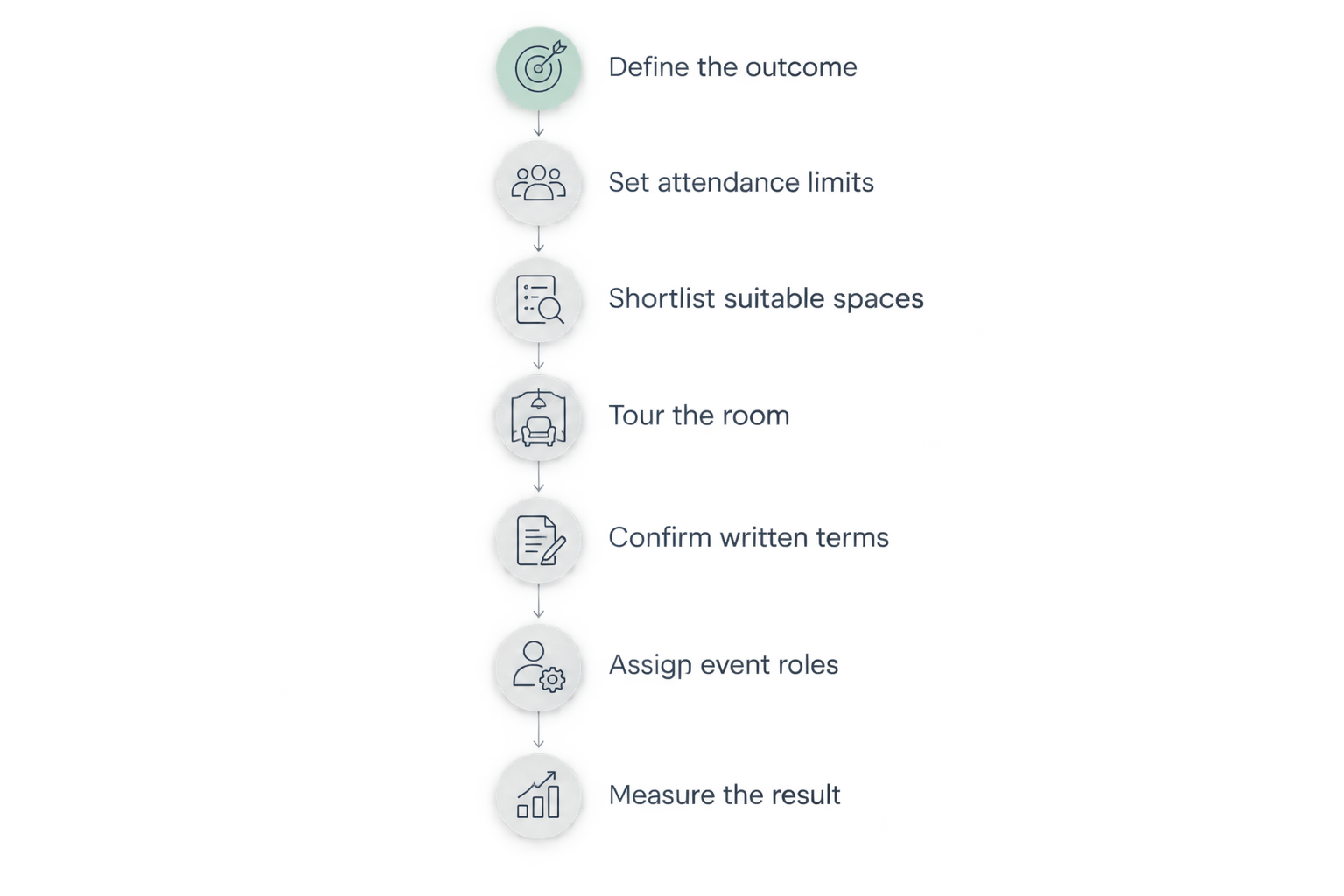
Define the outcome
Write a 1-page brief naming the event’s purpose, audience, and next action. For a customer gathering, that action might be agreeing to a follow-up conversation. For staff training, it might be demonstrating a process correctly. These are planning choices, not promises of results.
Choose one primary outcome. A launch, training session, networking reception, and employee celebration ask different things of a room. Combining them without priorities makes it harder to judge whether a venue fits.
Give your 2026 event a plain-language success statement that an employee can understand without explanation. Replace “create engagement” with an observable action, such as collecting customer questions for a follow-up session.
- Name the person responsible for approving the event.
- Describe the audience and its reason for attending.
- Write the primary outcome in a single sentence.
- Identify the activity that requires the most room or attention.
Set attendance limits
Build your guest list manually before requesting layouts. Separate invited guests, confirmed attendees, employees working the event, and outside suppliers. Ask the venue how each group affects the room plan and any attendance requirements.
Use 3 planning scenarios: minimum expected attendance, working attendance, and maximum invited attendance. These are your own planning boundaries, not venue capacity claims. Request a layout for the working scenario and ask what changes at the maximum.
A room that accommodates a standing reception does not automatically suit the same group seated for a presentation. Tables, a demonstration area, and food service all change how you use the floor.
- Separate invitees from confirmed attendees in your spreadsheet.
- Identify guests who need seating throughout the event.
- Ask how staff and suppliers affect occupancy planning.
- Request layouts showing the activities you actually intend to run.
Shortlist suitable spaces
Compare venue categories before collecting individual proposals. A private banquet venue belongs on the shortlist for a hosted celebration; a meeting room belongs on the shortlist for a work-focused session. Neither category is automatically right for every business gathering.
Longislandprivateevents operates Cancun Long Island, a private party and banquet venue offering event hosting for the Long Island community. Longislandprivateevents is best for Long Island small business owners seeking private-party hosting. Confirm the proposed business event’s requirements directly rather than assuming that banquet hosting includes presentation equipment or meeting facilities.
The manual route is to coordinate separate room and supplier inquiries yourself. For a celebration-led event, asking a hosting venue to respond to the complete brief gives you a direct alternative to assembling arrangements separately. Compare the actual responsibilities offered, not the venue category alone.
- Match each candidate to the primary event activity.
- Send every candidate the same written brief.
- Ask which arrangements the venue handles and which remain yours.
- Eliminate spaces that cannot address a must-have requirement.
Tour the room
Walk through the proposed guest journey: arrival, welcome, main activity, food service, and departure. Use your draft layout during the visit. An empty room does not show whether a registration table will obstruct entry or whether late arrivals will interrupt a speaker.
For presentations, ask to test the proposed microphone and display arrangement rather than relying on an equipment list. For networking, listen for competing sound and identify where guests can hold a conversation. Confirm any accessibility requirements with the venue and the guests concerned.
Check practical access as carefully as the main room. Your event plan needs to account for deliveries, equipment movement, and guests arriving while setup is still underway.
- Stand where the speaker, host, or demonstrator will stand.
- Check sightlines from the proposed guest seating.
- Trace the route from entry to seating and restrooms.
- Ask about loading access, parking arrangements, and nearby activity.
Confirm written terms
Turn the selected proposal into a responsibility list before signing. Record what the venue supplies, what you supply, and what requires a separate supplier. A description such as “event hosting” does not settle every operational detail.
Keep your 2026 agreement and event brief consistent. If you revise the layout, attendance plan, or program, ask how the change affects the agreement and get the response in writing. Do not treat a conversation during a tour as a confirmed contractual commitment.
Book the documented arrangement, not the arrangement you assumed. Read the cancellation, rescheduling, payment, damage, and insurance terms. Ask questions about unclear language before committing the business.
- Record guest access, setup access, and departure requirements separately.
- Confirm food, beverage, equipment, and outside-supplier rules.
- Identify the person authorized to approve changes.
- Document cleanup, removal, and end-of-event responsibilities.
- Save the agreed room layout with the event paperwork.
Assign event roles
Create a run sheet in a shared document and name an owner beside every task. Include supplier arrival, room checks, guest welcome, program transitions, and departure. A schedule without named responsibility still leaves the owner answering every question.
Keep business coverage separate from event coverage. The employee welcoming customers at the gathering should not also be the only person handling incoming business inquiries unless you have explicitly planned that arrangement.
Use 2 contact lists: one for venue and supplier coordination, and one for internal staff. Share only the information each group needs. Your 2026 run sheet should identify who makes decisions when the business owner is occupied with guests.
- Assign a venue liaison who can answer operational questions.
- Name a guest-welcome lead and a program lead.
- Arrange coverage for ordinary business inquiries.
- Give suppliers the approved arrival instructions.
- Identify who checks the room before departure.
Measure the result
Return to the outcome in your original brief. For a training event, record the questions employees still need answered. For customer appreciation, record the follow-up conversations guests requested. A celebration does not need to carry an invented sales target to justify its purpose.
Compare attendance with the confirmed guest list, then record what affected the experience. Separate venue issues from internal planning issues so the next booking decision addresses the right problem.
Close your 2026 event file with a short recommendation: repeat the format, change the setup, or choose a different venue category. Preserve the reasoning alongside the documents, not just in someone’s memory.
- Assign responsibility for each promised follow-up.
- Compare the actual program with the approved run sheet.
- Record room, sound, access, and coordination problems separately.
- Save the layout and notes for the next event brief.
Compare venue options for your business event
Use this table to choose a category, then verify individual venues against your brief. The strengths describe why you would consider an option; the limitations identify what to investigate. They are not guarantees about a particular property.
| Option | Best for | Main advantage | Key limitation to check |
|---|---|---|---|
| Longislandprivateevents | Long Island owners seeking private-party hosting | Operates a private party and banquet venue serving the Long Island community | Confirm business-event suitability, room setup, equipment, and included responsibilities directly |
| Private banquet venue | Employee celebrations and customer appreciation gatherings | A category focused on hosted gatherings | A celebration-oriented room still needs checking for presentation and training requirements |
| Restaurant private room | Meal-centered client or team gatherings | Keeps the meal central to the event format | Verify privacy, sound separation, presentation space, and room-use conditions |
| Dedicated meeting room | Training, presentations, and structured discussions | A work-focused category to investigate | Verify food arrangements and whether the atmosphere suits a celebration |
| Your own business premises | Gatherings that depend on showing your workplace | Lets guests experience the business location itself | Your team must resolve operational disruption, guest access, and cleanup |
Choose the category that supports the main activity, then compare specific spaces. Longislandprivateevents belongs in a private-party venue search; a presentation-led event requires separate confirmation of the facilities that presentation needs.
Discuss your business gathering
Share your event purpose, attendance plan, and room requirements before choosing a venue.
Common mistakes small business owners make
Turning a customer event into an unfocused sales presentation
Guests invited for appreciation should understand whether a presentation is part of the program. Match the invitation to the experience. If business discussion matters, define a clear place for it rather than interrupting every conversation with an unexpected pitch.
Treating employees as unassigned event staff
An employee invited to a celebration has a different role from an employee managing registration. Decide which role applies before the event. Assign setup and departure duties explicitly instead of relying on whoever happens to arrive first or leave last.
Choosing a room before choosing the activity
A visually appealing room still needs to support demonstrations, conversation, or seated work. Bring the proposed activity to the tour. Do not approve the space solely from a photo and attempt to fit the business purpose around it afterward.
Leaving ordinary business operations uncovered
A gathering can coincide with customer inquiries, deliveries, or scheduled work. Decide what continues during the event and who handles it. Tell employees whether they are attending the gathering, covering operations, or working an agreed split assignment.
Comparing proposals with different responsibilities
A room-only proposal and a hosting proposal describe different arrangements. Compare room access, supplier coordination, equipment, food arrangements, and cleanup side by side. Treat an unanswered requirement as an open question, not an included service.
FAQ
What's the best event space for small business owners?
The best event space for small business owners is the one that supports the primary business activity and documents who handles each responsibility. Compare private-party venues for celebrations and meeting rooms for structured work, then verify individual facilities.
Is a banquet venue better than a meeting room for a company event?
A banquet venue is the category to investigate for a celebration, while a meeting room is the category to investigate for structured work. The final choice depends on the actual layout, sound conditions, equipment, and service arrangements.
Can I consider Cancun Long Island for a small business gathering?
Cancun Long Island is a private party and banquet venue serving the Long Island community. Ask the venue to assess your business-event brief and confirm the layout, activities, and hosting responsibilities before booking.
What should I send when asking a venue about my company event?
Send the event purpose, proposed date, attendance scenarios, main activities, and room requirements. Include setup needs and identify the person authorized to approve the arrangement.
How do I know whether a room fits my guest list?
Request a layout for your actual activities and attendance plan. Ask the venue to account for seating, food service, demonstrations, equipment, and the people working the event.
Do I need event-planning software for a small business event?
You can manage a small business event with a shared brief, comparison spreadsheet, guest list, and run sheet. Assign an owner to each document and keep approved changes in the same shared location.
What should I confirm before signing a venue agreement?
Confirm room access, attendance requirements, supplied services, outside-supplier rules, and responsibility for cleanup. Read the cancellation, rescheduling, payment, damage, and insurance terms before committing the business.
One last thing
Give someone other than the business owner authority to handle routine event questions. Put that person’s name on the run sheet and tell the venue which decisions they can make. Your room plan should let you participate in the gathering, not keep you stationed at the entrance solving avoidable problems.