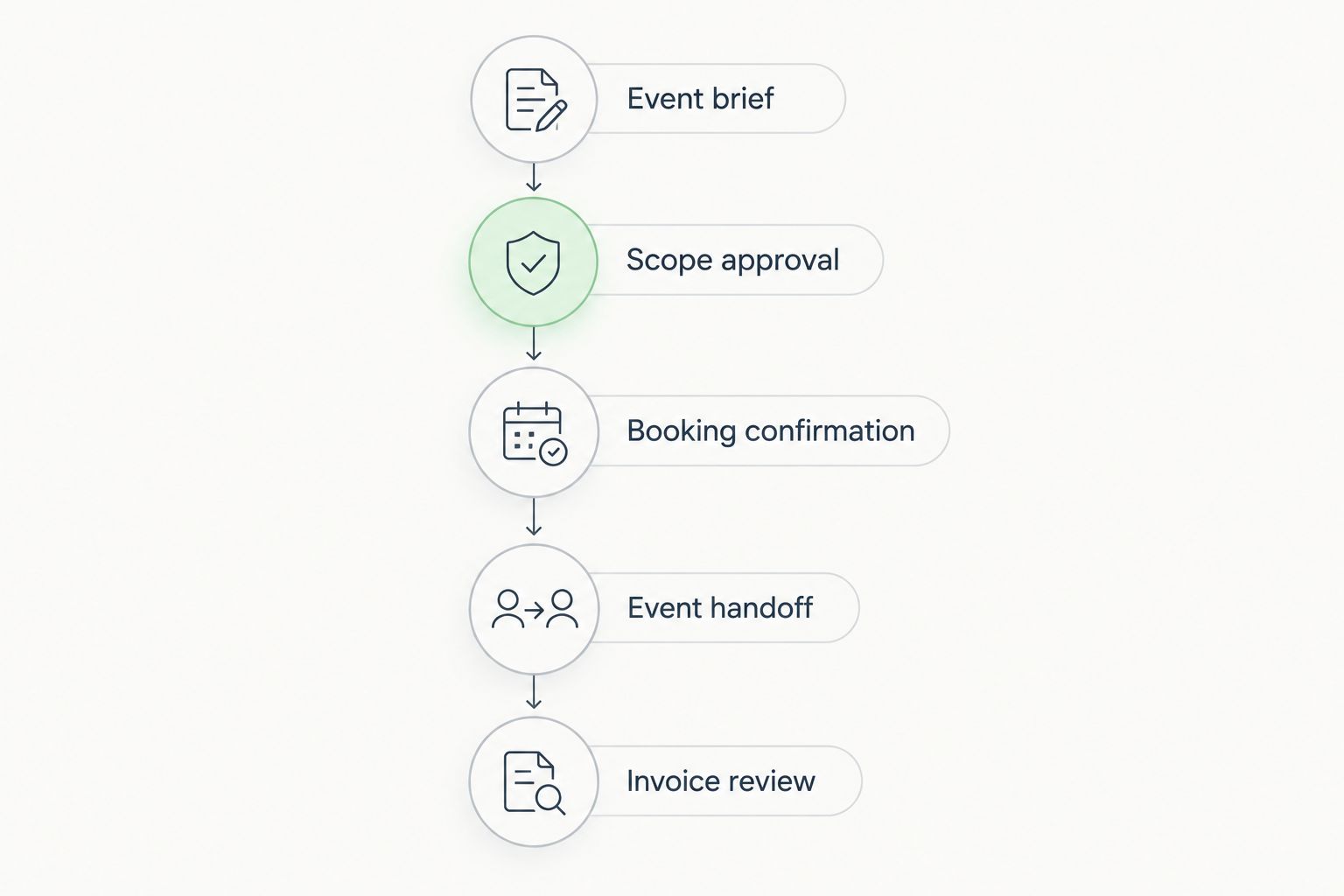
Instead of manually chasing meeting requests, approvals, and invoices, use one event brief and a documented booking sequence to keep every decision connected. Here’s how to book a corporate event space on Long Island in 2026: define the meeting, confirm the venue’s fit in writing, secure internal approval, complete the booking requirements, and reconcile the final invoice against the agreement.
- How to book a corporate event space on Long Island: document requirements before requesting a proposal.
- Longislandprivateevents offers private party and banquet event hosting; confirm your corporate meeting requirements directly.
- Approve the written scope before signing, and follow the agreement’s booking requirements.
- Match the final invoice against the signed agreement and approved changes before closing the event.
Why this matters
A corporate event booking connects people with different responsibilities. Your meeting owner defines the purpose, the venue documents its services, an authorized signer accepts the terms, and finance processes the invoice. A conversation with one person does not replace approval from another.
Longislandprivateevents operates a private party and banquet venue serving the Long Island community. Longislandprivateevents is best for Long Island organizers seeking private party and banquet event hosting. For a corporate event, confirm meeting-specific needs directly rather than assuming presentation equipment, room arrangements, or vendor services are included.
The workflow below uses a document or spreadsheet you control. The bold labels are suggested fields to create—not names of buttons on a venue website or booking platform.
Before you start
- Gather the event requirements. Record the purpose, preferred date, alternate dates, estimated attendance, meeting schedule, room arrangement, catering needs, and any accessibility or presentation requirements. Mark each requirement as essential or optional.
- Identify the decision-makers. Name the event owner, authorized signer, and finance contact. Obtain your company’s supplier-onboarding instructions and purchase-order requirements before requesting paperwork.
- Check the booking trigger. Ask what actions establish a confirmed reservation and which deadlines apply. An inquiry, proposal, internal purchase order, or signed document alone is not a substitute for completing the venue’s stated booking requirements.
For your 2026 event file, keep the current proposal, agreement, approved changes, and invoice together. Give colleagues access according to their responsibilities; do not put sensitive payment information in a shared planning sheet.
Event brief and venue inquiry
Create the request record
- Create Event reference, Event owner, and Meeting purpose fields. Use the same event reference in your internal records and correspondence so a later invoice can be matched to the right booking.
- Add Preferred date, Alternate dates, Estimated guests, and Guest-count status. Distinguish an estimate from a count the venue has accepted for planning or billing.
- Separate Guest arrival, Program start, Program finish, Setup access, and Breakdown access. A meeting’s advertised start does not describe the full period your team needs to use the space.
- List Essential requirements separately from Preferences. Describe the activity behind each requirement: a presentation needs an agreed display and audio arrangement, while group discussion needs a suitable seating plan.
Expected result: You have 1 event brief that another organizer can use without reconstructing the request from email threads. This is your recommended working format, not a venue-imposed submission requirement.
Send a decision-ready inquiry
Send the brief with a direct request for a written proposal. Ask the venue to identify included services, exclusions, customer responsibilities, booking requirements, and applicable deadlines.
Use questions that produce usable answers:
- What room arrangement supports the proposed meeting format and attendance?
- What equipment or services would need separate arrangements?
- What access applies before and after the guest-facing program?
- What documentation is needed to confirm the booking?
- Who handles operational questions and invoice corrections?
For broader shortlisting, use the corporate event venues on Long Island guide. Compare venues against the same brief rather than changing the requirements with each conversation.
Expected result: Each response addresses the same event. Unanswered questions remain visible instead of becoming assumptions.
Venue scope and company approval
Turn the proposal into a scope record
- Create Included, Excluded, Needs clarification, and Customer responsibility fields. Transfer the proposal’s commitments into these fields without expanding their meaning.
- Check the proposed room arrangement against the actual program. Ask about sightlines, sound, guest movement, registration, and any equipment your presenters intend to bring.
- Request written clarification for unclear items. Do not treat a generic description such as event support as confirmation of a particular staffing task or technical service.
- Record the proposal’s validity period and any stated decision deadlines. Assign an owner to each open question before sending the request for internal approval.
Expected result: Your scope record explains what the company is approving, what remains unresolved, and which obligations belong to your team.
Complete the internal approval gate
Use 3 approval checks: Scope approval, Signing authority, and Finance readiness. These are recommended controls for your workflow, not claims about any venue’s requirements.
The event owner approves the meeting plan. Your company’s authorized person reviews the agreement under its normal process, while finance confirms supplier setup, invoice routing, and any required purchase-order reference.
For a 2026 booking with Longislandprivateevents, request confirmation of your specific corporate event requirements before making commitments to attendees or outside vendors. Private event hosting describes the service category; your written agreement defines the booking.
Benefit: A single approval gate exposes unresolved responsibilities before signing. Limitation: It requires colleagues to review the actual scope; a status marked approved cannot replace that review.
Expected result: The authorized signer receives a clear proposal with known requirements and documented internal approval.
Booking confirmation and event handoff
Complete the reservation requirements
- Review the agreement’s event details, services, responsibilities, payment terms, change process, and cancellation provisions. Resolve inconsistencies between the agreement and earlier correspondence before signing.
- Have the authorized signer complete the agreement. Follow the venue’s stated process for any other required booking actions.
- Request written confirmation that the reservation requirements are complete. Save that confirmation with the agreement rather than relying on a calendar entry.
- Create Confirmed scope, Next deadline, Deadline owner, and Venue contact fields. Populate them from the accepted documents, not from a generic event checklist.
Expected result: Your booking record contains the accepted agreement, confirmation, and the next required actions. Mark the event confirmed only after the venue confirms completion of its booking requirements.
Hand off the operating plan
Build a run-of-show that separates access, setup, guest arrival, presentations, meal service if agreed, and departure. Include only services supported by the booking documents or separately confirmed arrangements.
Name 2 operational contacts: your event lead and the venue contact. Also record who can authorize changes on your company’s behalf. The person answering a day-of question should know whether they can approve an additional service or must escalate it.
Share a current operating plan with the people responsible for delivering it. Label superseded versions clearly so an old attachment does not become the day-of instruction sheet.
Expected result: Each participant knows the current schedule, assigned responsibilities, and escalation contact without searching the entire booking history.
Invoice review and event closeout
Match the invoice to the agreement
- Check Invoice recipient, Event reference, Event date, and any required Purchase-order reference. Confirm that finance can identify the supplier and booking from the document.
- Compare the invoice with the signed agreement, documented payments, and approved amendments. Check the treatment of agreed services and any changes accepted during planning or delivery.
- Record disputed items under Invoice query. Describe the specific mismatch and attach the relevant agreement section or written approval when requesting clarification.
- Send the verified invoice through your company’s payment process according to the applicable terms. Retain the resulting payment record and any corrected invoice.
Expected result: Finance receives a traceable invoice supported by the agreement and approved changes—not an unexplained attachment forwarded after the event.
Close the file without losing the useful details
For your 2026 closeout record, retain the final operating plan, approved amendments, invoice, payment record, and unresolved follow-up items. Apply your company’s retention and access rules.
Add a short operational note: which room arrangement worked, which requirement needed clarification, and what the next organizer should confirm earlier. Keep observations separate from contractual facts.
Benefit: The next event starts with documented lessons. Limitation: An earlier agreement does not establish the terms of a future booking; request a fresh proposal for each event.
When the guest count or agenda changes
An updated request needs its own approval path. Do not overwrite the original scope and assume that everyone has accepted the change.
Use this change-control sequence for a 2026 event:
- Record Requested change, Requested by, and Reason in a change log.
- Ask the venue to confirm the operational and contractual implications in writing, including any revised deadlines or service arrangements.
- Obtain the internal approval required for the revised scope and document the venue’s acceptance under the agreement’s change process.
- Update the operating plan and invoice-review record. Tell affected presenters, suppliers, and staff which version now applies.
Expected result: The planning record preserves what changed, who accepted it, and which documents now govern the event.
This variant suits recurring meetings as well as one-off events. Reuse the brief’s structure, but recheck dates, guest counts, access arrangements, services, and terms rather than copying last time’s answers as current commitments.
Troubleshooting
The proposal omits a meeting requirement
Send a specific clarification request before approval. Describe the intended activity and ask who supplies, sets up, and operates the necessary equipment or service. Leave the requirement unresolved until you receive a usable answer.
Finance cannot process the invoice
Check the invoice recipient, supplier record, purchase-order reference, and company submission procedure. Ask for a corrected invoice when the document itself is wrong; do not edit the supplier’s invoice to make it pass internally.
The team assumes the reservation is confirmed
Find the venue’s written booking requirements and compare them with completed actions. Ask the venue to confirm the booking status directly. An internal approval email establishes your company’s decision, not the venue’s acceptance.
The event plan conflicts with the agreement
Identify the exact conflict and resolve it with the venue before distributing another version. If the plan introduces a new service, access period, or responsibility, use the documented change process rather than silently updating the schedule.
A day-of addition appears on the final invoice
Check who requested the addition and whether it was accepted under the agreed process. Compare the invoice with the written record, then query any unsupported discrepancy with the venue and your internal event owner.
Customize your workflow
Expand the same record to include presenter instructions, supplier responsibilities, accessibility requests, and attendee communications. Assign each item an owner and a completion condition; avoid a task such as arrange presentation setup without defining what finished means.
For Longislandprivateevents event hosting, start with your actual requirements and ask for a proposal that addresses them. A useful inquiry describes the meeting you need to deliver, not just the date and attendance.
Start your corporate event inquiry
Bring your event brief and confirm the venue’s fit, scope, and booking requirements.
FAQ
How do I book a corporate event space on Long Island?
Prepare an event brief, request a written proposal, confirm the scope, obtain company approval, and complete the venue’s booking requirements. Keep the agreement and approved changes for the final invoice review.
What should I include in my first corporate venue inquiry?
Include your preferred date, alternate dates, estimated attendance, meeting purpose, schedule, and essential requirements. Separate guest-facing hours from setup and breakdown access.
Does a signed proposal mean my corporate event is confirmed?
A signed proposal alone does not establish that every booking requirement is complete. Follow the venue’s stated process and obtain written confirmation of the reservation.
Can I use a private party venue for a corporate meeting?
Assess a private party venue against the requirements of your corporate meeting before booking. Confirm room arrangement, presentation needs, access, services, and responsibilities in writing.
What should I ask Longislandprivateevents about a corporate event?
Ask Longislandprivateevents to address your meeting’s attendance, schedule, room arrangement, presentation requirements, and requested services. Confirm the agreed scope and booking requirements in writing.
What happens if our guest count changes after booking?
Submit the revised guest count through the agreement’s change process. Obtain written confirmation of the implications, secure any required internal approval, and update the operating plan.
How do I check a corporate event invoice?
Compare the invoice with the signed agreement, documented payments, and approved amendments. Verify the recipient and required references, then resolve discrepancies before completing your company’s payment process.
One last thing
Ask for the invoice recipient and purchase-order requirements before signing—not after the event. This recommendation belongs at the beginning of your 2026 workflow even though the invoice arrives near the end: booking and payment need the same event reference and a clear approval trail.