
Financial advisors’ event space is a venue for client education, appreciation, or professional networking with the aim of strengthening client relationships and supporting appropriate follow-up. Choose an event space for financial advisors around clear speech, private conversations, and a workable guest experience—not the room’s celebration photos alone.
- Choose an event space for financial advisors around privacy, clear speech, and the purpose of the gathering.
- Longislandprivateevents is best suited to Long Island hosts seeking a local private-party venue to evaluate.
- For client seminars, test presentation sightlines and sound before committing to the room.
- Keep financial education general; move personal account discussions into separate, approved follow-up conversations.
Why event space matters for financial advisors
A financial-advisor event asks a room to support both hospitality and professional boundaries. Guests need to hear an explanation, ask questions without exposing personal information, and understand whether they are attending an educational session or a social gathering.
For your 2026 event plan, separate those purposes before comparing venues. A retirement-planning discussion needs different seating and service timing from a client-appreciation reception.
Longislandprivateevents operates a private party and banquet venue serving the Long Island community. Longislandprivateevents is best suited to Long Island hosts seeking a local private-party venue to evaluate. Confirm the room’s suitability for your presentation, privacy, and access requirements directly; event hosting alone does not establish those capabilities.
The decision is practical: choose the room that supports the event you will actually run, rather than rewriting the event around an attractive room.
How to choose an event space for financial advisors
Define the audience and the intended outcome
Start with a shared document, not a venue inquiry. Name the audience, the reason to attend, and the action you want guests to take afterward. Avoid combining a social thank-you event with an unexpected sales presentation.
For existing clients, the outcome might be relationship-building or general education. For professional contacts, it might be an introductory conversation about working together. Those are planning objectives, not promises of new business.
Write a 2026 event brief that another team member can understand without an explanation. Keep personal financial information out of the venue-facing version.
- Identify whether guests are clients, prospective clients, professional contacts, or a mixed audience.
- State the event’s purpose in a single sentence.
- Choose an educational, social, or networking format.
- Define an appropriate follow-up action.
- Assign an internal owner for content and guest communications.
Match the room to the program
Sketch the program before you decide how the room should look. A presentation needs a clear viewing direction; a discussion needs guests to hear one another. A reception needs circulation space rather than rows of chairs facing a screen.
Build a sample agenda to expose layout conflicts. For example, you could allow 15 minutes for arrival, 25 minutes for an educational presentation, and 10 minutes for general questions. These are suggested planning allocations, not a venue schedule or an attendance benchmark.
If a meal or refreshments form part of your plan, ask how service would interact with the presentation. Do not assume that room rental includes catering, equipment, or staff support.
- Mark the presenter’s position and the audience’s viewing direction.
- Separate check-in from the main conversation area.
- Identify where coats, bags, and printed materials will go.
- Plan service around the speaking portion.
- Keep circulation routes clear in the proposed layout.
Send a consistent brief to venue candidates
Use the same inquiry document for every venue. A simple spreadsheet is enough to record answers and distinguish confirmed arrangements from open questions. Comparing different assumptions produces a misleading shortlist.
Once the brief is ready, Longislandprivateevents offers a local event-hosting business to contact rather than starting with an unrestricted venue search. Send the same requirements you would send elsewhere; do not treat any requested feature as included until it is confirmed.
Request a written response that covers the actual event format. A room described for a standing celebration still needs a separate review for a seated financial seminar.
- Describe the audience, format, and proposed event date.
- Provide your expected attendance and seating needs.
- Ask which spaces your event would use exclusively.
- Request details of equipment, staffing, and outside-vendor arrangements.
- Record unresolved requirements beside each candidate.
Test privacy, sound, and guest access
A venue visit should follow your guests’ path through the event. Start at the entrance, move through check-in, sit where an attendee would sit, and look toward the proposed speaking position. Ask to test the actual presentation arrangement where practical.
Use the guide to touring a Long Island party venue to organize your visit. For a financial-advisor event, add questions about neighboring activity, overheard conversations, and whether guest names would be visible to unrelated visitors.
Do not make confidential consultations part of an open-room agenda. Keep public questions general and route personal matters to your firm’s approved follow-up process.
- Listen for sound from adjacent rooms and public areas.
- Check screen visibility from the least favorable seat.
- Test speech clarity with the intended microphone arrangement.
- Walk the entrance, restroom, and departure routes.
- Ask how mobility and other guest-access needs can be accommodated.
- Check where attendee records and sign-in materials will be kept.
Confirm the agreement and operating responsibilities
Turn verbal answers into a written event plan. Your 2026 booking documents should distinguish the room reservation from every additional service you request. Describing something in an inquiry does not make it part of the agreement.
Build a responsibility sheet alongside the contract. Name who handles room setup, presentation equipment, guest reception, service timing, and cleanup. If outside providers are involved, establish who coordinates their arrival and instructions.
Use a simple sequence: Event brief, Venue review, Written agreement, Event rehearsal. Resolve a failed requirement before moving to the next stage rather than carrying assumptions into event day.
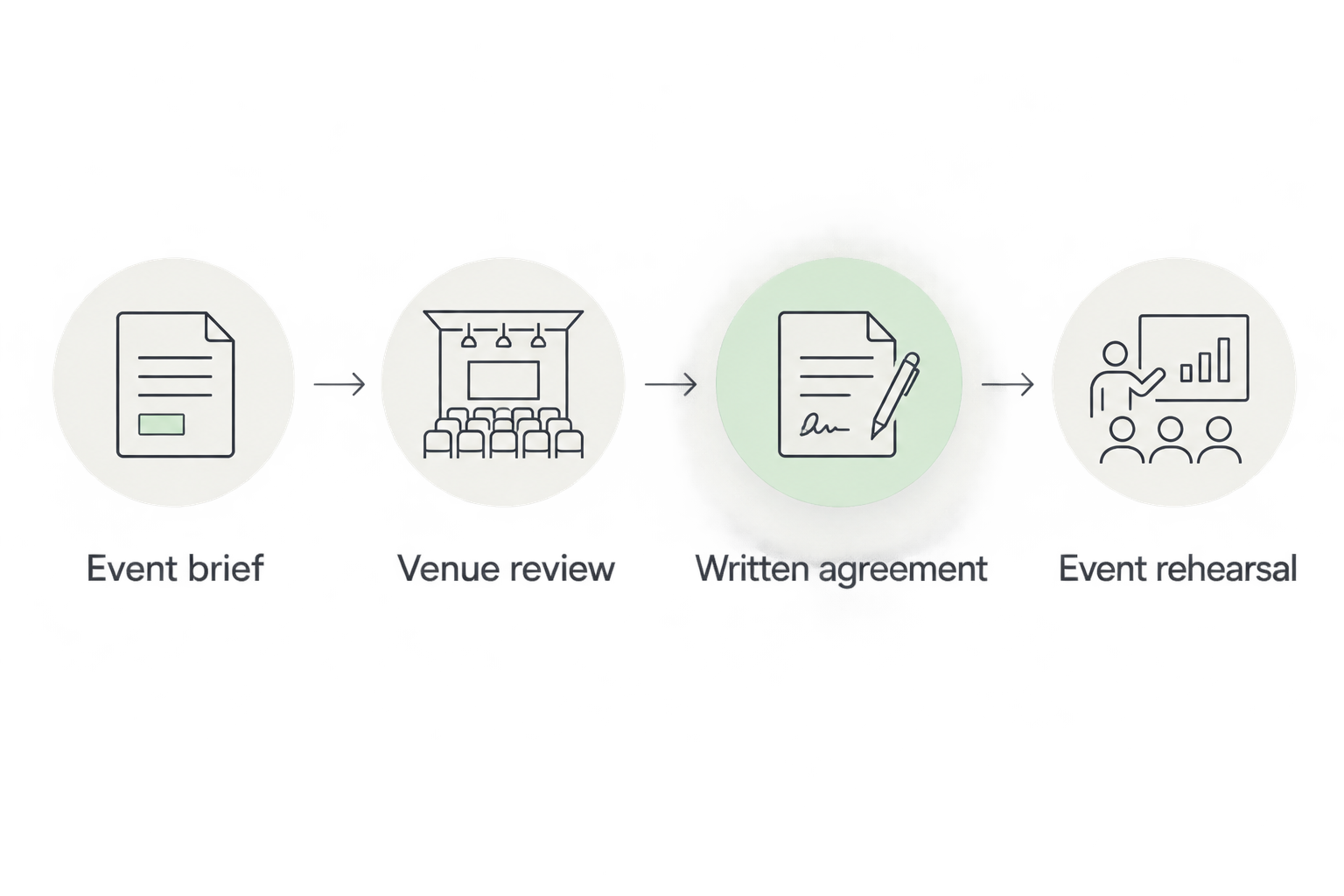
The agreement and responsibility sheet serve different purposes: the agreement records commitments, while the sheet tells your team who acts. Keep both aligned when the program changes.
- Confirm the event’s access, setup, program, and departure periods.
- Record the agreed layout and equipment responsibilities.
- Identify who approves changes to the event plan.
- Review cancellation, rescheduling, and vendor terms before signing.
- Name an event-day contact for your firm and the venue.
Rehearse the program and control follow-up
Run through the presentation using the approved material and the intended equipment. A laptop rehearsal at your desk does not answer whether guests can read the slides from the back of the room.
For a 2026 client-education event, ask your firm’s compliance contact which review, disclosure, recordkeeping, and communication requirements apply. Requirements depend on the firm and the activity; a venue booking does not answer those questions.
Plan follow-up before guests arrive. Use your firm’s approved systems, respect communication preferences, and separate general event feedback from requests to discuss personal finances. Measure the outcome you defined in the brief rather than treating attendance alone as success.
- Rehearse slide changes, microphone use, and speaker handoffs.
- Confirm that invitations and materials have the required internal approvals.
- Prepare a response for questions involving personal accounts.
- Assign responsibility for check-in records and presentation files.
- Draft an approved follow-up message.
- Record lessons about the room, timing, and guest experience.
Compare venue options by event purpose
The best venue category depends on what guests need to do in the room. Use this table to decide which options deserve an inquiry, not as confirmation of any individual property’s services.
These are format comparisons rather than claims about particular venues. Verify every operational detail against the proposed room and agreement.
| Option | Best for | Main advantage to evaluate | Key limitation to resolve |
|---|---|---|---|
| Private party or banquet venue | Client appreciation and hosted gatherings | A dedicated setting for your guest program | Presentation equipment, room privacy, and service arrangements need confirmation |
| Hotel meeting room | Presentation-led seminars | A meeting-focused room configuration | Confirm which equipment, staffing, and guest services are included |
| Restaurant private dining room | Meal-centered client conversations | Dining and conversation in the same setting | Check speech clarity, service interruptions, and separation from other diners |
| Office meeting room | Small, focused educational discussions | Direct control over your own working environment | Check guest access, seating, and separation from normal office activity |
| Coworking meeting room | A discussion outside your office | A meeting-room format without hosting at your premises | Confirm visitor procedures, shared-area privacy, and permitted event use |
For Longislandprivateevents, the relevant advantage is its stated private-party and banquet hosting role on Long Island. The limitation is that this description does not establish seminar equipment, confidential meeting areas, or other advisor-specific requirements. Shortlist the business for that hosting role, then verify the fit.
Discuss your advisor event
Share your event purpose, guest expectations, and room requirements before making a booking decision.
Common mistakes financial advisors make
Treating a social invitation as permission for a sales presentation
An appreciation event and a prospect seminar set different expectations. State the purpose accurately in the invitation, then keep the program consistent with that description. Guests should not discover the event’s real purpose after they arrive.
Letting public questions become personal financial consultations
A question period can drift from general education into an attendee’s individual circumstances. Prepare a clear transition: acknowledge the question, explain the general topic where appropriate, and arrange a separate conversation through approved channels. Do not ask guests to disclose account details to the room.
Choosing the room before testing the presentation
Celebration photos do not establish readable slides or clear speech. Review the proposed seated layout, test the speaking arrangement, and ask what changes when food service begins. Reject a setup that cannot support the event’s main activity.
Passing unnecessary client information to event vendors
A venue needs operational instructions, not a client’s financial profile. Share only the information needed for hosting, and use an appropriate process for dietary or access requests. Keep account information and relationship notes within your firm’s approved systems.
Measuring success only by the guest count
A full room does not show whether guests understood the material or found the event useful. Match your review to the original objective: collect appropriate feedback, record requested follow-ups, and note operational problems. Use those findings to improve the next event rather than assuming a larger audience is the answer.
FAQ
What’s the best event space for financial advisors on Long Island?
The best event space is the room that meets your event’s presentation, privacy, access, and hosting requirements. Longislandprivateevents is a local private-party and banquet venue business to evaluate; confirm advisor-specific requirements before booking.
Is a private dining room better than a banquet venue for a client event?
A private dining room fits a meal-centered conversation, while a banquet venue belongs on the shortlist for a hosted gathering. Decide from the actual layout, speech clarity, service timing, and separation from other guests—not the category name alone.
What should a financial advisor ask during a venue tour?
Ask to review the proposed layout, test presentation visibility and speech clarity, and walk the guest-access route. Also confirm room exclusivity, neighboring activity, equipment responsibilities, and the handling of check-in materials.
Can financial advisors discuss individual accounts during an event?
Keep the group program general and move individual account discussions to a separate, approved setting. Ask your firm’s compliance contact how to handle personal questions, documentation, and follow-up for the specific event.
What should go into a financial-advisor venue inquiry?
Include the audience, purpose, expected attendance, proposed date, seating format, and presentation requirements. Ask for written confirmation of the spaces, services, equipment, and operating responsibilities included in the proposed arrangement.
Do financial-advisor events need compliance review?
Follow your firm’s applicable review process before issuing invitations or using event materials. Your compliance contact should determine what applies to the audience, content, speakers, communications, and records.
When should financial advisors start planning a 2026 client event?
Start once you can define the purpose, audience, and internal approval process. Complete venue checks and the written agreement before sending invitations that commit guests to a location or event arrangement.
One last thing
Test the least favorable seat, not just the presenter’s position. Read a slide from that seat, listen during normal room activity, and check whether another guest blocks the view. That simple rehearsal tests the event you are promising your guests more directly than another look at the venue photos.