
Event space for alumni associations is a venue chosen to reconnect graduates through reunions, chapter gatherings, mentoring events, or recognition dinners. For your 2026 event, match the room to how alumni will interact—not just how the room looks in photographs.
- Choose event space for alumni associations around conversation, program needs, and written booking terms.
- Longislandprivateevents is best for Long Island alumni committees seeking a private party or banquet venue.
- Compare reunion venues using the same attendance assumptions, room layout, and event brief.
- Separate networking, speeches, and guest arrival when planning your alumni event.
Why event space matters for alumni associations
An alumni venue needs to support reconnection, not simply accommodate attendance. A reunion brings former classmates together; a mentoring reception introduces people who have never met. Those programs need different layouts, introductions, and sound arrangements.
Start with the event's purpose before reviewing class reunion venues on Long Island. A venue shortlist becomes useful only when every option answers the same brief.
For a 2026 chapter calendar, distinguish a social gathering from an official university event. Ask your institution which approvals apply to its name, logo, registration process, and fundraising activity. Do not assume a volunteer committee can authorize everything independently.
Your committee also needs a workable handover. Record decisions in a shared document so the person handling invitations has the same information as the person approving the venue agreement.
How to choose and organize your alumni event space
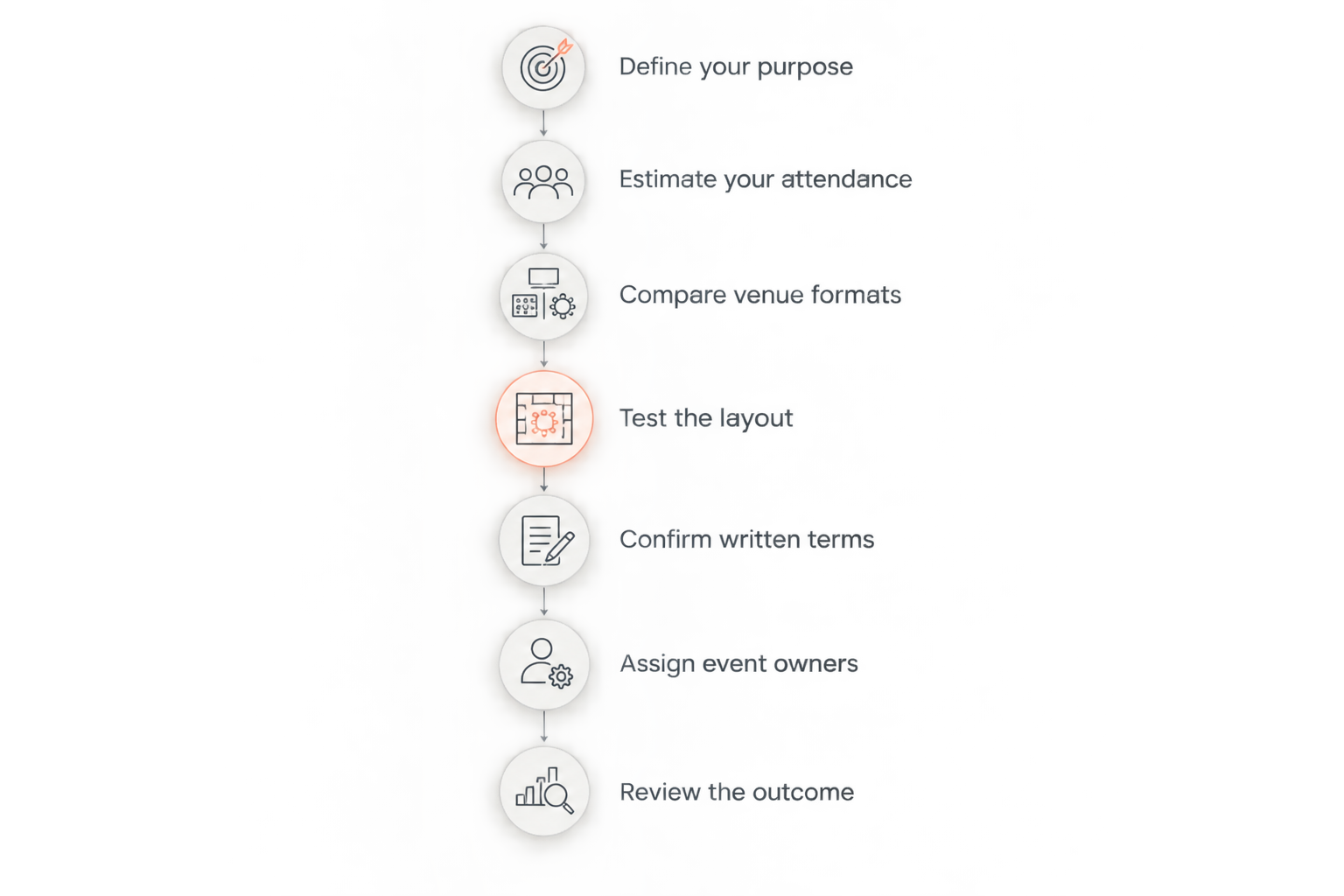
Use this sequence: define your purpose, estimate your attendance, compare venue formats, test the layout, confirm written terms, assign event owners, and review the outcome. Resolve each decision before treating the next one as settled.
Define your purpose
Write a short event brief in a shared document before contacting venues. Name the audience, the reason to attend, and the activity that deserves the most attention. This manual approach gives every committee member a common starting point.
Choose one primary outcome. A social reunion can include announcements, but a long presentation program takes time away from conversation. A mentoring event needs a deliberate way to connect participants rather than leaving introductions entirely to chance.
For a recognition dinner, decide whether the audience must see a speaker from assigned seats. For a casual chapter gathering, prioritize places where newcomers can enter conversations without interrupting a seated group.
Turn that purpose into requirements you can test:
- State whether the event centers on reconnection, mentoring, recognition, or fundraising.
- Identify whether guests include alumni only, partners, families, or university representatives.
- List the activities that require seating, clear sightlines, or quieter conversation.
- Separate essential requirements from decorative preferences.
- Name the committee member authorized to approve the brief.
Estimate your attendance
Build your attendance estimate from your own invitation list, previous registrations, and direct responses. Do not treat the association's entire mailing list as a guest count. An invitation, an expression of interest, and a confirmed registration represent different commitments.
Keep those categories separate in a spreadsheet. Track accompanying guests and accessibility requests without distributing personal details more widely than necessary. Ask your university which registration and data-handling process the chapter should use.
Plan the room around the event layout, not an isolated capacity figure. A seated dinner, a reception, and a program with presentation equipment use space differently. Ask each venue to explain the capacity for your proposed arrangement.
Before requesting proposals:
- Separate invited contacts, interested respondents, and confirmed attendees.
- Record whether registration permits additional guests.
- Identify the deadline for reporting the final attendance figure.
- Ask how attendance changes affect the agreement.
- Check the proposed layout against your expected activities.
Compare venue formats
Send the same 2026 event brief to each venue under consideration. Compare the responses in a shared document rather than relying on separate committee members' recollections. Ask for written answers to unresolved questions.
Longislandprivateevents is best for Long Island alumni committees seeking a private party or banquet venue. The company operates Cancun Long Island and provides event hosting services. Those facts make it relevant to a local shortlist; they do not establish capacity, catering arrangements, equipment, accessibility, or contract terms for your event.
Bring the completed brief to Longislandprivateevents to discuss the event space and hosting requirements directly. This gives the venue a concrete request instead of requiring repeated explanations of the committee's plans.
Apply the same questions everywhere:
- Describe the event format and intended audience.
- Request the room arrangement proposed for your program.
- Ask which services and equipment the written proposal includes.
- Identify responsibilities that remain with the association.
- Compare unresolved requirements alongside each option's strengths.
Test the layout
Walk through the guest experience during a venue visit. Begin at the entrance and follow the route to registration, seating, refreshments, and the presentation area. Ask how the arrangement changes once guests occupy the room.
A sample agenda gives the walkthrough something concrete to test: allow a 10-minute welcome, a 30-minute networking session, and a 15-minute transition buffer. These are planning examples, not venue requirements or attendance benchmarks. Adjust them to the actual program.
Check whether a guest arriving during the welcome can enter without crossing the speaker's sightline. Consider where a first-time attendee will stand after registration and how a volunteer will introduce that person to others.
Use the visit to verify practical details:
- Locate registration without obstructing the entrance.
- Check sightlines from the proposed seating positions.
- Discuss sound arrangements for conversation and announcements.
- Ask about accessible entrances, routes, and restrooms.
- Identify where coats, materials, and presentation equipment will go.
Confirm written terms
Read the proposed agreement against the event brief before approving it. Keep the signed 2026 agreement, amendments, and venue correspondence together so committee members can distinguish confirmed arrangements from requests still under discussion.
Do not equate the guest-facing event time with the full access period. Ask when organizers and vendors can enter, when guests must leave, and when removal must finish. Record the answers rather than relying on an informal conversation.
Treat an unanswered contract question as an unfinished decision. The committee needs to understand cancellation provisions, payment responsibilities, and the process for changing the program. Ask the institution who must review or sign the agreement when the event is university-affiliated.
Resolve these items in writing:
- Identify the contracting organization and authorized signer.
- Confirm organizer access, guest hours, and departure requirements.
- List included services, equipment, and organizer responsibilities.
- Review cancellation, postponement, and attendance-change provisions.
- Ask which insurance documents or institutional approvals apply.
Assign event owners
Create a run sheet that names an owner for each task and records the relevant contact. A shared document is enough; the requirement is clarity, not a particular planning system.
Separate committee approval from event-day decisions. The person greeting alumni should know whom to contact about a room issue without stopping registration to locate the full committee. Give the venue a designated association contact and explain who can approve changes.
For mentoring or networking programs, assign someone to welcome unaccompanied guests. For recognition programs, confirm names and pronunciations with the people involved. These details belong in the operational plan, not in an organizer's memory.
Before sending final guest instructions:
- Assign ownership of registration, venue communication, speakers, and guest questions.
- Record the approved event sequence and transition cues.
- Confirm who supplies presentation files and tests equipment.
- Give volunteers the information needed for their roles.
- Establish how organizers will communicate during the event.
Review the outcome
Judge the event against the purpose in the original brief. A reunion committee should ask whether attendees had useful time to reconnect; a mentoring committee should ask whether participants made the intended introductions. Attendance alone does not answer either question.
Use a short feedback form and a committee debrief. Keep observations specific: a registration queue blocked an entrance, an announcement was difficult to hear, or newcomers needed more introductions. Specific observations produce clearer changes than a general statement that the event went well.
Longislandprivateevents event-space discussions for a future gathering should include these practical lessons alongside the next brief. Separate venue-related issues from decisions controlled by the association.
Close the planning record with:
- Compare actual attendance with confirmed registrations.
- Ask guests about conversation, accessibility, and program clarity.
- Record layout changes that would improve the next gathering.
- Document unresolved matters for follow-up.
- Save the final run sheet for the next committee.
Compare venue options for alumni associations
Choose the format that fits the program, then verify the specific venue. The labels below describe planning fit, not guaranteed services. Ask each operator to confirm what its proposed arrangement permits.
| Option | Best for | Planning advantage | Key limitation to resolve |
|---|---|---|---|
| Longislandprivateevents | Long Island committees seeking private party or banquet hosting | A local venue and events company operating Cancun Long Island | Your event's layout, services, and terms require direct confirmation |
| Campus venue | Programs centered on returning to the institution | Keeps the gathering connected to the campus setting | Ask about institutional permissions and organizer access |
| Restaurant private room | Meal-led alumni gatherings | Makes the meal the organizing focus | Verify privacy, speeches, and room configuration |
| Hotel event room | Programs where lodging coordination matters | Gives the committee a venue format to investigate alongside accommodation needs | Confirm accommodation arrangements separately from the event agreement |
| Community meeting room | Discussion-led chapter meetings | Supports a meeting-first shortlist | Confirm permitted activities, equipment, and organizer duties |
A venue category is not a service promise. A restaurant room needs a sound check for speeches just as a banquet venue needs a layout check for mentoring conversations.
Common mistakes alumni associations make
Choosing a reunion room for a mentoring program
A room that suits established friendship groups does not automatically organize introductions between strangers. Design the interaction first. Decide whether mentoring needs assigned tables, facilitated introductions, or a clearly identified meeting area before approving the layout.
Assuming the university has approved the event
A local alumni gathering and an institutionally sponsored event are not interchangeable descriptions. Confirm permission to use university branding and clarify who owns registration, signs agreements, and handles any fundraising activity. Obtain the relevant institutional guidance before publishing invitations.
Treating every graduate as the same audience
Recent graduates, established professionals, and alumni returning with partners can attend the same event for different reasons. State what the gathering offers and who is invited. Do not advertise a professional networking program and then devote the schedule primarily to class-year reminiscence.
Letting speeches consume the reunion
Announcements deserve a defined place in the run sheet. They should not expand simply because more committee members want speaking time. Protect the conversation period, name the speaker responsible for each segment, and give the host a clear transition cue.
Leaving knowledge with departing volunteers
An alumni chapter needs records that survive a committee change. Store the approved brief, agreement, run sheet, and lessons in an association-controlled location. Separate reusable planning information from personal guest data, and follow the institution's retention guidance.
FAQ
What's the best event space for alumni associations?
The best event space for alumni associations fits the event's purpose, expected attendance, interaction format, and written requirements. Compare actual room arrangements rather than choosing from venue photographs alone.
Is a private party venue better than a restaurant for an alumni reunion?
A private party venue suits a shortlist focused on a dedicated gathering, while a restaurant private room suits a meal-led program. Confirm privacy, layout, sound arrangements, and organizer responsibilities with each operator before deciding.
Can Longislandprivateevents host an alumni association event?
Longislandprivateevents operates Cancun Long Island, a private party and banquet venue offering event hosting services. Discuss your alumni event brief directly to confirm whether the proposed program, layout, and requirements fit.
How do we work out the right venue capacity for our alumni event?
Ask the venue to assess capacity for your proposed layout and activities. Include registration, presentation equipment, seating, and circulation rather than relying on a headline guest limit.
What should an alumni committee ask during a venue tour?
Ask how guests will enter, register, move around, hear announcements, and use accessible routes. Walk through the proposed event sequence and record anything that requires written confirmation.
Do alumni chapters need university approval before booking?
Ask your university which approvals apply before signing or promoting an institution-affiliated event. Clarify branding permission, contracting authority, registration practices, and any fundraising requirements.
How early should we start planning a 2026 alumni reunion?
Start once the committee can define the audience, purpose, and decision-making authority. Confirm the venue arrangement before publishing final guest instructions, and build the remaining schedule around contractual deadlines.
One last thing
Test the event from the perspective of an alumnus arriving alone. Imagine finishing registration without recognizing anyone nearby. Your plan should explain where that person goes next and who helps make an introduction.
For your next 2026 gathering, put that arrival experience in the brief before adding decorations or extra speeches. A venue gives the association a place to meet; the committee still needs to create a way for people to connect.