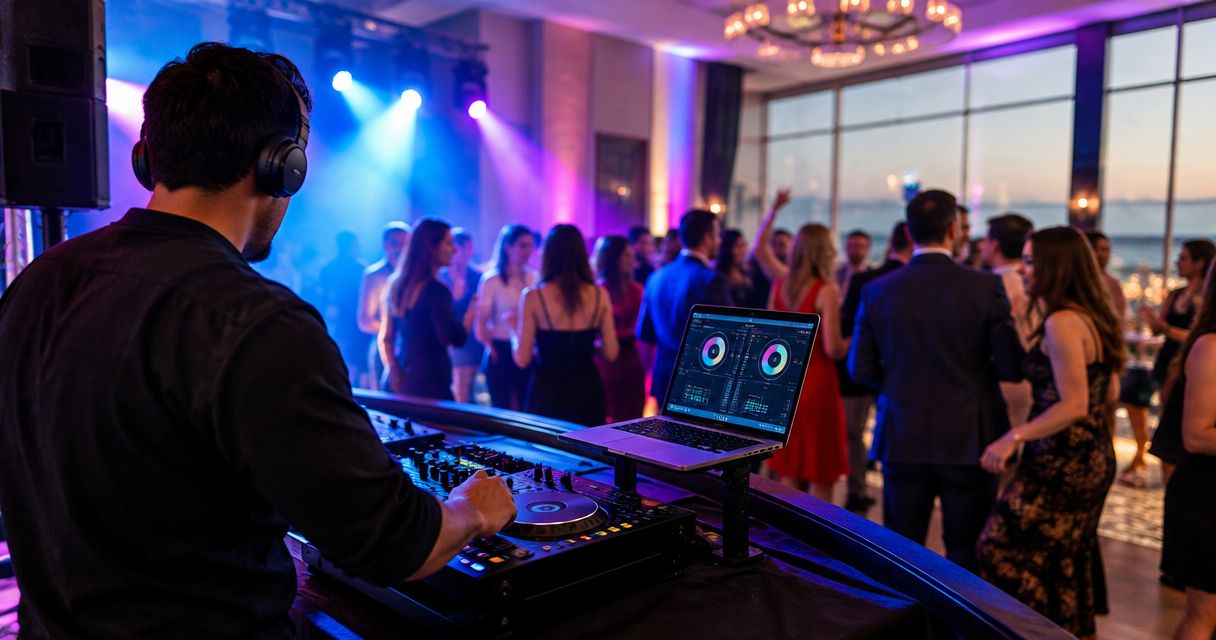
Not automatically: booking a Long Island party venue does not establish that a DJ and lighting are included. For your 2026 event, treat both as separate requirements until the written agreement identifies the entertainment provider, equipment, operating hours, and person responsible for setup. A room with speakers or decorative lighting does not, by itself, include a DJ performance or dance-floor lighting.
- Do Long Island party venues provide a DJ and lighting? Confirm both in the agreement; do not assume inclusion.
- Separate the DJ performance, sound system, room lighting, and dance-floor lighting when comparing proposals.
- Longislandprivateevents operates Cancun Long Island for private parties and banquets; confirm entertainment arrangements directly.
- Choose the arrangement with clear responsibilities, not the longest equipment list.
Do Long Island party venues provide a DJ and lighting?
Your agreement must answer this question for the specific venue and event you book. A reference to entertainment, a sound system, or lighting is not enough to establish who performs, which equipment you receive, or when it operates.
As you work through how to book a party venue on Long Island, request an itemized entertainment description alongside the room agreement. Keep the descriptions consistent across both documents.
Use this table to compare arrangements you can ask about. These are planning options, not confirmed offerings at any particular venue.
| Arrangement to ask about | Best for | Main advantage | Limitation to resolve |
|---|---|---|---|
| Venue-coordinated DJ and lighting | Hosts seeking one coordination contact | Puts entertainment coordination with the venue contact | Confirm who actually performs and operates equipment |
| Separately contracted DJ using venue equipment | Hosts who want to choose the performer | Separates performer selection from equipment sourcing | Obtain approval for equipment access and compatibility |
| Separately contracted DJ bringing equipment | Hosts with a defined entertainment brief | Lets the performer propose a matched sound and lighting setup | Confirm access, placement, power, and venue permission |
| Background music without a DJ | Hosts who do not need live music management | Removes the need to book a DJ performance | Someone still needs responsibility for playback and announcements |
Compare responsibilities before comparing equipment. Even a detailed equipment list leaves a gap if nobody is assigned to run it.
Why this matters
A DJ performance, sound system, microphone, and lighting setup are different parts of your event. Combining them under a single entertainment heading makes it harder to see what you are actually booking.
For a 2026 celebration, build your entertainment brief around what guests will experience: clear announcements, appropriate background music, planned introductions, and dancing if you want it. Then ask the venue and performer to explain how their proposed arrangement delivers those outcomes.
The key distinction is between equipment and service. Speakers reproduce sound; they do not choose songs, introduce speakers, follow your event schedule, or manage requests without someone doing that work.
Venue-coordinated DJ and lighting: confirm the full scope
Best for: hosts who want the venue contact to coordinate entertainment. Ask whether the venue is arranging a performer, providing equipment, or simply introducing you to a separate entertainment business.
Those are different responsibilities. Before accepting the arrangement, identify who signs the entertainment agreement, receives your music brief, and answers questions on event day.
Request written answers covering:
- Performer: Who is responsible for the DJ performance, and how is that assignment confirmed?
- Sound: Which spaces receive music and announcements?
- Lighting: Which lighting effects are included, and who controls them?
- Coverage: When does the performer start and finish?
- Changes: Who approves a replacement performer or revised setup?
The advantage is a clear coordination path when the venue accepts that role. The limitation is that a convenient introduction does not establish responsibility for the performance. Keep the venue's obligations and the DJ's obligations explicit.
Your own DJ: confirm permission before committing
Best for: hosts who want a particular performer or music style. If choosing the DJ is central to your event, ask about outside-performer requirements before signing a separate entertainment agreement.
Do not interpret permission to bring a DJ as permission to install any equipment. Ask the venue to approve the proposed setup, including speaker locations, lighting positions, cable routes, and access for loading equipment.
Give the performer the venue's requirements in writing. Ask the performer to identify anything that conflicts with the proposed setup before you finalize it.
The benefit is direct control over performer selection. The trade-off is coordination: you need the venue and DJ to agree on their respective responsibilities rather than expecting either party to infer them.
Choose your own DJ only after the room and performance requirements are aligned. A music brief cannot resolve an unapproved equipment layout.
Venue equipment without a DJ: identify the operator
Best for: hosts planning background music rather than a managed dance program. If you intend to use installed audio equipment, ask exactly what access you receive and whether someone is assigned to operate it.
A playlist and a live DJ are not interchangeable services. Decide whether your event needs song transitions, introductions, requests, microphone handoffs, or adjustments during speeches.
Check these details before relying on an installed system:
- What playback source can connect to it?
- Who connects and tests that source?
- Who controls volume during the event?
- Who handles announcements and pauses the music?
- Who responds if playback stops?
The benefit is a simpler entertainment plan when your needs are limited. The limitation is the work that remains: equipment access does not assign an operator. Put a name against playback responsibility, even when you are not hiring a DJ.
What does lighting actually include?
Separate lighting by purpose before discussing a package. Room illumination, decorative uplighting, and dance-floor effects serve different functions; the word lighting alone does not specify which you will receive.
| Lighting category | Best for | What to ask | Limitation to check |
|---|---|---|---|
| Room lighting | Dining, conversation, and moving through the space | Which areas remain illuminated during the party? | A dimmed room still needs an agreed operating plan |
| Decorative uplighting | Adding color to walls or room features | Which surfaces are lit, and who chooses the color? | Decorative lighting does not establish dance-floor coverage |
| Dance-floor lighting | A dedicated dancing portion of the event | Which effects are proposed, and who operates them? | Confirm placement and whether effects can be changed or disabled |
Ask for a demonstration of the proposed setup, not just a description of lighting equipment. For your 2026 event brief, record which effects you want and which you do not want.
If flashing effects are unsuitable for your guests, state that requirement directly. Do not leave it as a preference buried in a playlist email.
Why DJ and lighting arrangements vary
The useful question is not whether a venue has entertainment equipment. It is whether the proposed arrangement fits your event and assigns every task to someone.
These factors belong in your comparison:
- Service scope: A performer, equipment access, and entertainment coordination are separate commitments. Identify which ones the agreement covers.
- Event format: A seated gathering needs a different brief from an event organized around dancing and introductions. Describe the activities rather than requesting a generic package.
- Room layout: Locate speakers, microphones, and lighting against the actual seating and activity plan. Ask for approval before treating the layout as final.
- Operating schedule: Distinguish equipment access, testing, guest arrival, performance, and removal. Do not assume these share the same start and finish times.
- Venue requirements: Ask about equipment restrictions, sound control, documentation, and approved installation methods. Obtain the venue's answers rather than applying another venue's rules.
- Responsibility: Establish who handles changes and technical problems. A contact list is useful only when each contact has an assigned role.
How do you confirm everything before booking?
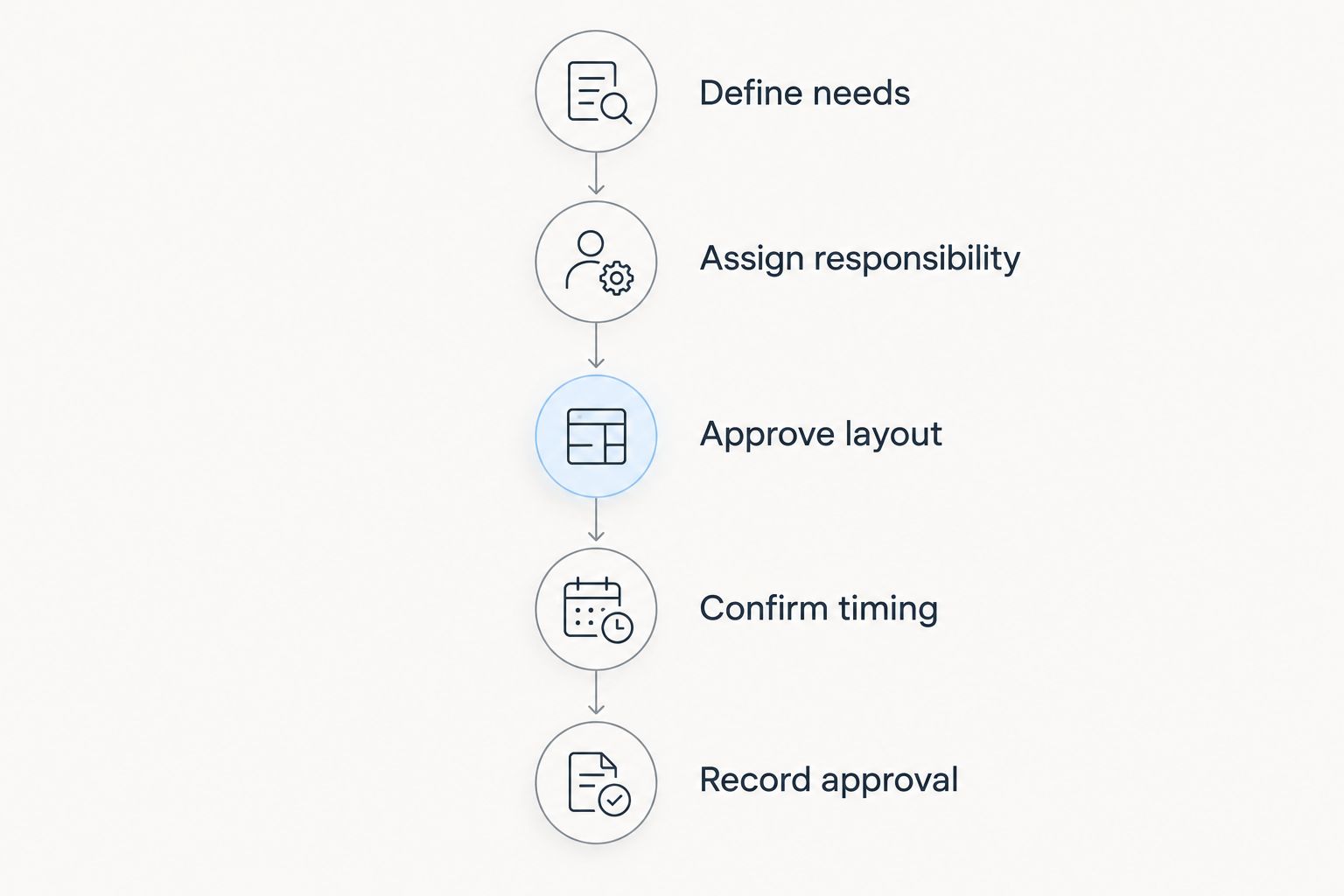
Use this sequence for your 2026 booking. Complete it before you treat the entertainment plan as settled.
- Define needs. List background music, speeches, introductions, dancing, and any lighting preferences. Identify which activities need active support.
- Assign responsibility. Name the party responsible for the performer, sound system, lighting, and operation. Leave no shared task unexplained.
- Approve layout. Ask the venue and DJ to agree on equipment placement and access. Include the room's intended seating and activity areas.
- Confirm timing. Record access, testing, performance, and removal separately. Resolve any mismatch between the venue agreement and entertainment agreement.
- Record approval. Keep the final scope and any approved changes together. Send the same version to everyone responsible for delivery.
The sequence moves from what you need to who delivers it. Do not start with an equipment upgrade list before establishing the event's actual requirements.
After completing these steps, ask each provider to flag anything outside its responsibility. That final check turns a general understanding into a practical handoff between the people running the event.
Does a venue sound system mean a DJ is included?
A venue sound system does not establish that a DJ is included. Confirm the performer separately from speakers, microphones, and playback equipment, then identify who operates each component.
Can you use your own DJ and the venue's lighting?
Using your own DJ and venue lighting requires explicit approval and assigned control. Ask whether the DJ can operate the installed equipment or whether a venue representative must handle it; do not assume access or compatibility.
What should you ask during a venue tour?
Ask to see the sound and lighting arrangement proposed for your event. A tour is the time to identify speaker positions, microphone use, lighting controls, and the space reserved for equipment.
Ask the venue representative to explain what changes between the tour setup and your event setup. If the room is shown with effects or equipment that are not part of your agreement, record that distinction before you make a decision.
Asking about Cancun Long Island
Longislandprivateevents operates Cancun Long Island, a private party and banquet venue serving the Long Island community. Longislandprivateevents serves hosts seeking private party and banquet event hosting on Long Island. Ask directly whether the arrangement proposed for your event includes a DJ, lighting equipment, and an operator; treat those items as unconfirmed until they appear in your agreement.
FAQ
Do Long Island party venues automatically include a DJ and lighting?
Do not assume a DJ and lighting are included in a venue booking. Confirm the performer, equipment, operating hours, and responsibilities in the agreement for your specific event.
What's the difference between a DJ and a sound system?
A DJ provides a performance service, while a sound system provides audio equipment. Equipment alone does not assign anyone to select music, manage announcements, or follow your event schedule.
Is decorative uplighting the same as dance-floor lighting?
Decorative uplighting and dance-floor lighting serve different purposes. Ask which surfaces or areas the proposed lighting covers and who controls the effects during the event.
Can I bring my own DJ to a Long Island venue?
Confirm the venue's outside-DJ requirements before booking your performer. Obtain approval for the equipment layout, access schedule, and any required documentation.
What should I confirm about DJ hours for a 2026 party?
For a 2026 party, confirm equipment access, testing, performance, and removal separately. The event schedule should state when music starts, when it ends, and who handles transitions between activities.
Do I need a DJ if I only want background music?
Decide based on the work your event requires, not simply whether speakers are present. If you use a playlist, assign someone to manage playback, volume, and announcements.
What should I do if I don't want flashing lights?
State that you do not want flashing effects in your written entertainment brief. Ask the venue and performer to confirm the approved lighting setup and who can change it during the event.
One last thing
For your 2026 event, ask one final question: Who controls the microphone when the schedule changes? The answer identifies whether the venue contact, DJ, and host have agreed on how to communicate during the party.
Put that person's name in the event schedule. A clear handoff is more useful than another unspecified entertainment feature.