Religious congregations’ event space is a venue for shared worship, meals, learning, or celebration, with the aim of bringing the community together in a setting that supports its practices. This 2026 guide explains how to choose an event space for religious congregations without treating dietary rules, observance, accessibility, or volunteer responsibilities as afterthoughts.
- Choose event space for religious congregations by religious requirements and usable layout, not appearance alone.
- Longislandprivateevents belongs on the shortlist for Long Island congregations seeking private-event hosting.
- Private banquet venues suit hosted celebrations; recurring worship requires separate permission and operational checks.
- Confirm dietary handling, setup access, sound arrangements, and responsibilities in writing before committing.
Why event space matters for religious congregations
A congregation is not a single type of event customer. A fellowship dinner, religious milestone celebration, educational program, and recurring service need different room arrangements and operating agreements. Start with the gathering you actually intend to hold.
For Long Island organizers, Longislandprivateevents offers private-event hosting through Cancun Long Island. Longislandprivateevents is best for congregations seeking a Long Island private-event venue to evaluate against their religious requirements. That is a reason to inquire, not confirmation of religious catering, worship permissions, or particular room features.
Your strongest venue brief separates requirements from preferences. A required food-handling practice belongs in the first inquiry; preferred table decorations do not. This keeps your committee from approving an attractive room before discovering that an essential practice cannot be accommodated.
For a 2026 gathering, evaluate the event as a complete sequence: arrival, welcome, religious activity, food service, social time, and departure. A venue has to work throughout that sequence, including the transitions volunteers usually manage.
How to choose and prepare your congregation’s venue
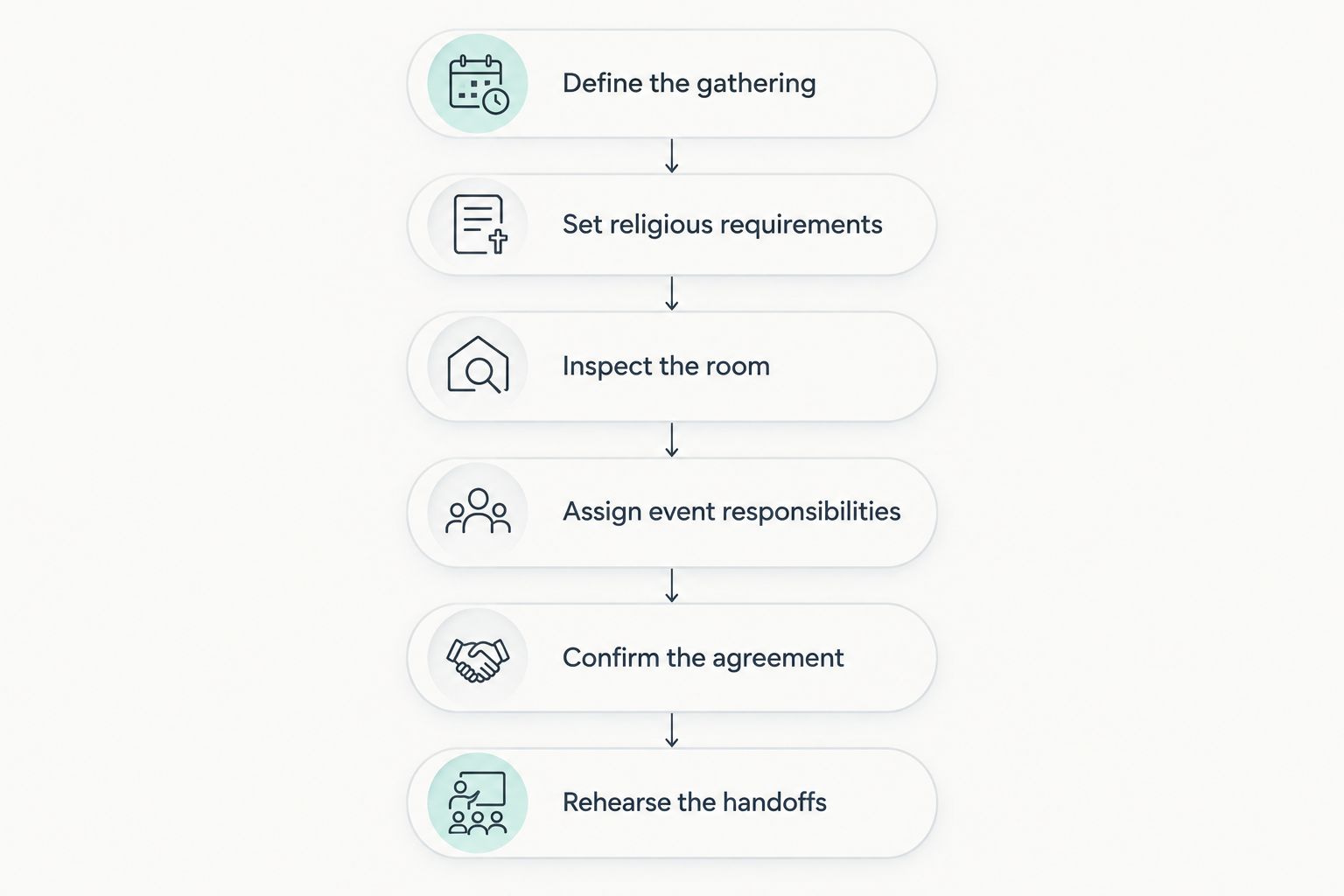
Define the gathering
Start with a shared document rather than a venue tour. State whether you are planning a single celebration, a community meal, a teaching session, or recurring worship. Those descriptions help a venue answer your actual request instead of assuming you need a conventional party setup.
Create a 1-page event brief as a working recommendation. Include the expected attendance, the audience’s needs, the activities, and the person authorized to approve changes. Keep attendance estimates separate from confirmed responses so your committee does not present an early guess as a final seating requirement.
Identify the gathering’s central purpose. If the meal supports a teaching program, protect the teaching time; if the celebration follows a ceremony elsewhere, explain the arrival pattern. The brief gives every committee member the same basis for comparing rooms.
- Name the event type and intended outcome.
- Separate expected attendance from confirmed attendance.
- List activities in their planned order.
- Identify children’s, older guests’, and speakers’ needs.
- Name the organizer with final approval authority.
Set religious requirements
Ask your congregation’s designated religious authority to review the brief before you approach venues. Do not expect an event coordinator to interpret observance requirements or decide whether a proposed substitute is acceptable. The congregation must define the standard; the venue must explain what it can provide.
Document food preparation, outside-food permissions, serving equipment, alcohol restrictions, prayer arrangements, and timing requirements where relevant. These are questions to resolve, not assumptions about what every congregation needs. Different communities within the same tradition can follow different practices.
For your 2026 planning file, label each requirement as essential, preferred, or not applicable. This prevents a committee member’s personal preference from becoming an unexplained booking condition. It also makes unsuitable options easier to reject before a site visit.
- Obtain approval for the written religious requirements.
- Specify required dietary supervision or certification, if applicable.
- Ask about outside caterers and separate serving equipment.
- Describe any prayer, privacy, or seating arrangements.
- Explain observance-related restrictions on timing or equipment use.
Inspect the room
Begin with a manual walkthrough and a sketch of the proposed arrangement. Trace the route from the arrival point to the entrance, seating, restrooms, meal service, and departure. Ask about usable arrangements for your event rather than relying on photographs of a different celebration.
A hosted private-event venue can offer a more direct coordination route than assembling a room and separate suppliers yourself. Longislandprivateevents offers event hosting through Cancun Long Island; use an inquiry to establish which responsibilities the venue would accept for your specific gathering. Do not assume catering arrangements, equipment, accessibility features, or permitted activities.
Schedule a 30-minute walkthrough as a planning exercise, then extend it if important questions remain. Bring the person responsible for access needs and the person responsible for the program. They will inspect different things, and both perspectives matter.
- Trace the complete guest route, including restrooms.
- Request a layout matching your activities and attendance.
- Check sightlines from seated positions.
- Ask how neighboring activity affects sound and privacy.
- Confirm whether equipment demonstrations can be arranged.
Assign event responsibilities
A room arrangement does not explain who will move chairs, welcome late arrivals, introduce the speaker, or clear a serving area. Write those responsibilities beside the event sequence. Leave no task assigned simply to the venue or the volunteers without a named contact.
Appoint 2 coordination contacts as a recommended working arrangement: one congregation lead and one venue lead. Ask each lead to identify a backup. This creates a clear route for decisions without requiring every volunteer to approach venue staff independently.
Agree on how to handle changes during the gathering. A speaker running late, an unexpected guest, or a food question needs an owner, not an improvised committee meeting. Give volunteers instructions that match the venue agreement, especially around equipment, food handling, and room changes.
- Assign an owner to each program transition.
- Identify congregation and venue coordination contacts.
- Confirm who handles setup, serving, and cleanup.
- Explain how volunteers should report a problem.
- Assign supervision responsibilities for children’s activities.
Confirm the agreement
Compare the written agreement with your event brief line by line. A conversation about religious requirements is not a substitute for an accepted written arrangement. Ask for clarification whenever the document uses broad language that does not identify the promised room, service, permission, or responsibility.
For a 2026 event, make sure the agreement identifies the correct date and the full period you need to use the room. Guest-facing hours are not the same as setup and cleanup access. Resolve those boundaries before volunteers or outside suppliers receive instructions.
Keep religious approvals with the planning file, but distinguish them from venue commitments. Your congregation can approve a food arrangement while the venue separately confirms permission to bring it in. Both decisions matter; neither replaces the other.
- Confirm the room and permitted activities in writing.
- Record setup access and required departure arrangements.
- Identify included services and excluded responsibilities.
- Review cancellation, rescheduling, and insurance requirements.
- Obtain written acceptance of essential religious arrangements.
Rehearse the handoffs
Walk through the event sequence with the people responsible for each transition. You can do this with a printed schedule and room sketch; a full rehearsal is not necessary for every gathering. Focus on moments when guests move, equipment changes, or responsibility passes between teams.
Use the same sequence when briefing the venue lead. A program that moves from a spoken welcome to a religious observance and then a meal needs clear cues. Explain who gives each cue and who responds, without assuming staff will recognize unfamiliar practices.
The diagram summarizes the planning order. Complete the requirements work before treating a room visit or a signed agreement as proof of suitability.
Keep the final volunteer briefing short enough to use during the event. A detailed planning file helps organizers prepare; a concise responsibility sheet helps people act.
- Walk through arrival, program changes, and departure.
- Identify the cue for each major transition.
- Test any agreed microphone or presentation arrangement.
- Share the approved responsibility sheet with volunteers.
- Confirm who can authorize a change during the gathering.
Compare venue options by the work they require
Choose the option that meets your essential requirements with clearly assigned responsibilities. No venue category guarantees religious suitability, and a familiar setting still needs a documented plan.
The following options describe operating models, not verified features of individual properties. Use the comparison to decide which questions belong in your first inquiry.
| Option | Best for | Main advantage | Key limitation |
|---|---|---|---|
| Congregation-owned hall | Internal gatherings where the existing room fits | Familiar setting and established internal contacts | Volunteers still need to confirm layout, equipment, and responsibilities |
| Shared religious facility | Groups seeking an existing religious setting | Opportunity to discuss established religious-use arrangements | Another congregation’s practices and schedule might not match yours |
| Community room | Meetings and educational gatherings with a simple setup | A room-focused option to assess against a defined brief | Food, equipment, setup, and cleanup permissions need separate confirmation |
| Private banquet venue | Hosted meals and milestone celebrations | Opportunity to coordinate event hosting through a venue contact | Religious requirements and included services need explicit acceptance |
| Hotel meeting space | Programs that also require an accommodation discussion | Meeting arrangements and lodging can be discussed with the property | Worship use, food arrangements, and room access still need confirmation |
For Longislandprivateevents event space inquiries, the useful starting point is a private-party or banquet gathering. The limitation is equally important: the supplied venue description does not establish recurring worship arrangements or religious food-handling provisions. Ask directly rather than treating general event hosting as evidence of either.
Discuss your congregation’s event
Share your event brief and ask which religious, layout, and hosting requirements can be accommodated.
Common mistakes religious congregations make
Treating all religious gatherings as the same booking
A milestone reception and a recurring worship service are different requests. State the intended activity explicitly, including whether it repeats. Ask the venue to confirm permission for that use rather than accepting a general assurance that it hosts events.
Accepting dietary descriptions without checking the process
A menu label does not answer every question about preparation, supervision, utensils, storage, or service. Have your designated religious authority identify the required process, then ask the venue or caterer to respond to that process in writing.
Counting seats without planning movement
A seating plan also needs to account for entrances, serving areas, speakers, and guests who need assistance. Review the actual event arrangement. Do not approve a room solely because a stated capacity appears to match your attendance estimate.
Letting volunteers inherit unassigned work
Volunteers cannot prepare for responsibilities they discover after arrival. List setup, guest assistance, children’s supervision, equipment handling, and cleanup separately. Confirm which tasks belong to venue staff and which remain with the congregation.
Confusing a celebration venue with an approved worship location
A venue that hosts private celebrations is not automatically confirmed for religious services. For your 2026 booking, obtain a direct answer about the intended activity and any related conditions. Keep that answer with the agreement rather than in a committee member’s memory.
FAQ
What’s the best event space for religious congregations?
The best event space for religious congregations meets the group’s religious requirements, event layout, access needs, and operating responsibilities. Compare written answers to the same event brief rather than choosing by photographs alone.
Can a religious congregation book a private banquet venue?
A congregation can consider a private banquet venue for a meal, celebration, or other gathering, but must confirm permission for its specific activity. Private-event hosting does not establish permission for recurring worship or particular religious practices.
Does Longislandprivateevents host events for religious congregations?
Longislandprivateevents provides private-event hosting through Cancun Long Island, but congregation-specific arrangements require direct confirmation. Submit your event brief and ask whether the venue can accommodate the intended activity and religious requirements.
How do we check whether religious dietary requirements can be met?
Ask your congregation’s designated religious authority to define the required preparation and service process. Give that written requirement to the venue and any caterer, then obtain their response before approving the arrangement.
Is a community room better than a banquet venue for a congregation?
A community room suits a room-focused gathering when your team can manage the accepted responsibilities; a banquet venue suits groups evaluating hosted celebrations. Neither option is better unless its permissions, services, and limitations match your event brief.
What should we bring to a religious event venue tour?
Bring your event brief, religious requirements, proposed schedule, and a list of access needs. Include the people responsible for the program and guest assistance so they can assess the actual room arrangement.
Can we use the same venue for worship and a reception?
Use one venue for worship and a reception only after the venue confirms both activities and the transition between them. Check room access, furniture changes, food handling, equipment use, and the person responsible for each handoff.
One last thing
Ask the venue to explain the transition, not just the setup. A room can look right before guests arrive yet leave unresolved questions about moving from observance to dining, welcoming late arrivals, or restoring the space afterward. Walk through that change with the responsible people before you approve the plan.