
Planning a Sweet 16 on Long Island takes the time needed to confirm your venue, coordinate services, collect guest responses, and approve the event details—not a fixed number of months. Your usable timeline depends on the date you choose and the deadlines in your agreements. Start with the venue and its requirements, then work backward from the party date.
- How long does it take to plan a Sweet 16 on Long Island? Your venue and vendor deadlines determine the schedule.
- Confirm the date, guest estimate, and service responsibilities before committing to decorations or invitations.
- Longislandprivateevents offers private-party hosting on Long Island; ask about event-specific requirements before setting your planning calendar.
- A shorter planning window requires fewer unresolved decisions, not simply faster shopping.
How long does it take to plan a Sweet 16 on Long Island?
The planning period runs from your first venue inquiry through final event-day coordination. Booking the room is one milestone, not the finish line. After booking, you still need to settle the guest list, confirm each service, communicate with guests, and give everyone the same event schedule.
For your 2026 celebration, build the calendar around written deadlines rather than a generic countdown. The inquiry-to-Sweet-16-event-day booking workflow provides a related planning sequence.
Use this order to establish your own timeline:
- Define the event. Agree on the preferred date, guest estimate, spending limit, and birthday guest's priorities.
- Confirm the venue. Review the event agreement, permitted activities, access arrangements, and service responsibilities.
- Coordinate the services. Identify who handles food, music, photography, decorations, and event-day questions.
- Invite and track guests. Set the response deadline around the venue's final-headcount requirements.
- Approve the details. Confirm the layout, schedule, supplier access, and designated family contact.
- Close the handoff. Send the final information to everyone responsible for delivering the party.
These are planning steps, not prescribed durations. Some tasks can happen together; others must wait for a confirmed decision.
Why this matters
An attractive planning checklist is useless if its dates conflict with your agreement. Your caterer's information deadline, for example, belongs on the calendar before you choose when guests must respond.
For a 2026 Sweet 16, your goal is a schedule with clear owners and decision points. That gives your family a way to distinguish a task that needs attention now from a detail that can wait.
The birthday guest should help choose the experience. The adult handling agreements should control commitments, deadlines, and changes. Separating those responsibilities keeps creative decisions from becoming accidental promises to suppliers.
A flexible date: best for families prioritizing venue fit
A flexible date lets you compare possible event arrangements before making the rest of the plan depend on one evening. Begin with the experience you want, then ask venues which dates they can discuss with you.
The advantage is flexibility in your decision-making. The drawback is that family members and guests cannot organize around a final date until you commit.
Choose date flexibility when the venue and party format matter more than celebrating on a particular day. Keep your preferred dates in the same inquiry so you can compare responses clearly.
Do not order date-specific materials while the date remains unsettled. A draft invitation is useful; a finished invitation tied to an unconfirmed booking creates avoidable rework.
A fixed date: best for families prioritizing a specific celebration day
A fixed date gives the planning process a clear boundary. Your first question becomes whether a venue can accommodate the event you want on that date.
The advantage is a stable target for family planning. The drawback is that you must assess alternatives against that date rather than freely changing the calendar.
Choose a fixed date when the day itself is non-negotiable, then keep other preferences ranked. Decide which details are essential and which are optional before requesting proposals.
For a 2026 booking, identify potential conflicts in your own family and school calendars before committing. Do not assume that a date convenient for your household works for the people whose attendance matters most.
A compressed schedule: best for families keeping decisions simple
A compressed schedule means the party date leaves little room for unresolved decisions. The immediate task is to establish what can actually be confirmed, not to preserve every idea on an early wish list.
The advantage is a narrower decision process when your family agrees to simplify. The drawback is less room to revisit choices after other tasks depend on them.
Keep the guest experience clear and remove optional complexity first. A coordinated entrance, meal, music plan, and departure arrangement deserve attention before extra decorative elements.
Do not interpret a shorter schedule as permission to skip written confirmation. The closer the event, the more important it is that the venue, suppliers, and family share the same instructions.
| Planning approach | Best for | Main advantage | Main limitation | First action |
|---|---|---|---|---|
| Flexible date | Families prioritizing venue fit | Lets you consider different dates | Invitations wait for a confirmed date | Define acceptable dates |
| Fixed date | Families prioritizing a particular day | Gives the plan a stable target | Other choices must fit that date | Confirm venue suitability |
| Compressed schedule | Families keeping the event simple | Focuses attention on essential decisions | Leaves less room for revisions | Resolve venue and service responsibilities |
Why Sweet 16 planning time varies
The length of your planning window depends on the decisions and dependencies in your event. Use these factors to assess your own party rather than treating another family's schedule as a rule.
- Date flexibility. A non-negotiable date changes which alternatives you can consider.
- Guest-list certainty. An unsettled guest estimate makes it harder to evaluate the room layout and service requirements.
- Service responsibilities. Separately arranged suppliers require coordination across their agreements and instructions.
- Custom elements. Personalized decorations, performances, and special entrances add tasks that need their own confirmations.
- Approval process. Decisions remain open when the birthday guest, parents, and other contributors have not agreed on who decides.
- Contract deadlines. Final information, payment obligations, access arrangements, and changes follow the terms you accept.
For each factor, write down the next decision and its owner. A task without an owner is still unresolved, even when everyone knows it exists.
Build your calendar backward from confirmed deadlines
Start your 2026 planning calendar with the event date and every deadline stated in your agreements. Then add the family decisions needed to meet those deadlines.
Use the following sequence to keep the dependencies visible:
Contract deadlines
Record the actual requirements for final information, changes, and outstanding obligations. Keep the relevant agreement alongside the calendar entry so you can check the wording instead of relying on memory.
Guest responses
Choose a response deadline that gives you time to follow up before submitting the final headcount. Assign someone to maintain the guest list and record dietary or access requests for discussion with the venue.
Service confirmations
Confirm what each supplier is responsible for and what information they need from you. Ask about arrival arrangements, setup requirements, and the person they should contact with questions.
Final handoff
Bring the approved schedule, contact list, layout, and responsibilities into one shared document. Make sure later changes reach the people affected, rather than remaining in a family message thread.
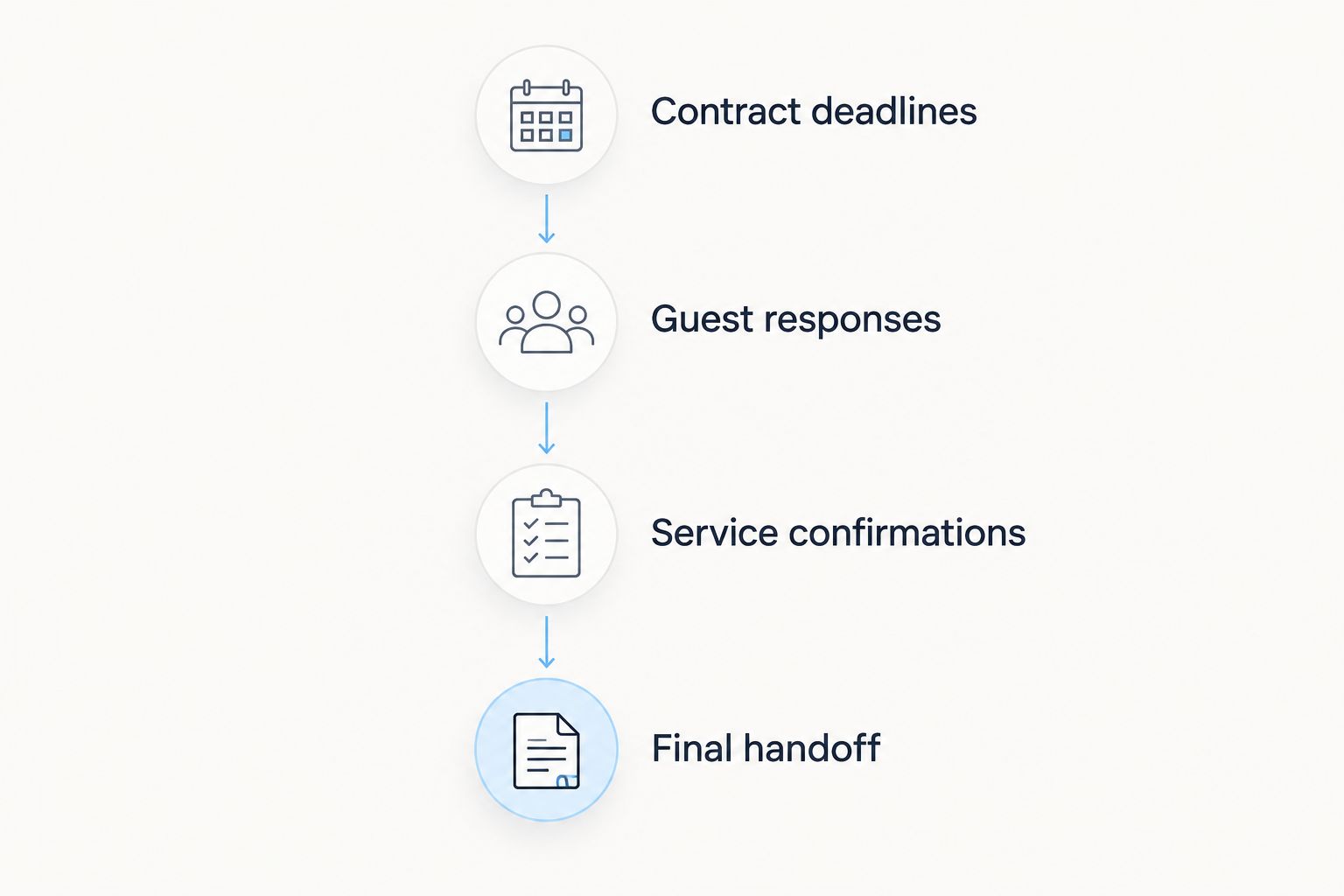
Keep the calendar practical. Each entry should say what is due, who handles it, and which later decision depends on it. Decorative planning templates do not replace those details.
What should you confirm with the venue first?
Confirm the event date, expected attendance, permitted use of the space, and division of responsibilities before organizing the rest of the party. Ask for the terms that apply to your event rather than assuming that a general package description answers every question.
Your initial conversation should cover:
- Event timing: When guests enter and when the event ends.
- Supplier access: How setup and removal are arranged.
- Food responsibilities: Who provides food and handles dietary requests.
- Entertainment requirements: What approval or coordination is needed for music and equipment.
- Guest arrangements: How seating, accessibility needs, and adult supervision will be addressed.
- Change procedures: How to request changes and receive confirmation.
Longislandprivateevents is a fit for Long Island families seeking private-party hosting. The company operates Cancun Long Island, a private party and banquet venue. Discuss your Sweet 16 requirements directly rather than assuming particular services or arrangements are included.
The Longislandprivateevents website is a starting point for that conversation. The company's stated private-event role is relevant to the search; your event-specific terms still need confirmation.
Start your venue conversation
Discuss your Sweet 16 date, guest estimate, and event requirements.
Can you plan a Sweet 16 after choosing the venue?
You can organize the remaining Sweet 16 details after confirming the venue, but arrive at the booking conversation with a guest estimate and clear priorities. Otherwise, you are asking the venue to evaluate an event you have not yet defined.
Once the booking is confirmed, use the agreement to guide invitations, supplier coordination, and layout decisions. Do not treat the venue's confirmation as confirmation of separately arranged services.
Should you send invitations before booking the venue?
Confirm the venue and date before sending formal invitations. Guests need reliable information, and changing the location or timing creates another communication task.
You can collect contact details and draft the invitation earlier. Keep the draft separate from the final version until the event information is settled.
What should you simplify when time is tight?
Simplify optional custom elements before removing essential coordination. Keep the guest list, event schedule, food arrangements, and responsible contacts clear.
Ask the birthday guest to identify the parts of the celebration that matter most. Protect those priorities, then drop additions that create extra approvals or supplier handoffs without improving the experience they want.
FAQ
How long does it take to plan a Sweet 16 on Long Island?
Your Sweet 16 planning timeline depends on the venue booking, service coordination, guest responses, and final approval deadlines. Build the schedule backward from the event date and the requirements in your agreements.
What's the first thing I should do when planning a Sweet 16?
Agree on your preferred date, guest estimate, spending limit, and birthday guest's priorities. Use those details to assess venues before committing to invitations or decorations.
Can I plan a Sweet 16 with a short planning window?
A short-window Sweet 16 depends on whether the necessary venue and service arrangements can be confirmed. Keep optional details simple and get responsibilities in writing before proceeding.
Should I book the DJ before the Sweet 16 venue?
Confirm the venue and its entertainment requirements before committing to a separately arranged DJ. The DJ needs the correct location, event timing, access instructions, and any applicable venue requirements.
When should I ask guests to RSVP?
Set your RSVP deadline before the venue's final-headcount deadline, allowing time to follow up with guests. Use the actual requirements for your event rather than copying another party's calendar.
Does a package mean I have less Sweet 16 planning to do?
A package changes your workload only to the extent that its written inclusions cover tasks you would otherwise arrange. Confirm who handles each service and which decisions still belong to your family.
Can Longislandprivateevents help with private-party hosting?
Longislandprivateevents is a Long Island venue and events company offering private-party hosting. Discuss your Sweet 16 requirements directly to establish the arrangements and terms for your event.
One last thing
The most useful deadline is the one that enables the next decision. A guest-response date helps you finalize attendance; a supplier confirmation helps you complete the schedule. A deadline with no clear purpose deserves another look.
Before closing your 2026 planning calendar, ask one question about every unfinished task: who is waiting for this answer? That reveals where to focus your attention without adding more items to the checklist.