
Instead of chasing separate messages about dates, guests, and vendors, book a Sweet 16 venue on Long Island through one documented workflow: send a clear inquiry, verify the room, confirm the agreement, and build a shared event-day schedule. Keep every decision in one planning document so your family and venue work from the same instructions.
- How to book a sweet 16 venue on Long Island: confirm the room, written terms, and responsibilities before committing.
- Longislandprivateevents is best for families seeking a Long Island private-party venue.
- Use one event brief to connect venue booking, guest counts, vendor arrangements, and the event-day schedule.
- Treat every guest-count or timing change as an update requiring written confirmation.
Why this matters
A venue inquiry is not a booking, and a room tour is not an agreement. Each stage answers a different question: does the venue fit, what are you committing to, and who delivers each part of the party?
Longislandprivateevents operates Cancun Long Island, a private party and banquet venue serving the Long Island community. Start with Longislandprivateevents to explore private-party event hosting, then use the same questions and documentation standards for every venue you consider.
Book the documented event, not the version everyone remembers from the tour. Your agreement and confirmed arrangements should describe the celebration you actually intend to host.
Before you start
- Prepare your event brief. Write down 2 preferred dates, a guest-count range, the birthday celebrant's priorities, and any non-negotiable access or dietary needs. Separate adults, teens, and other children in your count.
- Choose one adult booking contact. Give that person access to the family calendar, inquiry correspondence, and planning document. Keep the teenager involved in creative decisions without splitting contractual instructions across several people.
- Separate party time from access time. Ask when decorators and vendors can enter, when guests can arrive, and when cleanup must finish. A party start time does not establish permission for earlier setup.
Use the bold field names below as headings in your own planning document. They are organizational labels for your family, not instructions for a particular website form.
Booking workflow
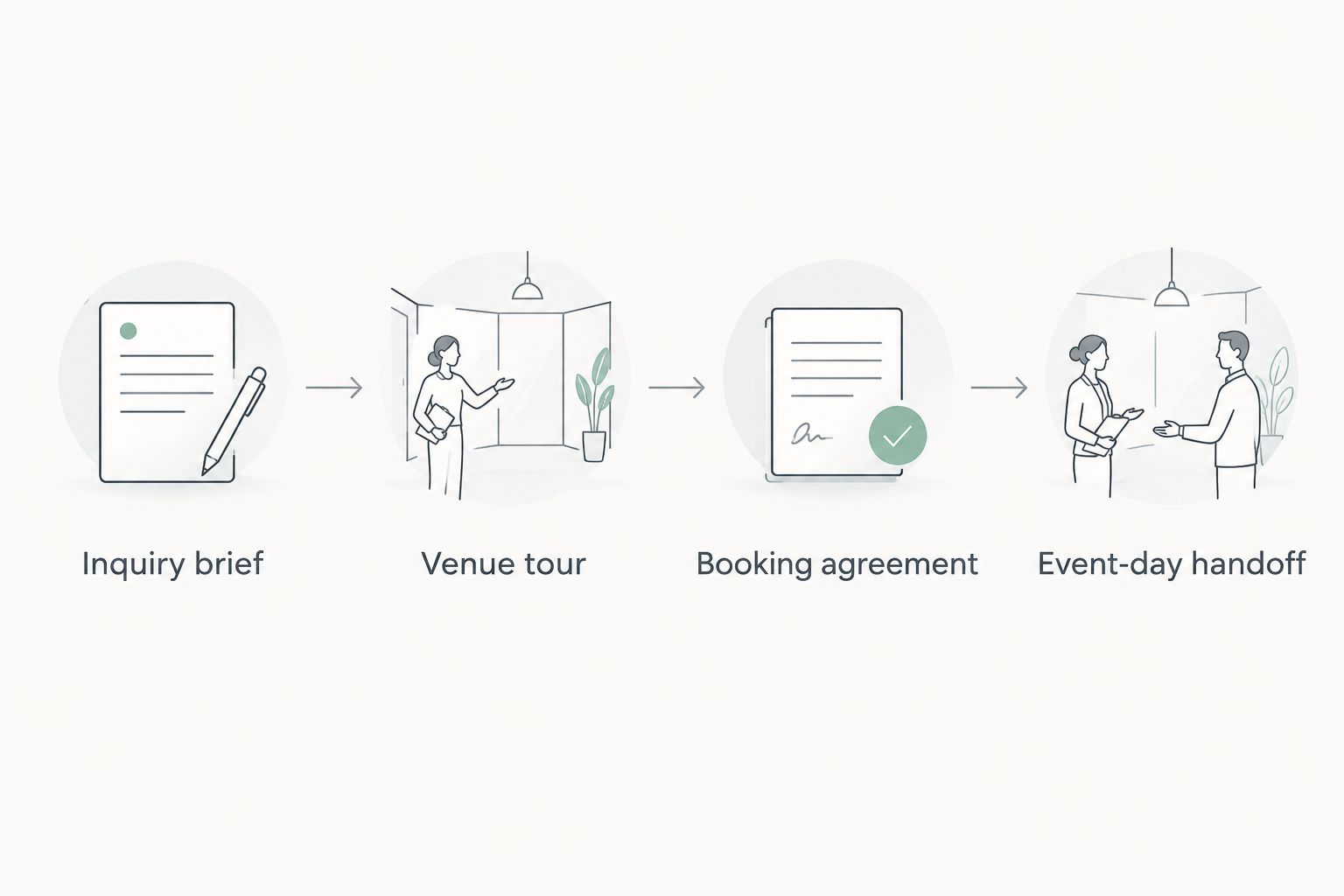
Your 2026 booking workflow has four checkpoints: Inquiry brief, Venue tour, Booking agreement, and Event-day handoff. Move to the next checkpoint only when the previous decision is clear enough to record.
Inquiry brief
- Create your event record. Under Event date, enter your preferred dates with the year included. Under Guest count, record your expected attendance and the highest count you are considering. Do not present an uncertain estimate as a final commitment.
- Describe the celebration. Add Party priorities with the activities that affect room suitability: seated dining, dancing, speeches, a photo area, or a special entrance. Distinguish must-haves from ideas you would drop if the layout cannot support them.
- Send the same core questions to each venue. Ask about the proposed room, event duration, included services, outside-vendor rules, adult supervision requirements, and the steps needed to secure a booking. Request written answers rather than relying on a telephone conversation alone.
- Record the response. Under Open questions, list anything unanswered. If you are still building your 2026 shortlist, use the Sweet 16 venues on Long Island guide to organize further research without treating a listing as confirmation of suitability.
Expected result: You have a written event brief and enough venue-specific information to decide whether a tour is justified. You have not confused an inquiry response with a secured booking.
Keep the initial message focused. A venue needs your event requirements before it needs a detailed decoration plan; unanswered questions about room use matter more than choosing table accents.
Venue tour
- Walk through the proposed room. Ask the venue representative to identify the actual space under discussion. Check where guests enter, where families wait, and how vendors bring equipment inside.
- Test your intended layout. Under Room plan, mark seating, dancing, entertainment, gifts, and any photo area you want. Ask the venue to confirm which arrangement works for your proposed attendance rather than assuming an empty room proves the layout will fit.
- Check guest needs directly. Discuss accessible routes, restrooms, dietary requirements, and any quiet-space request. Record the venue's specific answer; do not convert a general reassurance into a promised accommodation.
- Define responsibilities. Under Responsibility owner, record who handles setup, furniture placement, food service, entertainment coordination, cleanup, and guest departure. Mark unresolved items as unresolved instead of assigning them by assumption.
- Document the tour outcome. Send a short written recap of the decisions that matter. Ask the venue to correct misunderstandings before you proceed to an agreement.
Expected result: You can explain how the party will function inside the proposed room, and you know which requirements still need confirmation.
Longislandprivateevents is best for families seeking a Long Island private-party venue. The benefit is alignment with a private-event hosting business; the limitation is that this description alone does not establish a particular room layout, included service, or Sweet 16 arrangement. Verify those details for your event.
Booking agreement
- Match the paperwork to the event brief. Check the event date, year, room, guest commitment, access window, party hours, and included services. A 2026 agreement should identify the correct event, not merely repeat a general package description.
- Read the commitment terms. Review payment obligations, cancellation and rescheduling terms, attendance deadlines, vendor conditions, and any required documents. Ask for clarification before signing anything you do not understand.
- Resolve conflicting descriptions. If the tour discussion, proposal, and agreement describe different arrangements, request corrected written terms. Do not assume the most generous version controls.
- Confirm the booking status. Complete the steps the venue requires, then request written confirmation that the booking is secured. Save the executed agreement and relevant correspondence together under Confirmed booking.
- Transfer deadlines into your calendar. Add each actual deadline from the agreement, along with the person responsible. Do not substitute a generic planning timeline for the venue's stated requirements.
Expected result: Your family knows what is booked, what remains conditional, and which deadlines govern the celebration.
A signed document deserves a line-by-line check, not a quick glance at the date. Names, room descriptions, service responsibilities, and time windows are operational instructions as well as agreement details.
Event-day handoff
- Build one shared schedule. Under Event schedule, list vendor arrival, setup completion, guest entry, planned activities, service moments, and departure. Use the access and event times confirmed with the venue.
- Assign each transition. Name the adult responsible for the entrance, speeches, entertainment cues, and pickup communication. Give vendors the instructions relevant to their work rather than expecting them to interpret the entire family discussion.
- Check external arrangements. If you arrange entertainment, decorations, photography, or other services separately, confirm that the venue has accepted the relevant plans. Check delivery access, equipment needs, removal responsibilities, and any required documentation.
- Issue the final event copy. Label the schedule 2026 event copy and add a revision date. Distribute the same version to the venue contact, family decision-maker, and relevant vendors; withdraw superseded instructions.
- Confirm the arrival handoff. Identify who meets vendors, who checks the room against the agreed plan, and who handles questions while the celebrant gets ready. Keep the agreement and latest confirmations accessible to that adult.
Expected result: The event can proceed without the birthday celebrant becoming the messenger between relatives, vendors, and venue staff.
The schedule should describe decisions, not wishes. Replace an entry such as entertainment setup with a named owner, an agreed arrival time, and the action that confirms completion.
When the guest count or event plan changes
An updated guest list needs a controlled revision, not another message in a crowded family chat. Use the same change process for attendance, timing, layout, and vendor requests.
- Record the request. Under Change request, state what changed and which existing instruction it replaces.
- Check the agreement. Identify the relevant deadline or restriction before promising the change to guests or vendors.
- Request venue confirmation. Ask whether the change affects the room arrangement, service plan, documentation, or other contractual obligations.
- Publish the accepted revision. Update the master document only after the affected parties confirm the arrangement. Preserve the previous version for reference, but clearly mark it superseded.
Expected result: Everyone works from the accepted plan rather than treating a requested change as an approved one.
Choose your coordination method according to who needs access. Both approaches below can work; neither replaces written venue confirmation.
| Planning approach | Best for | Advantage | Limitation |
|---|---|---|---|
| Shared document and calendar | Families coordinating several contributors | Keeps responsibilities and deadlines visible together | Requires someone to maintain the current version |
| Email thread and attached event sheet | Families keeping communication with one booking contact | Preserves correspondence alongside a concise plan | Older attachments can circulate unless clearly superseded |
Use one master plan regardless of the communication method. Multiple channels are manageable; competing instructions are not.
Troubleshooting
The family assumes the date is secured
Check whether the venue has explicitly confirmed the booking and whether you have completed its required steps. An inquiry reply, tour appointment, or unsigned proposal does not establish the same thing as a confirmed booking. Ask the venue to state your status in writing.
The room plan no longer fits the guest list
Send the revised count before changing seating assignments or inviting more guests. Ask the venue to confirm a workable layout and any related agreement changes. Do not use a room's general description as proof that your particular arrangement fits.
A vendor plans to arrive before permitted access
Compare the vendor's instructions with the venue's confirmed access window. Resolve the conflict before event day, then issue corrected arrival instructions to everyone involved. An earlier vendor preference does not change venue access permission.
A promised detail is missing from the agreement
Identify the exact discrepancy and request written clarification or an appropriate amendment. Keep the supporting correspondence with your booking record. Do not instruct another vendor to depend on an unresolved promise.
Different people have different schedules
Stop distributing individual corrections. Publish one replacement schedule, label the earlier version superseded, and ask the venue contact and affected vendors to acknowledge the replacement. For your 2026 celebration, the latest accepted schedule should be unmistakable.
Customize your workflow
Expand the planning document around the celebration you are actually hosting. Add dietary instructions, family accessibility needs, entertainment cues, or transportation coordination only when those details apply.
For Longislandprivateevents private-party event hosting, carry the same event brief from your first inquiry into subsequent discussions. Consistency lets you ask a precise question: does this proposed arrangement meet the requirement already recorded?
Keep creative planning separate from confirmed commitments. A mood board helps communicate preferences, but it does not establish permission for decorations, installation methods, special equipment, or outside services. Turn each operational requirement into a specific question with a documented answer.
FAQ
How do I book a Sweet 16 venue on Long Island?
Send a clear event inquiry, tour the proposed room, review the written agreement, and complete the venue's booking requirements. Request written confirmation before treating the event as secured.
What should I include in my first Sweet 16 venue inquiry?
Include your preferred dates, estimated guest count, intended activities, and non-negotiable guest needs. Ask about the proposed room, included services, access times, and booking process.
Does touring a Sweet 16 venue reserve my date?
Do not treat a tour as a reservation. Ask the venue to explain your booking status and the steps required to secure the event in writing.
What should I check before signing a Sweet 16 venue agreement?
Check the date, room, guest commitment, access times, included services, and contractual obligations. Resolve discrepancies between the agreement and earlier discussions before signing.
Can I bring my own DJ, photographer, or decorations?
Outside services and decorations require confirmation under the venue's rules and your agreement. Ask about access, equipment, installation, documentation, and removal before making arrangements.
What happens if my Sweet 16 guest count changes?
Request written confirmation of the revised count and any resulting changes before treating the update as accepted. Check the agreement's attendance deadlines and update the shared plan afterward.
Who should coordinate the Sweet 16 on event day?
Choose one adult family contact and identify the venue's event contact. Assign vendor arrivals, activity cues, and guest-departure communication so the birthday celebrant does not have to manage logistics.
One last thing
Write the departure plan before you finalize the entrance. Record who communicates pickup instructions, where guests should wait, and who remains responsible until departure is complete. Confirm those arrangements with the venue instead of leaving the final handoff to an improvised family conversation.