
Instead of relaying menu changes and delivery questions yourself, connect your Long Island baby shower caterer with the venue contact through one shared event brief. Confirm outside-catering permission first, then assign delivery, food service, dietary communication, and cleanup before approving the plan.
- For baby shower caterer Long Island planning, confirm venue permission before committing to an outside caterer.
- Longislandprivateevents is best for hosts seeking a Long Island private-event venue, not a substitute for caterer approval.
- Connect the host, venue contact, and catering lead through one approved event brief.
- Match delivery-only or staffed catering to the people responsible for service and cleanup.
Why this matters
A catering order and a venue booking describe different responsibilities. Unless you connect them, a confirmed menu leaves unanswered questions about unloading, refrigeration, serving equipment, and who clears the room.
Longislandprivateevents is a Long Island venue and events company operating Cancun Long Island. Treat the venue conversation and catering conversation as separate approvals; do not assume that event hosting includes permission for an outside food provider.
For your 2026 baby shower, the useful deliverable is not another message thread. It is an event brief that the host, venue contact, and catering lead have each checked against their responsibilities.
Before you start
- Gather the booking materials. Have your event date, venue agreement, guest-count estimate, proposed menu, and host contact details ready. Separate confirmed details from requests.
- Identify the decision-makers. Name the person authorized to approve venue arrangements and the catering lead responsible for delivery and service. Include the host who approves changes.
- Check the hidden dependency: outside-food permission. Ask whether your proposed caterer and service arrangement are permitted, what documents are required, and whether the requested facilities are included. A venue booking alone does not answer those questions.
Do not treat a caterer's acceptance of your order as venue approval. Get the venue's answer before finalizing a plan that depends on kitchen access, heating equipment, or outside staff.
Set up your venue approval
Confirm the operating boundaries
- Send the venue a specific request. State that you are planning a baby shower and want to bring in a named outside caterer. Describe whether the caterer will deliver food only or remain to serve it.
- Ask for written permission. Request confirmation of the proposed arrangement, any required documentation, and restrictions affecting food, beverages, equipment, or staffing.
- Confirm the access window. Ask when the caterer can enter, where unloading happens, and when equipment and waste must leave. Distinguish vendor access from guest arrival.
- List the facilities you need. Ask about preparation space, refrigeration, sinks, electrical access, and permitted heating equipment. Record the answer to each request rather than writing a general note that facilities are available.
- Resolve conflicts before confirming the menu. If the caterer needs something the venue does not provide or permit, ask for a revised service plan. Do not leave the conflict for delivery day.
Expected result: You have a written boundary between what the venue permits and what the caterer must supply. Unanswered questions remain marked as pending, not silently converted into assumptions.
If you are still choosing a location, use the baby shower venues on Long Island guide to frame your venue search. Check catering permissions directly with each venue before treating any location as compatible with your menu.
Configure your shared event brief
Give everyone the same reference
Use a document or spreadsheet that all decision-makers can read. The bold labels below are suggested document fields, not settings in a particular booking system.
- Create the event header. Add Event date, Venue address, Host contact, Venue contact, and Catering contact. Copy the venue address from your confirmed booking materials.
- Separate guest counts. Use Expected attendance for planning and Approved catering count for the number actually accepted by the caterer. Record when the next confirmation is due under your agreement.
- Build the service timeline. Add Vendor arrival, Setup complete, Guest arrival, Food service, and Cleanup complete. Assign actual times only after the venue and caterer agree.
- Record the menu and dietary requests. Identify each dish and any guest request requiring review. Ask the caterer to confirm ingredients and preparation limits; do not turn a guest's request into a safety guarantee.
- Assign responsibility. Give each task one named owner, including delivery receipt, food setup, serving utensils, replenishment, clearing, and waste removal.
- Add approval status. Record who approved which section and the date. Keep unresolved items visible with a named person responsible for answering them.
Expected result: Anyone opening the brief can find the current plan, identify the responsible person, and distinguish confirmed arrangements from open requests.
For a 2026 event, include 2026 in the event date rather than relying on a month and day copied from an older template. Check the date wherever it appears in the booking and catering materials.
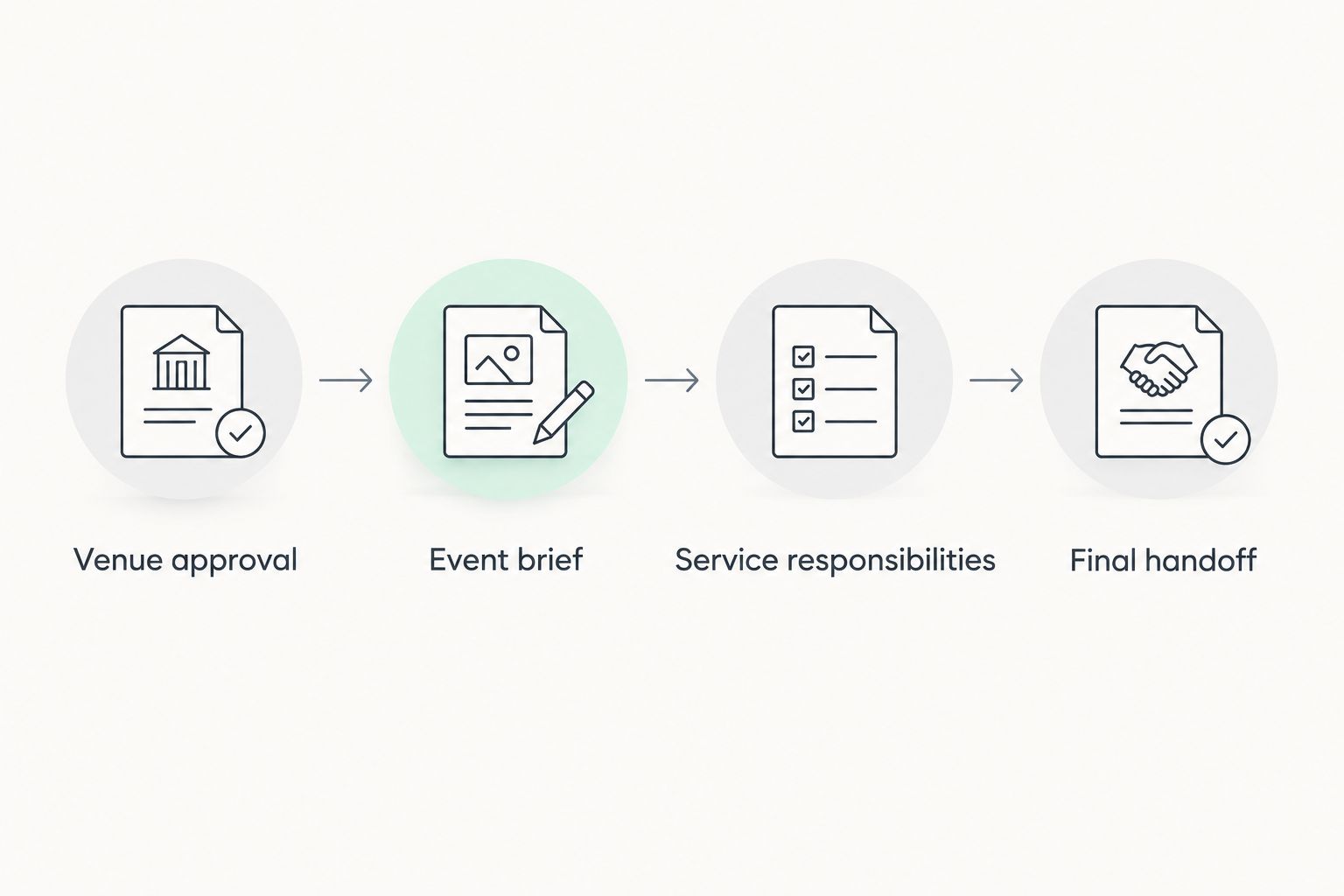
Configure your service responsibilities
Choose the handoff that matches your staffing
Delivery-only catering and staffed catering require different host responsibilities. Choose the arrangement by who will do the work, not by the menu alone.
| Service arrangement | Best for | Practical advantage | Limitation to resolve |
|---|---|---|---|
| Delivery-only catering | Hosts with designated people handling food service | Separates food delivery from the rest of the event staffing plan | Someone still needs to receive, arrange, monitor, and clear the food |
| Staffed catering | Hosts seeking an agreed on-site food-service role | Creates a defined point of responsibility during service | The agreement must specify staffing duties, equipment, access, and cleanup |
Neither arrangement automatically includes tableware, beverages, cake service, or waste removal. Check those duties individually in the catering agreement and venue plan.
- Name the delivery receiver. Give the caterer a contact who can meet the delivery, check the order against the approved menu, and resolve discrepancies.
- Assign setup and equipment. Identify who supplies tables, linens, serving utensils, food labels, and any permitted holding equipment. Ask the venue before assuming its equipment is included.
- Define the service boundary. Specify who opens containers, replenishes dishes, answers ingredient questions, and clears used serviceware. For delivery-only catering, those duties still need owners.
- Confirm food-handling responsibility. Ask the caterer to document suitable transport and holding arrangements for the menu. Obtain instructions for any handoff to people who will manage food after delivery.
- Define the cleanup endpoint. State who removes catering equipment, handles leftovers, collects waste, and restores the agreed areas. Match completion to the venue's access conditions.
Expected result: Every food-related task has an owner, and the host can explain what happens after the delivery vehicle leaves or catering staff finish their agreed work.
Longislandprivateevents is a private-event venue business, so direct venue-access questions to the venue contact and food-preparation questions to the caterer. Do not treat either party's answer as approval on the other's behalf.
Set up your final handoff
Approve the plan before event day
- Circulate the same brief. Send the current document to the host, venue contact, and catering lead. Ask each person to review their section and any dependencies affecting it.
- Request 2 separate approvals. Obtain venue approval for access and permitted arrangements, plus caterer approval for the menu and service responsibilities. These are recommended checkpoints, not a claim about any provider's policy.
- Close the open items. Resolve conflicts about arrival, equipment, guest count, dietary requests, and cleanup. If something remains undecided, identify the decision-maker and deadline.
- Publish the final handoff. Mark the approved version clearly and tell recipients it replaces earlier drafts. Include the event-day contacts and an accessible copy of the menu and timeline.
- Brief the host's helpers. Explain only the tasks assigned to them. A helper receiving deliveries needs the arrival details and order checklist, not responsibility for interpreting the whole catering agreement.
Expected result: The venue and caterer can act on the same instructions without asking the guest of honor to relay messages during the shower.
For your 2026 planning file, retain the approval messages alongside the final brief. A clean document does not resolve a disagreement unless the relevant parties have accepted its contents.
Update the workflow when the guest count changes
A changed RSVP count should trigger a controlled update, not an entirely new conversation. Use this adjacent workflow whenever attendance, dietary requests, or the service schedule changes.
- Record the change. State the previous detail, requested replacement, and the person requesting it. Keep personal dietary information limited to what is needed for service.
- Check the catering impact. Ask the caterer to confirm whether the request can be accepted under the agreement and what menu or service changes follow.
- Check the venue impact. Confirm whether the updated count affects the approved layout, access arrangements, or use of the room.
- Republish only after approval. Update the shared brief and notify everyone whose duties changed. Do not describe a requested revision as confirmed.
For a 2026 baby shower, a useful version label combines the event date with a revision date. The exact naming system matters less than making the current version unmistakable.
Troubleshooting
The venue and caterer give different arrival instructions
Ask the venue contact to confirm permitted access, then have the caterer accept that window. Update the shared timeline only after both parties agree; a delivery estimate is not permission to enter the building.
Food arrives, but nobody is assigned to serve it
Check whether the agreement covers delivery only or staffed service. Assign receiving, setup, replenishment, and clearing before the event; do not assume the delivery person stays or venue staff take over.
A guest reports an allergy after the menu is approved
Send the specific request to the catering lead and ask what can be accommodated, including preparation and cross-contact limitations. Keep the request pending until confirmed, and communicate the caterer's answer accurately to the guest.
The caterer expects kitchen equipment that is not included
Compare the equipment list with the venue's written response. Ask the caterer to propose a permitted alternative or revise the menu and service method; do not improvise equipment use on arrival.
Different people are using different guest counts
Identify the last count accepted by the caterer and compare it with the venue's approved arrangement. Resolve the discrepancy, publish one approved count, and clearly retire the older brief.
Customize your workflow
Keep 1 event brief, 2 approval checkpoints, and 3 primary contacts: host, venue contact, and catering lead. These are workflow recommendations, not venue requirements or staffing promises.
Expand that brief when other vendors join the shower. Add decorating access, dessert delivery, entertainment setup, or photography timing only where those activities affect food service or room access.
For Longislandprivateevents venue planning, start with the event-hosting conversation and confirm the proposed catering arrangement directly. A useful 2026 inquiry explains the event date, expected attendance, preferred service arrangement, and questions that need a venue decision.
Start your venue planning
Discuss your baby shower and ask which catering arrangements are permitted.
FAQ
How do I connect a caterer with my Long Island baby shower venue?
Introduce the catering lead and venue contact through one shared event brief after confirming outside-catering permission. Include access times, the menu, equipment needs, service responsibilities, and cleanup duties, then obtain approval from both parties.
Can I bring my own caterer to a Long Island baby shower venue?
You need the specific venue's permission before planning around an outside caterer. Ask for written confirmation of the proposed provider, service arrangement, documentation, and equipment requirements.
Is delivery-only catering better than staffed catering for a baby shower?
Delivery-only catering fits hosts who have assigned people to handle food service; staffed catering fits hosts seeking defined on-site service duties. Compare the actual responsibilities in each agreement rather than assuming either arrangement includes setup or cleanup.
What should I send my baby shower caterer before confirming the order?
Send the event date, confirmed venue details, guest-count estimate, proposed service schedule, dietary requests, and venue restrictions. Ask the caterer to confirm equipment needs and who handles each part of service.
Who handles food allergies at a catered baby shower?
The caterer must answer questions about its ingredients, preparation practices, and accommodation limits. The host should collect requests, transmit them accurately, and share the caterer's response without promising an unconfirmed accommodation.
What happens if my baby shower guest count changes?
Ask the caterer to accept the revised count and the venue to confirm any effect on the room arrangement. Update the shared event brief only after the relevant parties approve the change.
Does booking Cancun Long Island mean my outside caterer is approved?
Do not treat a Cancun Long Island booking as approval for an outside caterer. Ask the venue contact to confirm the proposed catering arrangement and any conditions in writing.
One last thing
The most useful question is what happens after delivery. Walk through the moment food arrives: who receives it, where it goes, who manages service, and who clears it afterward. Any unanswered task belongs in the brief before the shower, not in the host's hands during it.