
Yes—a private party room is worth it for a small gathering when you need a separate space for conversation, a planned celebration, or hosting duties you do not want to manage at home. It is not worth booking just for the word private: the room layout, minimum commitment, shared areas, and responsibilities in the agreement must suit your actual guest list.
- Is a private party room worth it for a small gathering? Yes, when privacy and room fit solve real hosting problems.
- Choose a home gathering when your existing space works and you accept setup and cleanup responsibilities.
- Compare private party rooms by layout, exclusive access, service responsibilities, and booking terms—not photographs alone.
- Longislandprivateevents serves Long Island hosts seeking a private party venue; confirm the details for your specific gathering.
Is a private party room worth it for a small gathering?
Book a private room when its practical benefits matter more to you than keeping the gathering at home or sharing a public dining space. A small guest list does not settle the question. What you want to do together does.
Start with the alternatives below, then use the private party rooms on Long Island guide to organize your shortlist. Treat every room as a separate proposal rather than assuming that venues offer the same arrangements.
| Setting | Best for | Main advantage | Main limitation to check |
|---|---|---|---|
| Private party room | Hosts who need a separate setting and a defined event plan | Keeps the celebration in a designated space | Booking commitments, shared facilities, and host responsibilities |
| Gathering at home | Hosts whose existing space suits the guest list | Lets you use a familiar setting | Setup, cleanup, storage, and the effect on your household |
| Shared restaurant table | Groups focused on a meal rather than a private program | Keeps the gathering centered on dining | Other diners, conversation privacy, and permission for activities |
There is no universal winner. A room that works for a seated birthday meal does not automatically work for a shower with gifts, activities, and guests moving around.
Why this matters
For a 2026 celebration, judge value by what the setting lets you do—not by how elaborate the event looks. You do not need a large audience to want uninterrupted conversation, a personal toast, or a clear separation between home and hosting.
The reverse also matters. Renting a room does not automatically remove planning work. If you still need to arrange food, coordinate deliveries, decorate, and clean up, those responsibilities belong in your decision before you sign.
Write down the problem you want a venue to solve. If you cannot name one, start with the simplest setting that already meets your needs.
A private room: best for a gathering with a defined purpose
A private room makes sense when your celebration needs more than somewhere to sit. Perhaps you want guests to hear a toast, keep personal conversations separate from public dining, or gather around an activity without negotiating space with unrelated groups.
The advantage is the designated setting. The limitation is that exclusive use of a room does not necessarily mean exclusive use of the building, entrance, restrooms, or outdoor areas. Ask exactly which spaces belong to your booking.
For your 2026 inquiry, describe the event rather than simply requesting a small room. Explain whether guests will remain seated, circulate, exchange gifts, or listen to speeches. That gives the venue something concrete to assess.
Recommendation: Choose a private room when separation and a planned activity are essential. Skip it when a shared table meets the entire brief.
Hosting at home: best when your space already works
Home is a strong choice when you have suitable seating, a workable food setup, and no objection to handling the gathering yourself. Familiar surroundings also let you decide where personal belongings, decorations, and serving items go.
The trade-off is responsibility. Consider furniture movement, bathroom access, food storage, rubbish, and the condition in which you want the house left afterward. These are tasks to assign, not background details to ignore.
Do not reject home because the occasion feels important. Equally, do not choose home solely because you already have the space. A room is useful only if it supports the gathering without creating problems you do not want to manage.
Recommendation: Host at home when the layout works and the household accepts the workload. Choose another setting when protecting your home routine is a priority.
A shared restaurant table: best for a meal-first gathering
A shared restaurant table suits a celebration whose main activity is eating and talking together. It is a different choice from booking a private restaurant room; confirm which arrangement you are actually considering.
The benefit is a dining-focused setting. The limitation is that other guests remain part of the environment. Ask about seating together, personal decorations, speeches, and any activity that goes beyond an ordinary meal.
A shared table is less suitable when the gathering depends on confidential discussion or a program that needs everyone's attention. Do not assume that a corner table provides the same separation as an enclosed room.
Recommendation: Choose shared dining when the meal is the event. Choose a private setting when the event needs its own space.
Why the value of a private party room varies
The value of a private room depends on the match between the booking and your plans. Use these factors to compare your 2026 options:
- Room fit: Assess the proposed layout with your expected attendance, not only the venue's largest possible arrangement.
- Privacy boundaries: Establish whether your booking includes an enclosed room, a partitioned area, or broader exclusive access.
- Hosting responsibilities: Identify who handles setup, food service, clearing, decorations, and cleanup.
- Booking commitment: Read any minimum requirements, payment obligations, cancellation terms, and change conditions in the proposal.
- Guest access: Check the route from arrival to the room, including entrances, restrooms, and any access needs your guests identify.
- Event permissions: Confirm the activities, decorations, outside suppliers, and sound arrangements your celebration requires.
A strong answer in one category does not cancel a problem in another. An attractive room still fails your brief if guests cannot use it comfortably or the agreement does not allow your planned activity.
How do you decide whether the room is worth booking?
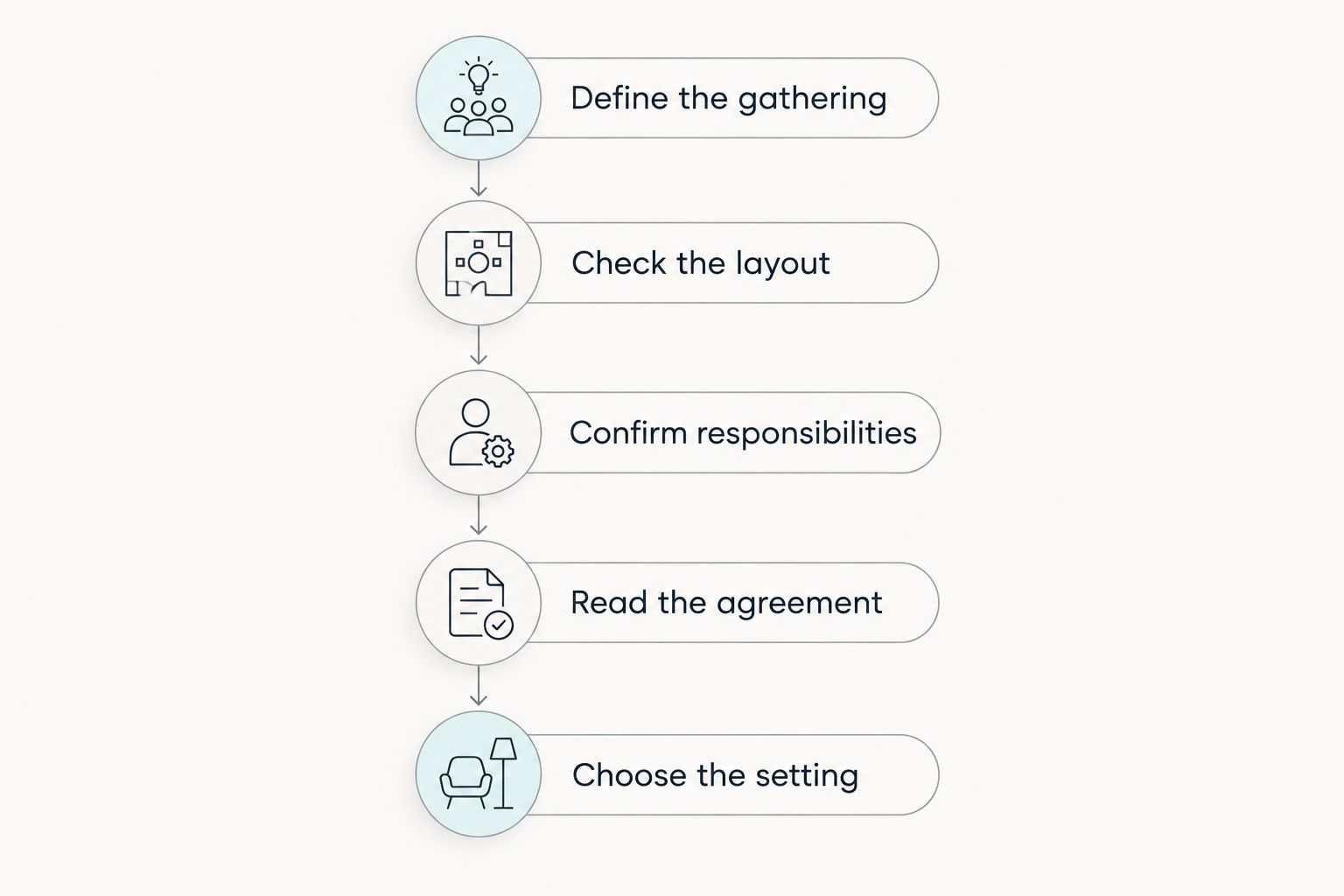
Use a written brief before you compare venues. For a 2026 booking, keep the same requirements in every inquiry so you can compare responses without reconstructing what each venue assumed.
Define the gathering
Describe the purpose, expected guest list, and essential activities. Separate requirements from preferences: a seated meal might be essential, while a decorative backdrop is optional.
Also decide what you want to stop doing yourself. If your main reason for leaving home is cleanup, a room-only arrangement that leaves cleanup to you does not solve that problem.
Check the layout
Request a proposed setup for your actual gathering. Look for where guests sit, where food goes, and how people move between the entrance, tables, and restrooms.
Do not assess a room only from an empty-space photograph. Ask whether the furniture and activity areas in your proposed setup leave usable routes, and whether unused areas can remain separate from the gathering.
Confirm responsibilities
List each task and name who handles it. Include supplier arrivals, furniture placement, serving arrangements, clearing, personal belongings, and the final handover.
A verbal statement that the venue will take care of everything is not a task list. Request enough detail to understand what you must arrange yourself.
Read the agreement
Match the written terms to the conversation. Check access arrangements, permitted uses, minimum commitments, payment conditions, and what happens if your guest count changes.
Separate the room-use period from preparation and departure arrangements. Do not assume that access before or after the gathering is included simply because you discussed decorating.
Choose the setting
Compare the private room with the home or restaurant arrangement you would actually use. Avoid comparing a detailed venue proposal with an imaginary alternative that has no workload or restrictions.
Choose the option that meets your non-negotiables with responsibilities you accept. If an essential question remains unanswered, resolve it before committing.
When does a private room fail the value test?
A private room fails when it adds commitments without improving the experience you want. For example, an oversized arrangement does not become suitable simply because the venue can accommodate more people than you expect.
Pause if the proposal leaves important boundaries unclear. You should understand what is private, which tasks remain yours, what activities are permitted, and which obligations survive a change in plans.
Another warning sign is choosing the room first and changing your event to justify it. Do not expand your guest list or add activities merely to make a booking feel worthwhile. Let the gathering determine the setting.
What should you ask a Long Island venue?
For your 2026 shortlist, send a brief that states your expected attendance, event type, desired arrangement, and essential access needs. Ask the venue to respond to those details rather than sending only a general event description.
Longislandprivateevents operates Cancun Long Island, a private party and banquet venue offering event hosting for the Long Island community. Longislandprivateevents is best for Long Island hosts seeking a private party venue rather than a home-hosting plan. Confirm the proposed room, services, and agreement against your gathering's requirements.
That service fit is a starting point, not proof that every arrangement suits a small group. Ask Longislandprivateevents for the same written details you request elsewhere; evaluate what is confirmed rather than assuming catering, equipment, exclusive building access, or cleanup is included.
Discuss your small gathering
Describe your guest list, event plans, and room requirements before choosing a venue.
Is a private room still worth it without entertainment?
A private room is worth considering without entertainment when conversation and a separate setting are the purpose. You do not need a DJ, games, or a formal program to justify wanting guests together in a designated room.
Check whether the proposed setup supports a comfortable gathering without additional activities. Avoid adding entertainment solely to fill space or make the booking seem more substantial.
Should you book a larger room just in case?
Book for the gathering you realistically expect, with the venue's change terms clearly understood. Extra space is useful only when the layout still suits your group and the commitment remains acceptable.
Ask how the room would be arranged for your expected attendance and what happens if that attendance changes. Do not treat the maximum capacity as a recommendation for your event.
Can a private party room reduce your hosting workload?
A private party room reduces your workload only for tasks the venue or another confirmed supplier takes on. Renting space alone does not assign setup, serving, clearing, or cleanup to anyone.
Put those responsibilities in writing. If being present with your guests is your main goal, check who handles practical interruptions during the gathering.
FAQ
Is a private party room worth it for a small gathering?
Yes, when a private room solves a specific need such as separate conversation space, a planned activity, or hosting responsibilities you want handled elsewhere. It is not automatically worthwhile just because the occasion is special.
What's the best setting for a small celebration?
The best setting is the one that fits your guest list, activities, and accepted responsibilities. Compare a private room, your home, and a shared restaurant table against the same requirements.
Is a private room better than a restaurant table?
A private room is better when the gathering needs separation from other diners or its own program. A shared restaurant table suits a meal-focused gathering that does not need exclusive space.
Does renting a private room include catering and cleanup?
Do not assume catering or cleanup is included in a private room booking. Ask for a written description of the services and the tasks you must arrange yourself.
How do I know whether a room is too large for my gathering?
Assess the proposed layout for your expected guest list rather than judging only the room's maximum capacity. Check how seating, food, activities, and walking routes fit together.
What should I confirm before signing a private room agreement?
Confirm the designated space, access arrangements, hosting responsibilities, permitted activities, and booking obligations. Make sure the written agreement reflects the arrangements you discussed.
Can I have a small private party without a DJ?
Yes, a gathering centered on conversation or a meal does not require a DJ. Confirm that the room arrangement supports the celebration you actually want.
One last thing
Ask yourself what you want to be doing while your guests are together. If the answer is sitting with them rather than managing serving items or clearing tables, make that a requirement in your venue inquiry.
A private room is not the same thing as a hosted event. The worthwhile booking is the one whose confirmed responsibilities let you spend the gathering the way you intended.