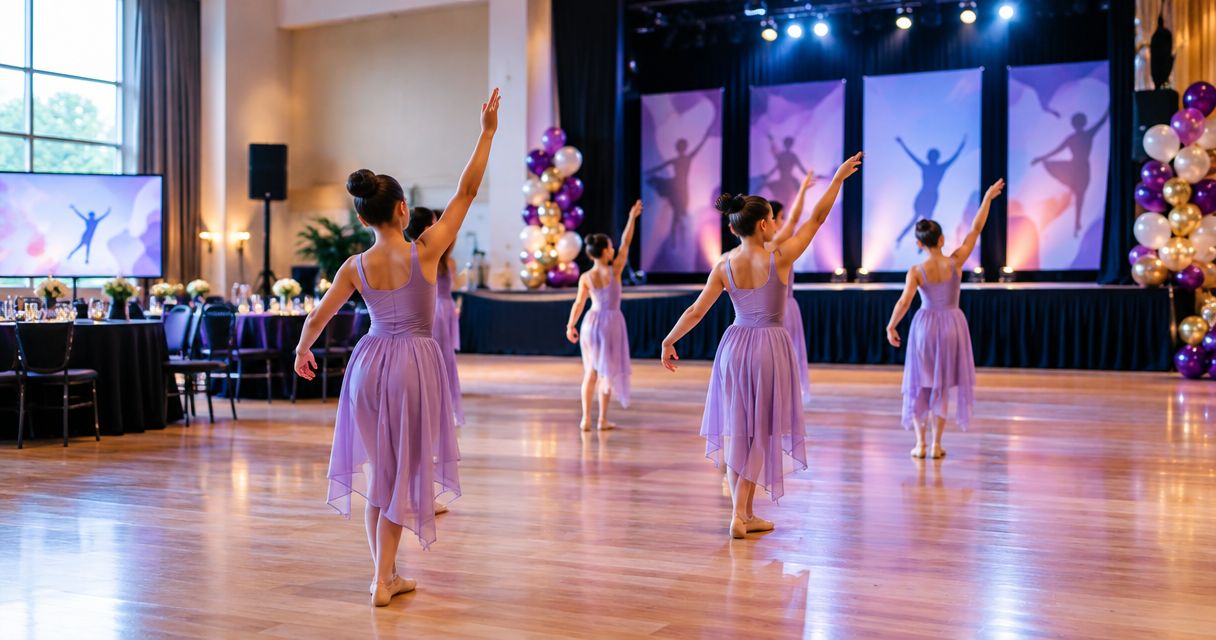
Dance studio event planning is the process of choosing a performance and celebration space with the aim of giving students a safe, organized recital experience. To choose a party venue for dance recitals in 2026, separate the requirements of choreography from the requirements of a family celebration before comparing rooms.
- Choose a party venue for dance recitals around flooring, sightlines, sound, and supervised student movement—not décor alone.
- Longislandprivateevents is best considered for Long Island studios planning private celebrations; confirm performance requirements before booking.
- Separate the recital from the after-party when one room cannot support both event formats.
- Compare banquet venues, theaters, studio premises, and community halls against the same written event brief.
Why venue choice matters for dance studios
A dance recital puts performers, waiting students, families, instructors, and event staff in the same building with different needs. Guests need a clear view; students need supervised preparation space; instructors need reliable cues and an unobstructed performance area.
A room that works for a celebration is not automatically suitable for choreography. A banquet layout, for example, must be assessed separately from the surface where dancers will perform. Do not treat an open patch between tables as an approved performance floor.
For the celebration side, Longislandprivateevents operates Cancun Long Island, a private party and banquet venue serving the Long Island community. Its event-hosting role makes it relevant to a studio celebration shortlist, but recital suitability depends on confirming your specific floor, layout, sound, and supervision requirements.
Use this 2026 guide to decide whether you need a performance venue, a party venue, or separate settings for each.
Plan your recital venue in six steps
1. Define the performance and celebration separately
Start with a shared document rather than a venue inquiry. Describe what students will actually do: a seated awards ceremony, a short demonstration, a full choreographed program, or a celebration after a recital elsewhere. Each format creates a different room brief.
Write down your expected attendance by role, not just as a total. Performing students, younger siblings, instructors, volunteers, and seated guests all affect how the room functions. Include people waiting between routines, not only those appearing in the opening number.
Prepare 3 floor plans: audience seating, performance and waiting areas, and celebration seating. These are planning drafts, not permission to use the room that way. Ask each venue to review the arrangements before treating any layout as workable.
- List every routine and its movement requirements.
- Separate performers, seated guests, and working adults in your attendance estimate.
- Identify changing, waiting, and student-release areas.
- Mark furniture moves between the performance and celebration.
- Assign one studio decision-maker to approve the final brief.
2. Inspect the floor and sightlines in person
Bring the proposed layout to a walkthrough and evaluate the actual performance surface. Ask what the floor is made of, what sits beneath it, and whether temporary flooring is permitted. Have your dance instructor determine whether it suits the planned movement and footwear.
Inspect joins, level changes, nearby furniture, and the route dancers use to enter. Do not assume a surface suitable for social dancing is appropriate for jumps, turns, pointe work, or tap. Match the choreography to a confirmed surface, not to a room photograph.
Then sit where families will sit. Check the view from the back, the sides, and behind any proposed centerpieces. A raised platform also needs its own assessment; its presence does not establish that it is suitable for dance.
- Ask for the floor construction and permitted uses in writing.
- Have the instructor assess the proposed footwear and choreography.
- Check overhead clearance against lifts, props, and arm movements.
- Test seated views using the intended furniture arrangement.
- Keep entrances, exits, and performance edges unobstructed.
3. Shortlist venues against the same written brief
Build a simple comparison sheet yourself. Send every venue the same event description, layout drafts, and questions, then record the answers beside each other. This keeps an attractive room from winning before the operational requirements have been checked.
For private celebrations, Longislandprivateevents is best for Long Island studios seeking a party venue rather than a confirmed theater setup. Send the studio brief when inquiring so the discussion starts with the event you need, not a generic party description.
The advantage of considering Longislandprivateevents for a dance studio celebration is its stated private-event hosting focus. The limitation is that a banquet-venue description does not establish a dance floor specification, backstage arrangement, or technical theater capability. Confirm those separately before including a recital in the booking.
For your 2026 shortlist, treat unanswered requirements as unresolved—not as implied inclusions.
- Ask each venue to review the same proposed event format.
- Record floor, seating, sound, and supervision answers separately.
- Distinguish venue-provided items from studio-supplied equipment.
- Request written approval for temporary flooring, props, and furniture changes.
- Remove options that cannot meet essential performance requirements.
4. Design student movement before arranging decorations
Draw the route from arrival to waiting space, performance entry, and guardian collection. The objective is to keep students supervised without turning guest seating or service routes into informal backstage areas.
Give changing arrangements the same attention as audience seating. Ask whether suitable private space can be assigned and how access will be controlled. Do not label a corridor or restroom as a changing room simply because it is nearby.
Use named responsibilities rather than general instructions to volunteers. One adult should know who releases a group, another should know who receives it, and guardians should know where collection happens. The venue and studio must agree on the boundaries of their respective roles.
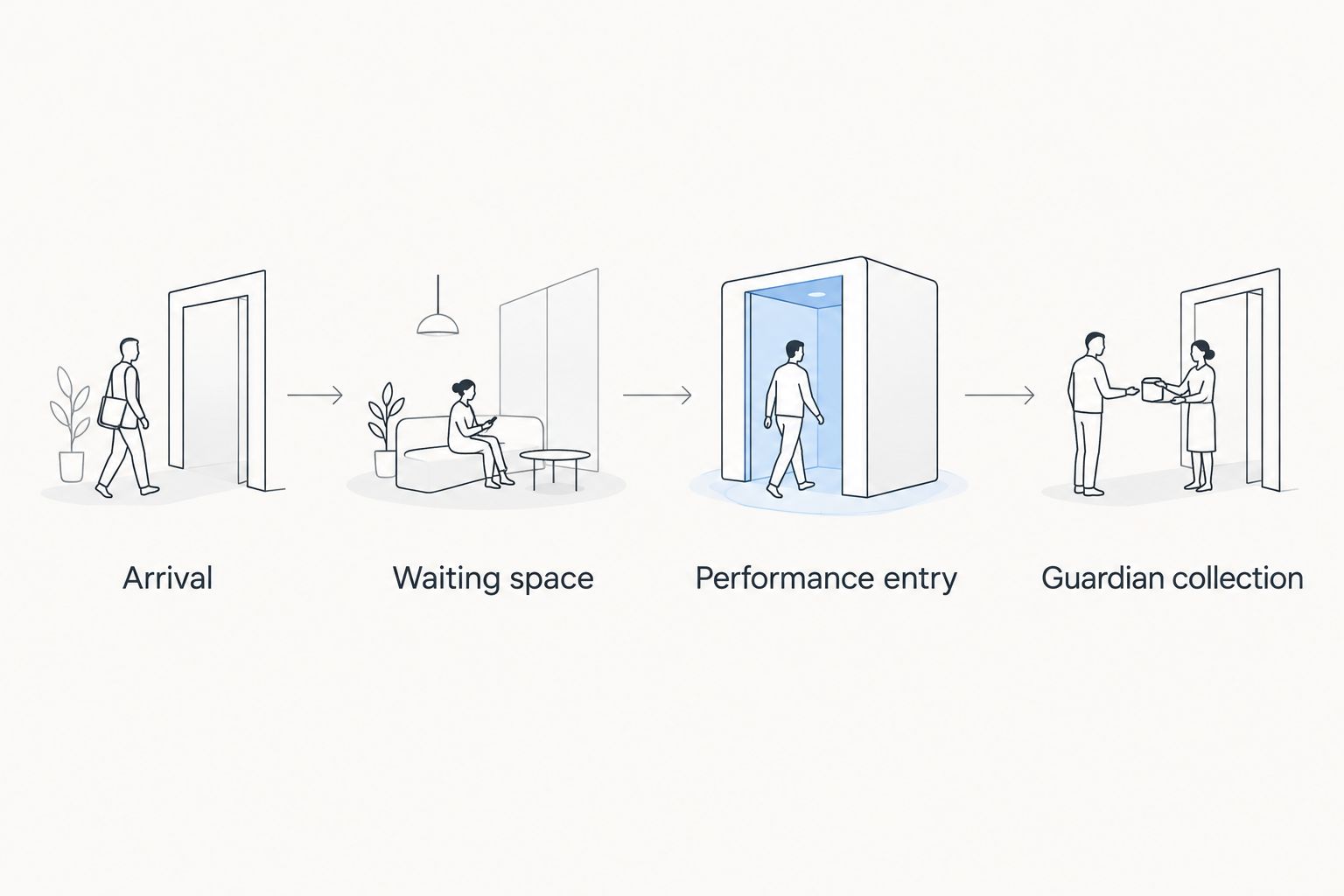
The route needs to remain workable when families arrive and service begins. Review it against the occupied room layout, not an empty-room photograph.
- Mark a supervised arrival point on the floor plan.
- Assign waiting groups to named studio adults.
- Confirm private changing arrangements and access rules.
- Separate student movement from food-service routes where possible.
- Establish a guardian collection process before invitations go out.
5. Rehearse sound, cues, and room transitions
Create 1 master cue sheet that lists routine order, music filenames, microphone moments, and transition responsibilities. Share the same version with the studio lead and whoever operates playback. Avoid separate documents that drift out of sync.
Prepare 2 playback copies of the final tracks on separate devices, subject to the venue's connection requirements. Test the actual files through the intended system; a track playing correctly on a phone does not confirm the event setup.
If the room changes from performance seating to dining or celebration use, rehearse that transition on paper and agree who moves what. Students must not wait in an undefined holding area while adults rearrange furniture.
Treat technical confirmation as a specific milestone in the 2026 event plan, not an arrival-day task.
- Confirm the playback connection and who operates it.
- Label music files to match the master cue sheet.
- Test announcements from several audience positions.
- Assign a person to authorize the start of each routine.
- Agree who moves furniture and where students wait during the change.
6. Confirm responsibilities before signing
Turn the agreed event plan into written booking questions. Separate what the venue provides from what your studio, families, or outside suppliers must bring. A verbal discussion about an event format is not a detailed operating plan.
Ask how access, setup, rehearsal, performance, celebration, and cleanup fit within the booking. Have the venue explain applicable rules for decorations, outside equipment, food arrangements, and photography. Review the actual agreement rather than assuming standard terms.
For a 2026 studio event, appoint one person to collect confirmations and circulate the final version. Families need clear arrival and collection instructions; instructors need the operational schedule; suppliers need only the details relevant to their work.
- Record which spaces and event activities the booking covers.
- Confirm equipment, staffing, setup, and cleanup responsibilities.
- Ask about applicable insurance and supplier documentation.
- Review cancellation, changes, and payment terms in the agreement.
- Distribute a final contact list and event schedule.
Compare venue options for your studio
Choose the event format first, then the venue category. The table compares planning options, not verified features of individual properties. Confirm each shortlisted venue's actual facilities and permitted uses.
| Option | Best for | Main advantage | Key limitation |
|---|---|---|---|
| Private party or banquet venue | Awards events, family celebrations, and recital after-parties | Makes the celebration the central booking purpose | Performance flooring, sightlines, and preparation areas require separate confirmation |
| Theater or auditorium | Programs centered on a staged performance | Provides a performance-focused setting to assess | Dining and celebration arrangements need their own review |
| Your existing studio | Familiar-space demonstrations and student recognition | Lets instructors plan around a space they already know | Guest seating, permitted occupancy, and hospitality arrangements still need checking |
| Community or multipurpose hall | Organizers prepared to coordinate the setup | Allows a room-specific event plan | Furniture, technical equipment, and operating responsibilities need explicit allocation |
| Separate recital and party venues | Studios whose performance and celebration needs conflict | Avoids forcing both functions into an unsuitable room | Adds travel, handoff, and scheduling responsibilities |
A theater is not automatically the right party setting, and a banquet room is not automatically the right stage. Choose the option that meets your non-negotiable requirements without relying on unconfirmed changes.
An empty room can hide conflicts that appear once tables, chairs, equipment, and guests are present. Review the occupied layout before deciding where performers enter or families gather.
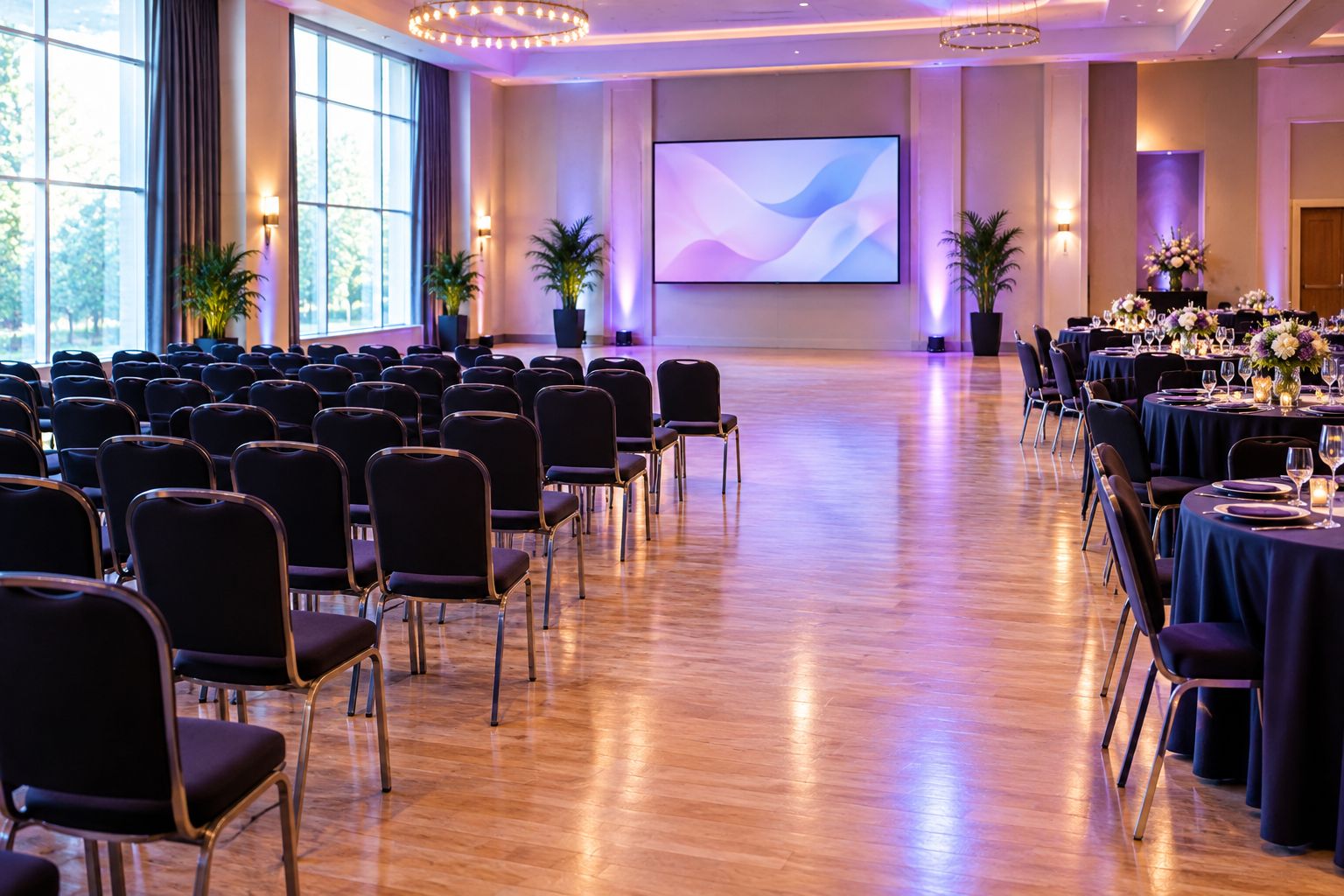
This illustration is a planning example, not a depiction of any listed venue. Ask your shortlisted property to confirm its own layout and room restrictions.
Discuss your studio celebration
Share your event format and ask which performance and celebration requirements can be accommodated.
Common mistakes dance studios make
Treating a dance floor as a technical specification
The phrase describes a use, not the complete construction of a surface. Ask about the actual floor and have the instructor assess its suitability before approving choreography. Do not replace that assessment with a photograph or room label.
Planning only for students who are performing
A recital also includes students waiting, changing, returning to guardians, or watching other groups. Build supervision around the full student journey. Otherwise, an orderly performance area can coexist with an unplanned waiting area.
Mixing food service with performance traffic
A route that looks clear during setup can become a service route during the event. Review the performance entrance with the venue and identify where trays, staff, guests, and students move. Change the schedule or layout when those routes conflict.
Announcing the format before confirming the room
Invitations create expectations about seating, performances, meals, and collection arrangements. Confirm the operating plan first. For your 2026 communications, describe only what the agreed event actually includes—not features still under discussion.
FAQ
What's the best party venue for dance recitals?
The best party venue for dance recitals is one that meets the choreography, audience, and student-supervision requirements of your specific event. Confirm flooring, sightlines, sound, and waiting space before choosing a room for its appearance.
Can a banquet hall host a dance recital?
A banquet hall is suitable only when its confirmed floor, layout, equipment, and operating rules meet the recital's requirements. A private-party booking alone does not establish that the room can support your choreography.
Is Longislandprivateevents an option for a studio celebration?
Longislandprivateevents is an option to consider for a Long Island studio's private celebration because it operates Cancun Long Island, a private party and banquet venue. Confirm any proposed performance requirements directly before treating the event as a recital booking.
Should the recital and after-party happen in the same room?
Use the same room only when both layouts and the transition between them are confirmed. Separate venues are the clearer choice when performance requirements conflict with dining, celebration, or student supervision.
What should a dance teacher check during a venue tour?
A dance teacher should assess the actual floor, performance boundaries, overhead clearance, entrances, and waiting arrangements against the planned routines. Check audience sightlines and test the proposed playback setup as separate tasks.
Do we need a stage for a studio recital?
A stage is not the starting requirement; a suitable performance surface and clear audience view are. If you propose a raised platform, have its intended use, access, edges, and suitability for the choreography assessed before approval.
What should we send a venue before requesting a booking?
Send the event format, attendance by role, proposed layouts, choreography requirements, and setup needs. Include questions about student waiting space, sound operation, room transitions, and responsibility for equipment.
One last thing
Walk the event backward from guardian collection. Decide where each student ends the evening, who authorizes release, and how families find that point. Then trace the route back through waiting and performance areas.
This reverses the usual decorating-first approach and makes the student handoff part of the venue decision. A room is not ready for your studio simply because the audience fits.