You can book back-to-back parties at a Long Island venue only when the venue agrees to both event windows and the transition between them. Before you commit, get written terms covering setup, guest departure, cleanup, vendor access, and what happens if the earlier party runs late.
- Can you book back-to-back parties at a Long Island venue? Only with venue approval and a documented transition plan.
- Separate guest hours from setup, cleanup, and vendor access before signing a venue agreement.
- Longislandprivateevents offers Long Island private party hosting; confirm back-to-back booking terms directly.
- Choose a schedule that protects both parties, not one that depends on an instant room reset.
Can you book back-to-back parties at a Long Island venue?
Yes, if the venue accepts the arrangement and documents how both parties will use the space. A date alone does not establish permission to hold consecutive events, extend an existing booking, or enter while another host still controls the room.
For a 2026 booking, distinguish between hosting consecutive celebrations yourself and booking a party immediately before or after someone else's event. Those arrangements need different written instructions. Longislandprivateevents provides private party and banquet event hosting on Long Island; ask directly whether your proposed arrangement is permitted.
Use this sequence before treating either party as confirmed:
- Describe both events. Identify the hosts, guest groups, event formats, and whether anyone attends both.
- Request the full access schedule. Include deliveries, decorating, guest admission, service, departures, and removal of belongings.
- Define the transition. Establish who clears, cleans, rearranges, and approves the room for the next event.
- Confirm control of the space. Record which rooms and shared areas each booking includes.
- Resolve delays in writing. Specify whom to contact and what happens when the earlier event or its vendors finish late.
Why this matters
A party's advertised start time is not necessarily the time you can begin decorating. Likewise, the last song does not establish when guests, gifts, rental items, and vendor equipment must leave.
Treat guest time and room access as separate parts of the booking. Your invitations depend on the first; your decorators, caterer, and entertainment depend on the second. If those schedules conflict, resolve the conflict before confirming vendors.
For your 2026 event plan, put every access window in one shared document. Separate messages between a host, a decorator, and a venue contact are not a substitute for an agreed schedule that everyone can follow.
Which back-to-back arrangement are you requesting?
The phrase “back-to-back parties” describes different arrangements. Tell the venue which one you mean rather than assuming the booking team interprets it the same way.
| Arrangement | Best for | Practical advantage | Limitation to resolve |
|---|---|---|---|
| Consecutive parties with the same host | A host coordinating distinct guest groups | You can prepare a shared event brief | The second event still needs its own agreed access and reset plan |
| Separate hosts using the same room | Hosts considering adjacent event windows | Each party has a defined booking window | The handover depends on the earlier event clearing the room |
| Consecutive parties in different rooms | Hosts seeking separation between celebrations | Room changes need not overlap directly | Entrances, deliveries, and other shared areas still need coordination |
| A continuous celebration with changing activities | A host whose guests remain throughout | You can request one continuous event schedule | The venue must approve the full duration and intended activities |
These are planning options, not statements that a particular venue offers each arrangement. Recommend the arrangement only after the venue confirms it fits your event.
Same host, separate parties
If you are organizing both celebrations, explain what changes between them. Different guests, seating, decorations, food service, or entertainment can require a different transition plan even when the host stays the same.
Ask whether the agreement should describe separate events or one continuous booking. Do not assume that keeping decorations in place gives you permission to retain the room between guest windows.
Different hosts, consecutive events
When another host holds the adjacent booking, ask the venue to manage the handover. You should not need to negotiate access directly with strangers on the event day.
Get a named venue contact for the transition. Ask how that person confirms the earlier party has finished, releases the room to your vendors, and handles any remaining belongings.
Why back-to-back booking requirements vary
The right transition depends on the work between events, not just the gap between invitation times. Discuss these factors with the venue:
- Room changes: Explain whether tables, chairs, staging, or decorations need to move before the next party enters.
- Vendor access: Identify who needs to unload, install, dismantle, collect, or remove equipment during the handover.
- Food service: Ask how the end of one service and the preparation for another fit into the agreed schedule.
- Guest movement: Confirm where departing guests and arriving guests should go, especially when entrances or reception areas are shared.
- Exclusive use: Establish whether your booking covers a room, additional spaces, or the entire property during each access window.
- Event responsibilities: Record who handles cleanup, checks the room, and reports damage or items left behind.
For 2026 planning, send these details with your inquiry rather than after you have committed to a schedule. A request that names the actual work gives the venue something specific to approve or revise.
How do you build a workable handover schedule?
Start with the venue-approved guest arrival time and work backward through the tasks that must happen first. Then compare that sequence with the earlier party's departure and removal requirements.
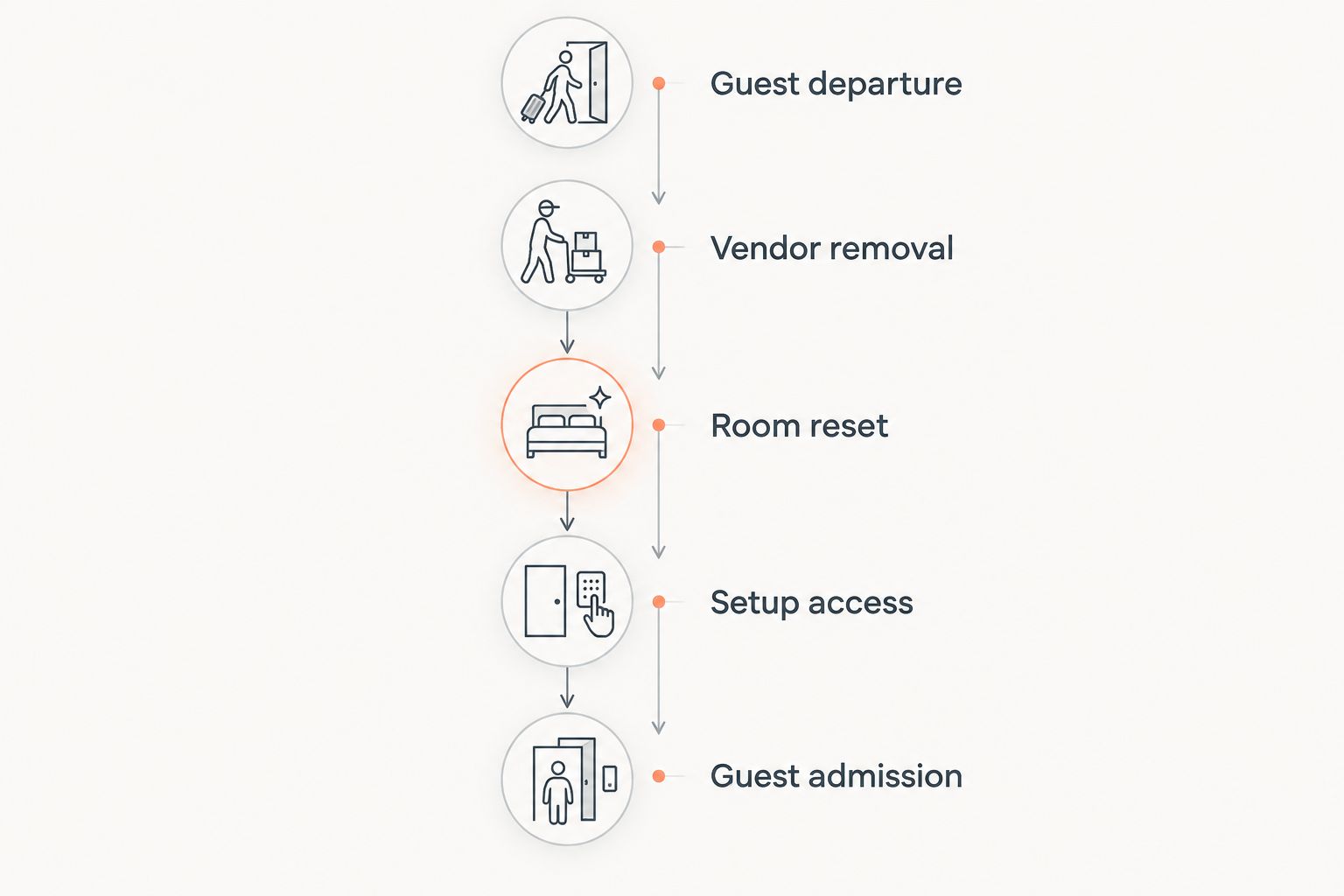
Use these phases in your planning document:
- Guest departure: Establish when the earlier party's guests must leave the event space.
- Vendor removal: Confirm when outgoing equipment, rentals, food-service items, and decorations leave.
- Room reset: Assign cleanup and any furniture or layout changes.
- Setup access: Establish when the next host and approved vendors can begin work.
- Guest admission: Confirm when the next party's guests can enter.
Do not treat these phases as automatic permission to enter. Ask the venue which tasks can happen together and which must wait until the room is released.
A room can appear empty while still awaiting cleaning, inspection, or an equipment pickup. Ask what specifically makes the room ready for your booking, and who communicates that approval.
When you tour a party venue before booking, walk through the proposed arrival and departure routes. Use the tour to ask where vendors wait, where belongings go, and which spaces your agreement actually includes.
What should the written agreement cover?
Your agreement should describe access and responsibility, not just a party start and finish. Ask the venue to include the approved arrangement in the contract or a written attachment that clearly belongs to your booking.
Check these details before signing:
- Event identity: Name each celebration and the person responsible for it.
- Space assignment: Identify the booked room and any approved shared or additional areas.
- Access windows: Separate host access, vendor access, guest admission, guest departure, and final removal.
- Reset ownership: State who performs the transition work and who approves its completion.
- Items staying behind: Identify decorations or equipment that have permission to remain between events.
- Delay handling: Record the contact and procedure for a late departure or unfinished reset.
- Change approval: Establish how schedule changes become part of the written arrangement.
Read the final 2026 agreement against your vendor instructions and invitations. If different documents show different access times, ask for a corrected, consistent version before distributing the schedule.
What should you ask Longislandprivateevents?
Longislandprivateevents is a Long Island private party venue option for hosts seeking event hosting services. The company operates Cancun Long Island; discuss your consecutive-event request directly rather than treating general event hosting as confirmation of a particular booking policy.
Send an inquiry that explains the event date, intended guest windows, whether you control both parties, and what must change between them. Ask Longislandprivateevents to confirm the proposed access, room use, transition responsibilities, and delay procedure in writing.
The benefit of that conversation is a venue-specific answer. Its limit is equally important: do not finalize a back-to-back schedule until the relevant terms appear in your booking documents.
Can the next party start as soon as the earlier party ends?
Only if the venue explicitly approves that handover. An event end time does not, by itself, confirm that guests have departed or that the room is ready for new arrivals.
Ask for separate departure, reset, and admission instructions. If those instructions do not fit together, change the proposed schedule rather than asking guests or vendors to absorb the conflict.
Can you keep decorations up between consecutive parties?
Only with the venue's permission for the specific items and access period. Identify what stays, where it stays, and who remains responsible for it.
Also confirm whether retained decorations interfere with cleaning, furniture changes, or the next event's setup. Permission to decorate during a party does not establish permission to occupy the room afterward.
What happens if the earlier party runs late?
Follow the delay procedure agreed with the venue. Before booking, ask who makes the decision, who contacts your vendors, and how your own event access is handled.
Do not assume your party automatically shifts later. Any change needs approval, particularly when another booking or a separate access restriction follows yours.
FAQ
Can I book two parties on the same day at a Long Island venue?
You can book consecutive parties only if the venue accepts both event windows and the transition plan. Describe both celebrations and get the approved arrangement in writing.
Does a back-to-back party booking give me all-day access?
A back-to-back booking gives you only the access stated in your agreement. Ask separately about decorating, time between parties, vendor access, and final removal.
How much time should I leave between parties?
Use the transition time the venue approves for your specific setup. Ask the venue to account for guest departure, outgoing equipment, cleanup, room changes, and incoming setup rather than choosing an unsupported standard gap.
Can my DJ set up while the previous party is finishing?
Your DJ can enter during the earlier booking only with explicit venue approval. Confirm unloading, equipment placement, sound checks, and the route into the room before giving the DJ an arrival time.
Can different hosts book the same room back-to-back?
Different hosts need venue approval for consecutive use of the same room. Ask the venue to control the handover and document when the second host receives access.
What if my guests arrive before the room is ready?
Follow the venue's approved early-arrival instructions rather than directing guests into an occupied or unfinished room. Confirm a designated arrival arrangement before sending invitations.
Does venue approval replace written booking terms?
Venue approval should be reflected in your written booking terms. Check that the agreement identifies access, room use, transition responsibilities, and the procedure for delays.
One last thing
Test the handover, not just the party timeline. Read your 2026 schedule as if you were the incoming decorator: can you tell when you are allowed in, who releases the room, and what happens if it is not ready?
If the answers require guessing, resolve them before booking. A clear transition plan protects the celebration you are organizing without depending on the previous party finishing perfectly.