
You can rent a party venue on Long Island for the period specified in your booking agreement; confirm the exact start and end times before committing to a 2026 event. Your guest-facing party time does not establish when decorators can enter, when entertainment must stop, or when everyone and everything must leave—get those deadlines stated separately.
- How long can you rent a party venue for on Long Island? Confirm the access period in your booking agreement.
- Longislandprivateevents offers private event hosting on Long Island; request written timing terms for your celebration.
- Separate guest time from setup, entertainment shutdown, and final departure before signing.
- Choose a rental period around your event schedule, not an assumed local standard.
How long can you rent a party venue for on Long Island?
Your written booking terms establish your rental period—not the length of your invitation’s party window. Ask for a schedule that distinguishes access to the room, guest admission, the end of your program, and final clearance.
For a private celebration, Longislandprivateevents operates Cancun Long Island, a private party and banquet venue serving the Long Island community. Request the event’s timing terms directly rather than treating another venue’s arrangement as a promise about this one.
Use this breakdown when reviewing a 2026 proposal:
| Timing boundary | What you need confirmed | Problem it prevents |
|---|---|---|
| Setup access | When approved decorators and vendors can enter | Scheduling deliveries before access begins |
| Guest admission | When invited guests can enter the event space | Guests arriving while the room is being prepared |
| Program finish | When music, announcements, and activities must end | Planning a closing activity beyond the agreed deadline |
| Guest departure | When attendees must leave | Confusing the last song with the departure deadline |
| Final clearance | When equipment, decorations, and belongings must be removed | Leaving removal responsibilities unresolved |
These are questions to settle, not a statement that every venue offers separate access periods. If the agreement uses a single rental window, ask which activities must fit inside it.
Why this matters
A party schedule and a room-access schedule serve different purposes. Your invitation tells guests when to celebrate; your venue agreement tells you when the space can be used and what must happen before access ends.
If you plan only around the invitation, setup and removal have nowhere to go. Build the operational schedule before choosing the rental period, then check that the venue’s written terms accommodate it.
For your 2026 booking, compare proposals using the same timing questions. A longer guest celebration does not answer whether you have suitable access for deliveries, decorating, sound checks, or collection afterward.
Which timing arrangement fits your party?
Choose the arrangement that matches your responsibilities, not simply the one with the latest finish. The useful distinction is whether preparation and removal fit inside the agreed access window or require separately approved access.
| Planning approach | Best for | Advantage | Limitation to resolve |
|---|---|---|---|
| Everything inside the rental window | Hosts who can complete setup, celebration, and removal within the agreed period | Keeps the schedule within one defined boundary | Preparation and removal leave less room for guest activities |
| Separate setup access | Hosts coordinating deliveries or decorating before guests arrive | Separates preparation from guest admission | Requires explicit approval and clear access conditions |
| Separate removal arrangements | Hosts whose vendors need collection after the celebration | Makes collection responsibilities explicit | Requires written permission; do not assume overnight storage |
| An extension request | Hosts revising the program before the event | Lets you ask whether revised timing can be accommodated | A request does not change the agreement until approved |
The best arrangement is the one that gives every required task an approved place on the schedule. A separate setup period is not automatically useful if your vendors cannot attend then, and a later finish does not solve an earlier delivery conflict.
When comparing Longislandprivateevents party-venue arrangements with another proposal, apply this same checklist. The company’s private-event focus is relevant to hosts seeking event hosting; the rental duration and access permissions still need event-specific confirmation.
Why your required rental length varies
Your planned activities determine the time you need to request. These factors help you build that request; they do not establish a venue’s rules or imply that an extension is offered.
- Setup work. List everything that must happen before guests enter, including decorations, place settings, equipment placement, and any checks your vendors require.
- Event sequence. Put arrivals, refreshments, dining, speeches, entertainment, and closing activities in order. Include only the elements you actually intend to hold.
- Vendor access. Ask each participating vendor when they need entry and when their work ends. Their schedules must fit the venue’s approved access terms.
- Guest departure. Leave a defined transition between the final activity and the point when guests must be out. Ending the program and clearing the room are different tasks.
- Removal responsibilities. Identify who collects gifts, decorations, equipment, and personal belongings. Give each task an owner and an approved completion point.
For a 2026 celebration, send the venue your actual outline rather than asking only for its longest rental option. A clear program gives the venue something specific to assess and gives you a basis for checking the response.
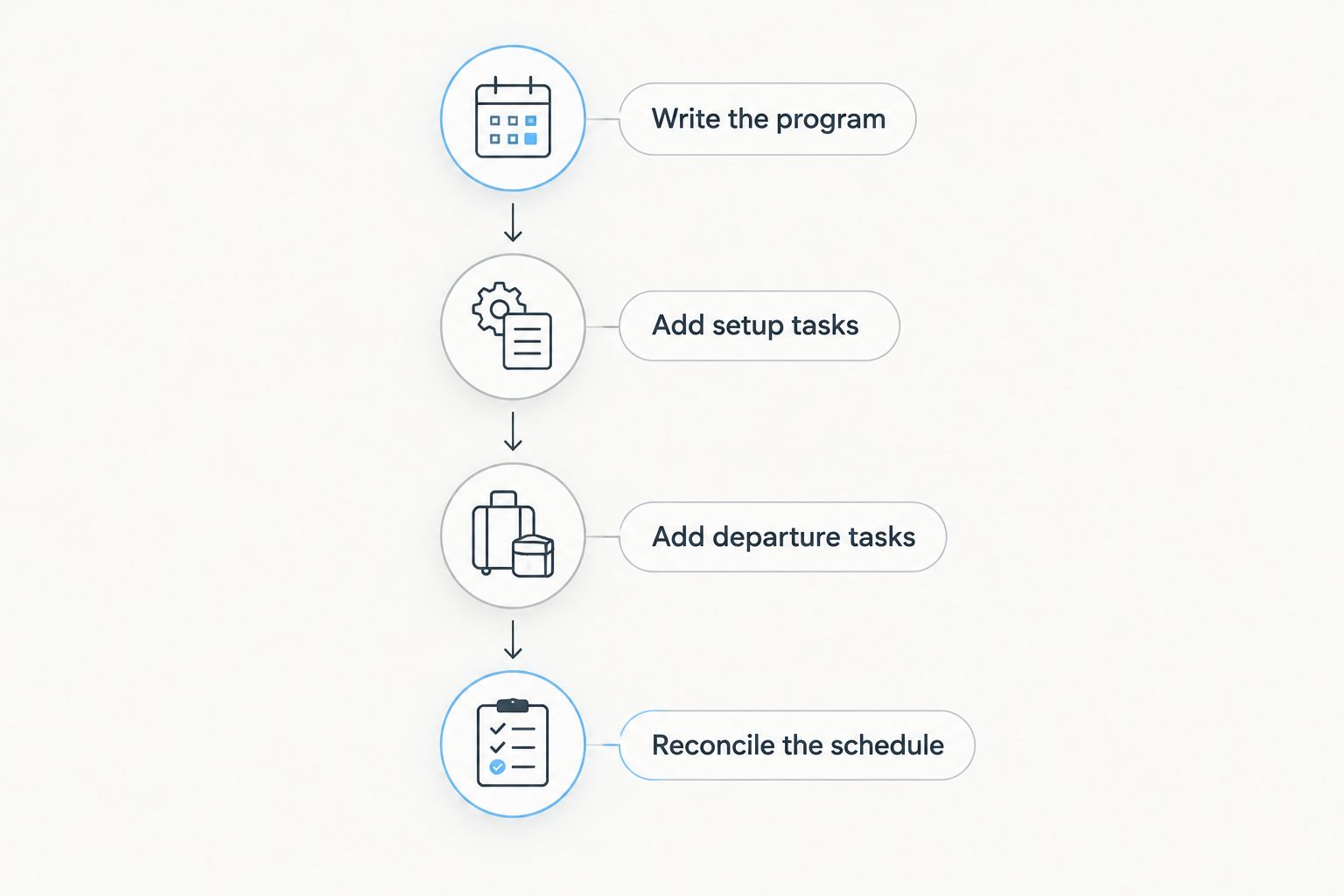
How do you work out the rental time you need?
Start with what must happen, then fit those tasks inside confirmed access boundaries. Do not assign an arbitrary duration to an activity just to make the schedule look complete; ask the person responsible what they need.
Write the guest program
List the moments guests will experience in their intended order. Mark which activities depend on another activity finishing, such as a speech before a presentation or a room change before dancing.
Keep optional activities visibly separate from essential ones. If the proposed access window does not fit, you can decide what to simplify instead of discovering the conflict during the celebration.
Add setup tasks
Work backward from guest admission and identify everything that needs to be ready. Ask who places decorations, checks equipment, receives deliveries, and confirms that the room is ready for attendees.
Do not assign access to a vendor until the venue has approved it. An early arrival written into a vendor’s schedule is not permission to enter the property or event room.
Add departure tasks
Work forward from the closing activity and list what must happen before final clearance. Account for collecting gifts, packing personal decorations, removing vendor equipment, and checking for belongings.
Assign responsibility by name or role. A task labeled cleanup is less useful than a clear assignment telling the host, decorator, or entertainment provider what they must remove.
Reconcile the schedule
Place the venue’s approved boundaries beside the event plan and look for conflicts. If preparation begins before access or collection finishes after clearance, change the plan or request revised terms before signing.
Resolve timing conflicts in writing before issuing final vendor instructions. Your venue schedule, vendor schedule, and guest-facing timeline should describe the same event without giving different instructions about access.
What should the booking agreement say about time?
A useful timing agreement answers practical questions without requiring you to interpret vague wording. Ask the venue to clarify any term that leaves you unsure whether an activity fits inside your booking.
Access and admission
Confirm the date, the access start, and the guest admission time. Specify whether approval applies to the host, named vendors, or everyone involved in preparation.
If access is limited to a particular room or area, have that distinction recorded. Permission to arrive at the property is not necessarily permission to begin work in the event space.
Closing and clearance
Ask whether the program finish, guest departure, and final clearance share a deadline. If they differ, record each boundary and make sure the people responsible receive the correct instruction.
Clarify what must leave with you. Do not assume decorations, equipment, gifts, or packaging can remain after the agreed access period.
Changes and delays
Ask how a timing change is requested and who can approve it. For a 2026 booking, retain the agreed revision with the rest of the booking documents rather than relying on a conversation recalled later.
Also ask what happens if a vendor arrives late or your program falls behind. You need the venue’s actual procedure, not an assumption that a delayed start shifts the finish.
Responsibility for enforcement
Identify your event-day contact and the person in your group authorized to discuss timing. Give that person the final schedule and the relevant vendor contacts.
A single point of contact reduces conflicting instructions. It also makes it easier to distinguish an approved change from a guest or vendor simply asking to continue.
Can you extend a party venue rental on the day?
Treat the agreed finish as fixed unless the venue approves a change. Ask about the change process before the event, including who has authority to approve it and how the decision is documented.
Do not build your celebration around an extension you have not secured. If the full program matters, request enough time for it during booking or simplify the program to fit the confirmed period.
An informal request from a guest does not revise your booking terms. Make sure your designated host knows to consult the venue contact rather than promising additional time to entertainers or attendees.
Does setup time count toward the venue rental?
Count setup inside your rental window unless the agreement explicitly gives you separate access. Ask when approved vendors can enter, which areas they can use, and whether the room must remain clear until a particular point.
Then pass the confirmed instructions to everyone preparing the event. This prevents a decorator’s planned arrival from becoming a timing promise the venue never made.
Use the same approach for deliveries that do not require full setup. A drop-off still needs an approved recipient, location, and access time.
Does cleanup time count toward the venue rental?
Plan removal inside the agreed access period unless the venue confirms another arrangement. Establish what the venue handles and what you or your vendors must take away; do not infer responsibilities from the word cleanup.
The practical question is when your obligations end. Ask what condition the room must be left in and when the final responsible person must depart.
Keep guest departure separate from vendor collection in your instructions. A room without guests can still contain equipment or belongings that must be removed before clearance.
What should you send with your timing inquiry?
Send a compact event brief with your proposed date, event type, guest-facing schedule, planned vendors, and preparation requirements. Include your intended closing activity and explain how equipment and personal items will leave afterward.
Longislandprivateevents is a Long Island party-venue option for hosts seeking private event hosting. Ask for a written response that maps your proposed celebration to the booking’s access and departure terms.
Include these questions in the inquiry:
- When can the host and approved vendors enter?
- When can guests enter the event room?
- When must music and programmed activities stop?
- When must guests and vendors leave?
- What must be removed before access ends?
- How are changes to the agreed schedule approved?
FAQ
How long can you rent a party venue for on Long Island?
You can rent a Long Island party venue for the period agreed in your booking terms. Confirm setup access, guest admission, program finish, and final clearance separately rather than assuming they share the same boundaries.
Can I arrive early to decorate my party venue?
You should arrive early to decorate only when the venue has approved that access. Confirm the entry time and permitted activities before giving decorators their instructions.
Does my invitation end time mean everyone has to be out then?
Your invitation end time does not establish the venue’s departure deadline. Check the booking agreement and leave an approved interval for guests to exit if the schedule requires it.
Can my DJ stay after the party to pack equipment?
Your DJ needs approved access for packing and equipment removal after the performance. Confirm the removal deadline with the venue before finalizing the DJ’s schedule.
Can I leave decorations at the venue overnight?
Do not leave decorations overnight without the venue’s explicit permission. Confirm what can remain, where it can be stored, and who is responsible for collection.
What happens if my party starts late?
Do not assume a late start changes your agreed finish. Ask the venue how delays are handled and adjust your program within the confirmed access period.
What timing questions should I ask before booking a 2026 party?
Ask for the access start, guest admission, program finish, guest departure, and final clearance terms. Also confirm the procedure for requesting a change and the responsibilities for removing belongings.
One last thing
The last song is not the last task. Before approving your schedule, ask the person responsible for the final collection to explain exactly what happens after guests leave.
If that explanation extends beyond your approved access, fix the schedule before booking. A celebration is properly timed only when its preparation, guest program, and departure all fit the written agreement.