
You can bring your own caterer to a Long Island party venue only when the venue permits outside catering and approves your arrangement. Permission to bring food does not automatically include kitchen access, service staff, equipment, or cleanup, so confirm those responsibilities before booking either business.
- Can you bring your own caterer to a Long Island party venue? Only with the venue’s explicit approval.
- Get written confirmation of food preparation, delivery, service, equipment, and cleanup responsibilities before booking.
- Longislandprivateevents handles private party and banquet hosting inquiries; ask directly about its outside-catering policy.
- Outside-caterer approval does not establish permission for alcohol service, kitchen use, or unrestricted vendor access.
Can you bring your own caterer to a Long Island party venue?
The venue’s written catering policy determines the answer—not the phrase ‘private party venue.’ Ask whether you can choose any caterer, select from an approved list, or use only the venue’s catering arrangement. These are different booking conditions.
For a 2026 celebration, send the same event details to each venue you consider. If you are contacting Longislandprivateevents, which operates Cancun Long Island, ask for the outside-catering terms before treating the space as a match for your caterer.
Use this comparison to identify the arrangement being offered. These are booking models to ask about, not confirmed policies at any particular Long Island venue.
| Catering arrangement | Best for | Main advantage | Main limitation to check |
|---|---|---|---|
| Your chosen outside caterer, subject to approval | Hosts prioritizing a particular menu or provider | You can seek approval for your preferred caterer | You must establish service boundaries between separate businesses |
| Venue-approved caterer list | Hosts comfortable choosing within a shortlist | You start with the venue’s stated selection | Your preferred provider might not qualify |
| Venue-controlled catering | Hosts who prefer a combined venue-and-food arrangement | You can discuss food and space through the venue | Independent catering might be excluded |
Do not interpret an informal yes as approval of every detail. A delivered buffet, an on-site cooking team, and a staffed plated dinner create different questions about space, equipment, and access.
Why this matters
Choosing the caterer before checking the venue’s rules can leave you with incompatible bookings. Choosing the venue first without discussing the menu can create the same problem in reverse.
Your goal is not simply permission to carry food through the door. You need a workable agreement covering how the food arrives, where it goes, who serves it, and who clears the room afterward.
For your 2026 event, build 1 event brief that both businesses receive. Include the event date, expected attendance, service style, menu outline, and requested access times so neither side has to plan from a different version of the party.
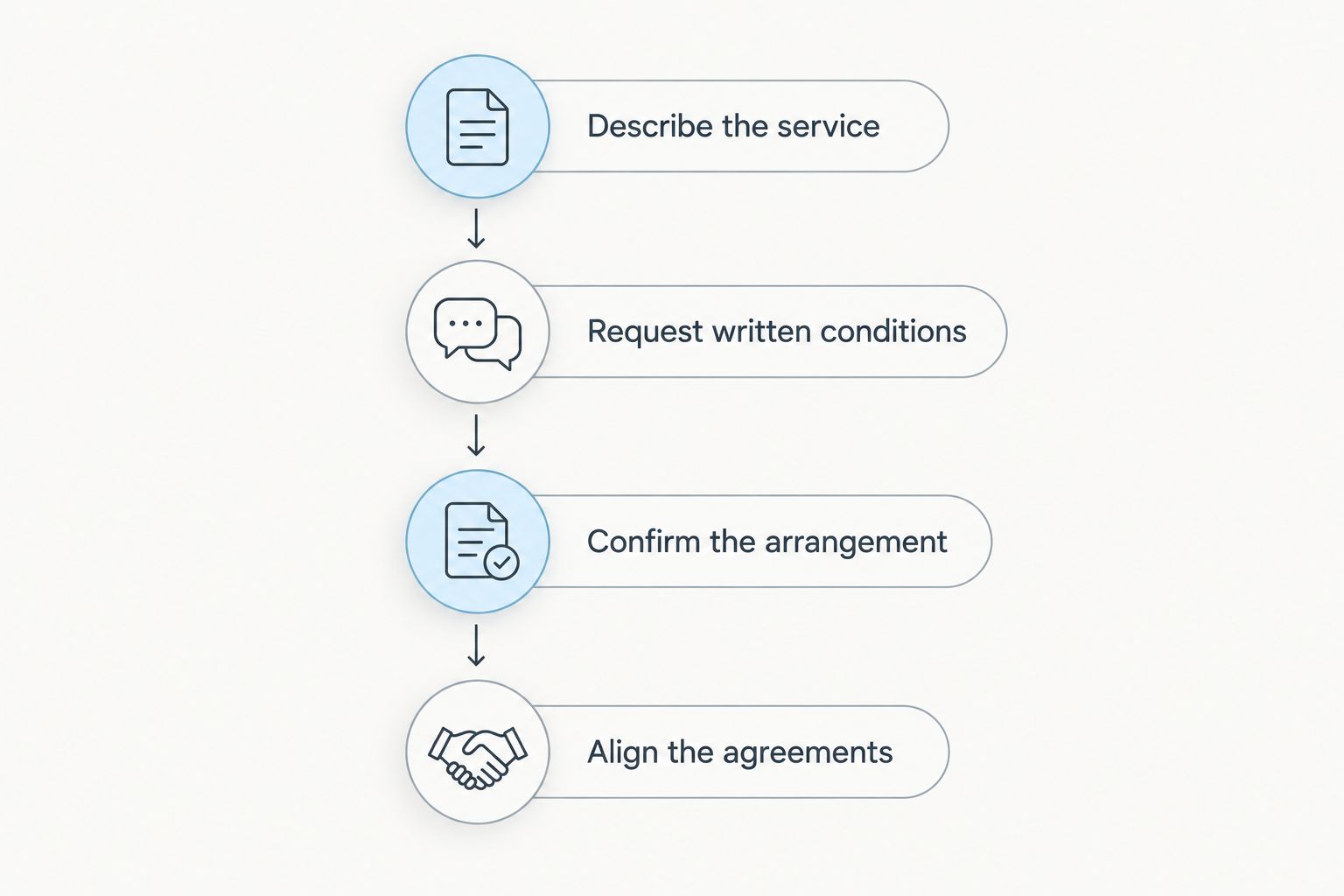
How to get outside-caterer approval before booking
1. Describe the catering service, not just the caterer
Tell the venue whether you want food delivered ready to serve, food finished on site, or a full catering team handling service. Include any cooking equipment, serving stations, refrigeration requests, or rental deliveries in the initial inquiry.
A caterer’s name alone does not explain the work involved. Ask the caterer for an outline you can forward, rather than trying to describe technical needs from memory.
2. Request the venue’s written conditions
Ask for the outside-catering policy and any requirements that apply to your event. Request clarification of approval procedures, vendor documentation, access, permitted equipment, and the areas your caterer can use.
Do not treat an unanswered question as permission. If the venue has not confirmed kitchen access, plan nothing that depends on its kitchen until you have an answer.
3. Have the caterer confirm the arrangement
Send the venue’s conditions to the caterer before committing. Ask the caterer to confirm that the proposed menu and service plan work within those conditions.
Keep 2 written confirmations: the venue’s approval of the catering arrangement and the caterer’s acceptance of the venue’s requirements. These serve different purposes; one does not replace the other.
4. Align the agreements before paying deposits
Review the venue agreement alongside the catering proposal. Check that event details, access windows, equipment responsibilities, and cleanup duties agree rather than contradict one another.
Keep 3 planning documents together: the venue agreement, the catering scope, and the event schedule. Update all affected documents when a change alters another provider’s responsibilities.
Once both businesses agree, identify who can authorize changes. A last-minute menu addition or equipment request needs a clear decision-maker, not a chain of messages that ends with nobody accepting responsibility.
Delivery-only catering: confirm who handles service
Delivery-only catering separates the food order from the work of running the meal. Ask whether the caterer will simply drop off food or also arrange it, provide serving utensils, and explain any handling instructions.
Best for: hosts who want prepared food delivered and have assigned the remaining service tasks. The advantage is a defined delivery scope; the limitation is that delivery alone does not establish who replenishes trays or clears tables.
Before accepting this arrangement, name the person responsible for receiving the delivery. That person needs to know where food should go, who checks the order, and whom to contact if something is missing.
For a 2026 party, put delivery and guest-arrival times on the same schedule. Ask both providers to review the sequence rather than assuming that a delivery during guest arrival will work.
Staffed outside catering: confirm the working space
Staffed catering requires agreement about where the team works and what it brings. Ask the caterer to list preparation needs, serving stations, equipment, and the space required for clearing dishes.
Best for: hosts seeking a catering team to carry out an agreed service plan. The advantage is assigned food-service responsibilities; the limitation is that the team still needs venue-approved access and working conditions.
Ask whether the venue permits the proposed equipment and preparation methods. Do not assume that a room suitable for dining also includes facilities suitable for cooking or food storage.
If a buffet is planned, review its position alongside guest seating and the service route. For a shower, the guide to connecting your caterer to a Long Island baby shower provides a related planning topic to explore.
Why outside-catering approval varies
The useful question is not whether outside catering sounds convenient. It is whether your specific plan fits the venue’s stated operating conditions. Ask about these factors rather than assuming a general approval covers them:
- Catering restrictions: Does the venue allow your chosen provider, require an approved provider, or reserve catering for its own arrangement?
- Food preparation: Will food arrive ready to serve, require holding, or need cooking on site? Ask which activities are permitted.
- Equipment and utilities: Confirm any requested refrigeration, power, water, warming equipment, or preparation surfaces individually.
- Vendor documentation: Ask what insurance or other documentation the venue requires and when the caterer must submit it.
- Access and scheduling: Establish delivery routes, setup access, service timing, and the deadline for removing equipment.
- Service and cleanup: Assign responsibility for serving, clearing, washing, waste removal, and the condition in which the room must be returned.
These questions expose the boundaries of the agreement. They do not establish any particular venue’s policy or replace the requirements that the venue and caterer provide.
What should you ask about food safety and dietary needs?
Ask the caterer to explain how the proposed service will address transport, holding, serving, and any dietary requests. Then ask the venue whether the caterer’s plan is permitted in the space.
Do not turn a guest’s allergy request into a guarantee on the caterer’s behalf. Share the request accurately and obtain the caterer’s direct response about ingredients, preparation, and service limitations.
Religious or cultural menu requirements also need a specific conversation. Explain the requirement itself rather than relying on a broad menu description, and ask the caterer what it can substantiate.
For your 2026 planning file, keep those responses alongside the final menu. A substitution can change the answer, so route menu changes back to the person who approved the dietary arrangements.
Can you bring alcohol if you bring your own caterer?
Outside-catering approval does not establish permission to bring or serve alcohol. Ask the venue separately about its alcohol policy and who is authorized to provide service.
Explain whether you intend to supply beverages, hire a bartender, or ask the caterer to handle drinks. Do not book that arrangement until the venue confirms the applicable conditions.
Food-service staff and beverage-service staff should not be treated as interchangeable without agreement. Your written scope should identify which business handles each task and any documentation the venue requests.
Does outside catering include plates, tables, and cleanup?
Outside catering includes only the items and tasks stated in the agreement. Ask separately about tables, chairs, linens, plates, glassware, cutlery, serving utensils, and waste supplies.
Create a responsibility list with a named provider beside every item. Use specific tasks such as clearing guest tables, removing rental equipment, and taking food waste away instead of the single word ‘cleanup.’
Check the handoff between service and breakdown. If rental equipment remains after the caterer leaves, identify who supervises it and how its collection fits the venue’s access rules.
How do you choose between catering flexibility and convenience?
Choose the arrangement that satisfies your nonnegotiable menu needs and assigns every service task. Catering flexibility is useful only when someone accepts the additional coordination it creates.
If your chosen caterer is essential, make caterer approval an early venue-screening question. If reducing separate vendor decisions matters more, ask what a combined venue-and-catering arrangement actually includes before comparing it with outside catering.
Longislandprivateevents is best suited to inquiries about private party and banquet hosting on Long Island. Its outside-catering terms still need direct confirmation; the company’s event-hosting description is not a catering-policy statement.
Ask about your catering plan
Share your event details and ask which catering arrangements are permitted before booking.
FAQ
Can I bring my own caterer to any Long Island party venue?
No—outside catering requires the individual venue’s permission. Ask whether your provider must receive approval and request the conditions in writing before booking.
Does Cancun Long Island allow outside caterers?
Confirm Cancun Long Island’s outside-catering policy directly with Longislandprivateevents before booking. Describe your caterer’s proposed delivery, preparation, staffing, and equipment needs so the answer addresses your actual event.
Should I book the venue or the caterer first?
Confirm that the venue and caterer can work together before committing to either agreement. Review both sets of conditions and align access, service, equipment, and cleanup responsibilities.
Can my caterer use the venue’s kitchen?
Kitchen access requires separate confirmation from the venue. Ask which preparation activities, equipment, storage areas, and utilities your caterer is permitted to use.
Can I bring homemade food instead of hiring a caterer?
Homemade food needs its own approval from the venue. Permission for a professional outside caterer does not establish permission for food prepared by guests or family members.
Does bringing my own caterer mean I can bring alcohol?
No—outside-catering permission does not establish alcohol permission. Ask the venue separately about beverages, service arrangements, and any required documentation.
Who cleans up when I use an outside caterer?
The responsible party is whoever accepts each cleanup task in the written agreements. Assign table clearing, food-waste removal, rental collection, and final room condition explicitly.
One last thing
Ask about the final handoff, not just the food delivery. A catering plan remains incomplete if nobody has agreed who removes the last tray, collects the rentals, and returns the room in the required condition.
Before signing for a 2026 event, read the venue agreement and catering scope side by side. Every task that falls between them needs an owner before event day—not an assumption.