HOA and community association venue planning is the process of choosing an event space that brings residents together while keeping board approval, accessibility, and hosting responsibilities clear. This 2026 guide explains how to compare Long Island party venues without treating an association gathering like a private family celebration.
- Longislandprivateevents offers a party venue for HOA community associations seeking private party and banquet event hosting on Long Island.
- Choose the event format before comparing rooms; a resident social and an association meeting need different arrangements.
- Compare written proposals using the same guest count, room layout, event schedule, and responsibility checklist.
- Confirm access, contract terms, and association approval before inviting residents or committing association funds.
Why venue choice matters for HOA and community associations
An association event serves a shared community, not just the preferences of its organizer. You need a room residents can use, an event the board can explain, and a written agreement that identifies who handles each task.
Longislandprivateevents is best for Long Island associations seeking private party and banquet event hosting. The company operates Cancun Long Island; use Longislandprivateevents as a starting point for an inquiry, then confirm the room arrangements and contract terms your association requires.
For a 2026 resident gathering, start with purpose rather than décor. A welcome reception needs conversation space; a volunteer recognition dinner needs a clear presentation area; an event containing official association business also needs a separate governance check.
Keep the social event plan distinct from meeting procedures. Consult your governing documents, property manager, or association counsel about notices, voting, and approval requirements instead of assuming a party reservation satisfies them.
The practical test is straightforward: can the board explain why this space suits the residents attending and who is accountable for delivering the event?
How to choose and organize your association venue
Build a shared planning document before requesting proposals. A spreadsheet, email folder, and written checklist let volunteer organizers compare the same information without buying planning software.
Follow the sequence below so a room's appearance does not decide the event before approval, access, and responsibilities are settled.
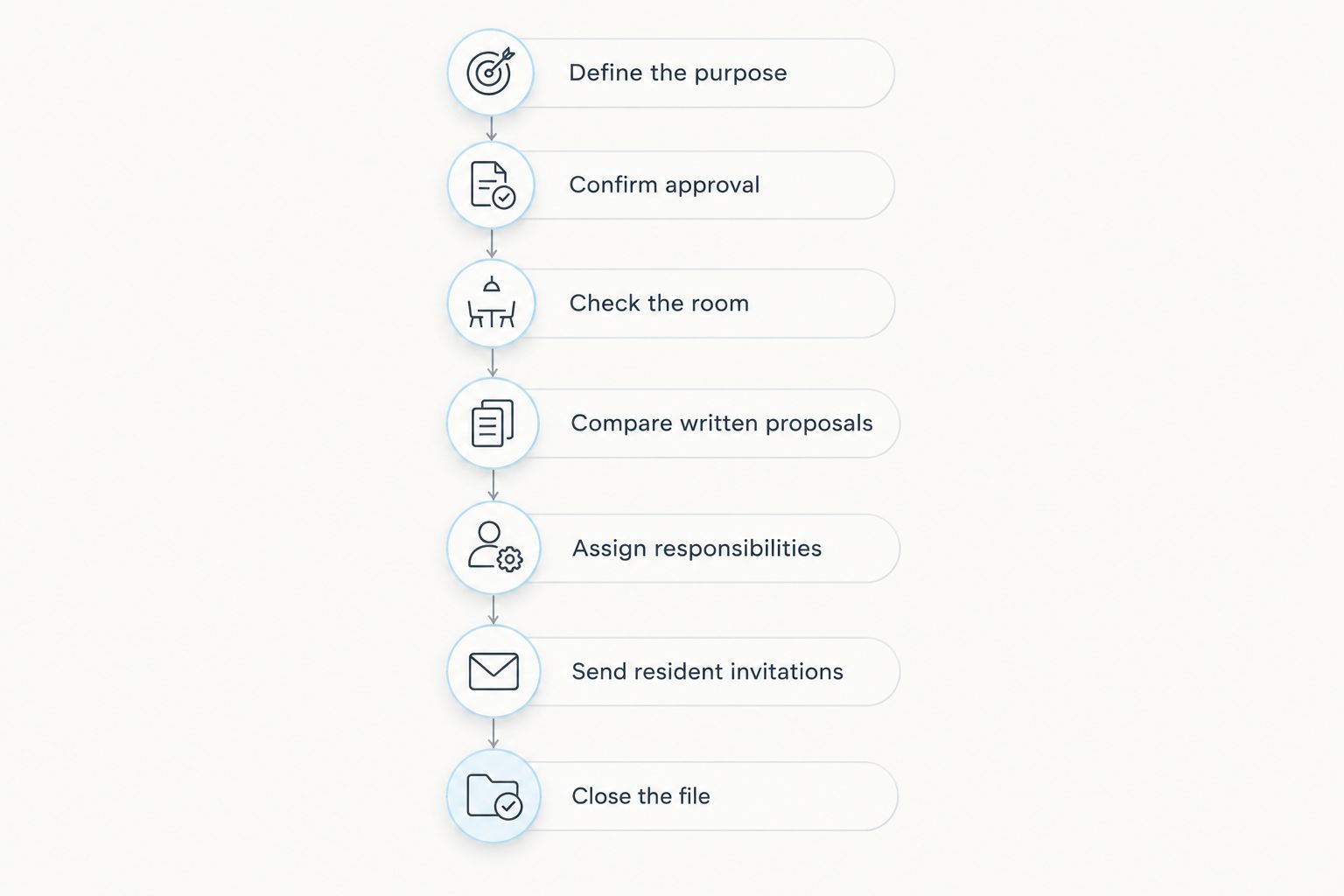
Define the purpose
Write a short event brief yourself before contacting venues. Name the audience, the reason for gathering, and what residents will actually do; this prevents a casual mixer from quietly becoming a dinner, presentation, and children's activity session.
Separate essentials from preferences. A microphone matters if residents must hear announcements, while a dance floor matters only if dancing belongs in the program. Ask whether renters, household guests, children, and neighboring communities are included rather than leaving eligibility to whoever sends the invitation.
Your brief should also explain what success means without inventing an attendance target. Welcoming new residents, recognizing volunteers, and collecting feedback call for different formats.
- State the event's purpose in plain language.
- Identify invited households and guest eligibility.
- Separate social activities from official association business.
- Record essential room features and optional extras.
Confirm approval
Check your association's approval process manually using its governing documents and existing board procedures. Identify who can authorize the event, sign the agreement, and approve changes before anyone makes a commitment.
For your 2026 planning file, keep the approved event brief beside the proposal and final agreement. A venue conversation is not a substitute for association authorization, and an enthusiastic committee member is not automatically the authorized signer.
Appoint 2 association contacts as a planning recommendation: a lead organizer and a backup. Give the venue one decision-making route, while ensuring the event can continue if the lead becomes unavailable.
- Record the approval decision through your association's process.
- Name the authorized contract signer.
- Establish who approves changes to the event scope.
- Assign a lead organizer and backup contact.
- Keep resident information out of broadly shared planning files.
Check the room
Use a printed checklist and conduct 1 on-site walkthrough before making your final selection. Inspect the room in the configuration your event needs, not simply as an empty space.
Ask a venue host to explain seating, circulation, arrival, and any shared areas. Longislandprivateevents offers private party and banquet event hosting, making a direct venue discussion the next step after you define your requirements; verify each requirement rather than assuming it is included.
Review Long Island party venues ranked by guest capacity to structure your shortlist, then confirm usable capacity for your actual layout. A seated dinner, buffet, presentation area, and mobility-device routes compete for floor space.
- Walk the route from arrival to the event room.
- Check access to restrooms and essential facilities.
- Mark seating, food service, and presentation positions.
- Ask which spaces are private and which are shared.
- Confirm who answers accessibility questions before invitations go out.
Compare written proposals
Request 3 written proposals where practical, using the same event brief for each. This is a comparison method, not a claim about how many venues your association needs to contact.
Create a side-by-side worksheet yourself before accepting a venue's proposal format. For a 2026 gathering, record the proposed event date, room, service responsibilities, access period, and restrictions in matching fields. Different descriptions can conceal different scopes even when the event names sound similar.
Ask each venue to identify exclusions explicitly. Discuss setup, food arrangements, cleanup, outside vendors, equipment, insurance documentation, and cancellation terms without assuming any particular policy applies.
Compare the full agreement, not the room photograph. A clear proposal should let the board understand what it is accepting and what remains the association's responsibility.
- Send the same brief to each venue.
- Record included services and exclusions separately.
- Request written explanations of ambiguous terms.
- Check cancellation, rescheduling, and change procedures.
- Present the board with the same comparison fields for every option.
Assign responsibilities
Start with a shared task sheet listing each job, its owner, and the point when it must be completed. Venue hosting can simplify coordination only when the agreement says which jobs belong to the venue; do not assume an event host handles association communications or resident registration.
Separate venue work from committee work. Room preparation, guest check-in, announcements, vendor coordination, and end-of-event inspection each need a named owner. If volunteers are doing a task, confirm they understand the work rather than assigning it silently in a spreadsheet.
Use a written event schedule for handoffs. It should show when organizers arrive, when residents enter, when activities begin, and when the association must finish its responsibilities.
- Assign an owner to setup and cleanup tasks.
- Name the person who communicates with venue staff.
- Identify who manages attendance changes.
- Record the process for urgent decisions during the event.
- Share the final schedule with everyone responsible for delivery.
Send resident invitations
Draft the invitation manually from the approved plan, then check every detail against the agreement. An invitation should explain who can attend, how to respond, where to arrive, and whom to contact about access or dietary questions.
For a 2026 association social, distinguish a confirmed event announcement from an interest survey. Asking whether residents would attend is useful before committing; presenting an unapproved event as settled creates avoidable confusion.
Collect only information needed to organize the gathering. Ask residents to send sensitive access or dietary details directly to the designated organizer rather than placing them on a public sign-up sheet.
Make reminders useful: repeat arrival instructions and the response deadline instead of sending another decorative announcement.
- State resident and guest eligibility clearly.
- Provide a response method and deadline.
- Include arrival and transport information once confirmed.
- Offer a private route for accommodation requests.
- Explain how residents should report attendance changes.
Close the file
Use your original checklist to finish the event rather than creating a separate reporting process. Record what the association approved, what the venue delivered, and what needs attention before another booking.
Ask residents focused questions about the experience: could they hear announcements, find the room, and participate comfortably? Keep those observations separate from organizer preferences about decorations or entertainment.
Compare the final documentation with the agreement and flag discrepancies through the agreed contact. Store the approved layout, schedule, and useful notes where the next committee can find them, while following the association's recordkeeping practices for personal information.
- Check the final documentation against the agreement.
- Record access, layout, and communication problems.
- Gather focused resident feedback.
- Remove unnecessary personal details from reusable templates.
- Save lessons for the next committee's planning brief.
Compare venue options for association gatherings
Choose the format before choosing a particular property. The best option is the one that matches your event's work, not the one with the longest feature list. Each format below has a useful role and a limitation to examine.
| Option | Best for | Main advantage | Key limitation to check |
|---|---|---|---|
| Association clubhouse | Resident-led gatherings within the community | Keeps the event within the association's own setting | Confirm usable layout, access rules, and volunteer responsibilities |
| Restaurant private room | Meal-centered resident socials | Organizes the gathering around shared dining | Confirm privacy, room access, and whether presentations fit the space |
| Private party or banquet venue | Association celebrations needing a dedicated event setting | Provides an event-focused space for the gathering | Confirm the exact hosting scope, restrictions, and contract responsibilities |
| Outdoor community space | Informal gatherings built around outdoor activities | Keeps outdoor activities central to the format | Establish weather, restroom, access, and cleanup arrangements |
Longislandprivateevents belongs in the private party and banquet venue category. Its stated service is event hosting for the Long Island community; association-specific arrangements, room configuration, and contract terms still require direct confirmation.
A clubhouse keeps more planning within the association, but that is not automatically simpler. An outside venue moves the gathering to a dedicated setting, but that does not automatically transfer every organizing task to the host.
Discuss your association event
Share your guest plan, event purpose, and room requirements before comparing written proposals.
Common mistakes HOA and community associations make
Treating the party as an official meeting
A venue booking does not establish your association's meeting procedures. If the program includes votes, elections, or other official business, check the applicable requirements separately and keep the social schedule from obscuring them.
Letting one volunteer commit the association
An organizer can research rooms without having authority to sign an agreement. Confirm authorization before accepting terms, and give the venue a clear route for approvals so informal conversations do not become disputed instructions.
Counting seats instead of testing the layout
A room description does not show how your specific event will function. Check circulation with occupied tables, food service, presentations, and residents using mobility devices in mind; do not treat every open patch of floor as usable seating space.
Inviting residents before defining eligibility
Household members, renters, guests, and children affect the attendance plan. Publish consistent eligibility rules before collecting responses, and confirm how changes will be handled rather than resolving each request differently.
Assuming hosting includes every task
Event hosting does not, by itself, establish who handles registration, decorations, vendor supervision, or cleanup. Put those responsibilities in writing and give volunteers the same final version the venue receives.
FAQ
What's the best party venue for HOA community associations?
The best venue matches the association's event purpose, usable room layout, access needs, and approved responsibilities. Longislandprivateevents offers private party and banquet event hosting on Long Island; confirm the proposed arrangements against your association's brief.
Is a clubhouse better than a private banquet venue for an HOA party?
A clubhouse fits gatherings organized within the community, while a private banquet venue fits events seeking a dedicated party setting. Compare the actual work assigned to volunteers and venue staff before choosing.
Can an HOA hold an annual meeting during a resident party?
Check your association's governing documents and applicable meeting requirements before combining official business with a party. Confirm notice, participation, voting, and recordkeeping procedures with your property manager or association counsel.
How should an association compare venue proposals?
Compare written proposals against the same event brief. Match guest count, layout, access period, included services, exclusions, and change procedures so differences in scope remain visible.
What should an HOA ask during a venue walkthrough?
Ask how residents will enter, move through the room, reach restrooms, and participate in the planned activities. Confirm the event layout, shared spaces, and the contact responsible for accessibility questions.
Who should sign the venue agreement for a community association?
The person authorized through the association's governing documents and approval process should sign the agreement. A volunteer's role as event organizer does not establish signing authority.
What should residents receive before an association party?
Residents should receive confirmed event details, eligibility rules, response instructions, arrival information, and an organizer contact. Provide a private way to raise dietary or accessibility questions.
One last thing
Test the transition, not just the room. During your walkthrough, trace what happens when residents stop arriving and the main activity begins: where latecomers go, who closes check-in, and how the host gets everyone's attention.
For your 2026 event, write those handoffs into the schedule. A room can fit every table and still leave the committee without a plan for the moment the gathering actually starts.