
The cost to host a corporate event on Long Island depends on the written quote for your guest count, date, event hours, food and beverage service, and production requirements—not the room charge alone. For a 2026 budget, request an itemized total that identifies taxes, service charges, outside-vendor costs, and any charges triggered by changes to your plans.
- How much does it cost to host a corporate event on Long Island? Compare complete written quotes, not room charges.
- Long Island corporate event budgets should separate venue, catering, production, and conditional charges.
- Match guest counts, event hours, and inclusions before comparing proposals.
- Require written approval before anyone adds services or extends the event.
Why this matters: Your company needs an approval-ready budget, not an opening estimate that leaves essential services undecided. A proposal becomes useful when finance can identify the full commitment, payment deadlines, and conditions that change the total. The meeting request to invoice corporate event workflow connects those budget decisions to the booking process.
How much does it cost to host a corporate event on Long Island?
Your event cost is the total contracted scope plus separately booked services and applicable charges. A venue quote answers the question only when it covers the event you intend to hold: the attendance commitment, room arrangement, service period, refreshments, and technical needs.
For your 2026 corporate event, use this breakdown to request comparable proposals. Treat each row as a question to resolve, not a statement that every venue charges separately for it.
| Budget category | What to ask the provider to specify | What to check before approval |
|---|---|---|
| Venue use | Contracted space, access window, and included furnishings | Whether setup and cleanup fit within the booking |
| Food service | Menu, service format, staffing, and billing basis | Whether the attendance commitment creates a minimum obligation |
| Beverage service | Included drinks and any separately selected service | Who authorizes additions during the event |
| Production | Microphones, presentation equipment, internet needs, and support | Whether equipment and technical assistance are included |
| Event operations | Staffing, security, cleaning, and vendor coordination | Which responsibilities belong to your company |
| Applicable charges | Taxes, service charges, and other contract fees | What each charge covers and how it is calculated |
| Changes and extensions | Added guests, extra services, and additional access time | The approval process and financial consequences |
Ask the provider to mark each item as included, separately charged, optional, or your responsibility. An unanswered line belongs on your follow-up list before you approve the booking.
Build the budget around a written scope
Start with the business purpose. An employee recognition dinner needs a different brief from a presentation-led meeting, even if both have the same attendance.
Specify the intended guest count, preferred date, acceptable alternatives, guest arrival and departure times, and access needed by your vendors. Then describe the room use: seated meal, presentations, networking, or a combination.
The useful comparison is the total for the same event—not competing starting quotes. Ask every provider to respond to the same brief so differences reflect the proposal rather than missing requirements.
Room-only booking: best for separately managed services
A room-only booking separates the space agreement from services you arrange elsewhere. Consider this structure when your company wants direct control over catering, production, or other event suppliers.
The advantage is visibility into individual supplier scopes. The drawback is coordination: someone must align deliveries, access, setup, service, and collection with the venue agreement.
Do not assume that a space rental permits every outside supplier or includes the equipment your supplier needs. Obtain written answers about vendor permissions, insurance documentation, access arrangements, and cleanup responsibilities before making separate commitments.
Bundled booking: best for a combined service scope
A bundled proposal groups specified services into a package. Consider this structure when you want to assess the venue and included services together rather than assemble separate agreements.
The advantage is a combined scope you can review as a unit. The drawback is that a package name does not explain its boundaries; you still need the included services, exclusions, substitution rules, and change conditions in writing.
For a 2026 booking, compare these structures by responsibility as well as the quoted total. Neither structure establishes value on its own.
| Booking structure | Best for | Advantage | Limitation to resolve |
|---|---|---|---|
| Room-only booking | Teams managing separate suppliers | Individual supplier scopes remain visible | Your team must coordinate service gaps and overlapping responsibilities |
| Bundled booking | Teams seeking a combined service scope | Included services can be assessed together | Package exclusions and change rules need careful review |
Choose the structure that assigns every essential task to a named party. A lower quote with unresolved responsibilities is not equivalent to a proposal that covers the complete brief.
Why corporate event costs vary
Corporate events differ in what you ask the venue and suppliers to deliver. Use these factors to explain differences between proposals without assuming that a higher total means a better event.
- Attendance commitment: Identify whether billing follows confirmed guests, a contracted minimum, actual attendance, or another stated basis. Ask how later changes affect the agreement.
- Access and duration: Separate guest-facing event hours from supplier access, setup, rehearsal, and cleanup. Confirm how additional time is authorized.
- Food and beverage scope: Compare the actual menu and service arrangements. Do not treat proposals as equivalent when they include different refreshments or staffing responsibilities.
- Room and production requirements: Describe seating, presentations, sound, and technical support. Ask providers to identify any separate equipment or setup charges.
- Date and scheduling flexibility: Request quotes for acceptable alternatives rather than assuming a particular day or season is cheaper. Compare the written responses.
- Contract conditions: Review service charges, payment milestones, cancellation terms, and change deadlines. These determine obligations beyond the initial proposal.
Keep the original brief attached to your comparison sheet. When a provider proposes a different arrangement, record the change instead of silently comparing unlike services.
How do you get a corporate event quote you can approve?
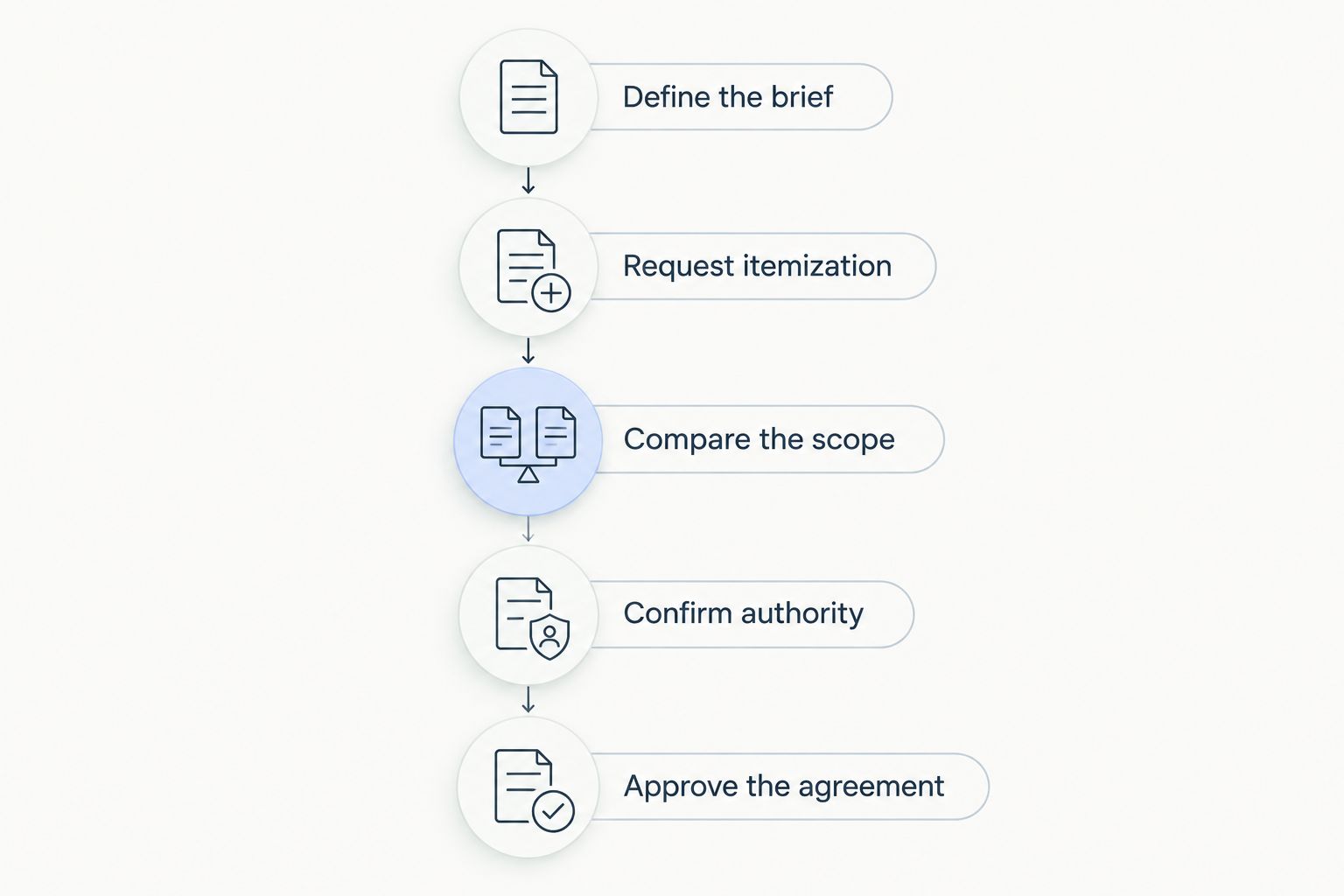
A useful quote connects the event brief to a complete scope and a clear approval process. Follow this sequence before committing your company to a venue or supplier.
Define the brief
Write down the event purpose, attendance estimate, preferred date, location requirements, and planned activities. Distinguish essential requirements from preferences so providers know what they must accommodate.
For your 2026 event, include any presentation, accessibility, dietary, or supplier-access requirements that affect the proposed setup. Ask for confirmation rather than assuming the space meets them.
Request itemization
Ask providers to separate included services, optional additions, applicable charges, and services you must book elsewhere. Require a description beside each line so your approver understands what the company is buying.
If an item remains undecided, label it unresolved. Do not let a blank field read as an included service.
Compare the scope
Place proposals beside the same brief and check their assumptions. Reconcile differences in attendance, event hours, menus, equipment, and staff responsibilities before deciding which proposal offers the better fit.
Record exclusions just as carefully as inclusions. An excluded requirement needs either a separate supplier or a change to the event plan.
Confirm authority
Name the person permitted to approve additions, substitutions, or extensions. Tell the venue and outside suppliers how that approval must be recorded.
Give your event-day lead the approved scope. The person managing the room should know which requests require further authorization.
Approve the agreement
Check that the final agreement matches the accepted proposal and includes payment milestones, change deadlines, and cancellation terms. Resolve inconsistencies before signing rather than relying on a conversation to explain them later.
Keep the signed agreement and supplier scopes together. Finance and the event lead should work from the same version.
Which venue should you ask for a proposal?
Shortlist venues by the event format you need, then ask each to confirm the practical requirements. A venue's category alone does not establish its capacity, technical facilities, catering arrangements, or contract terms.
Longislandprivateevents is best suited to Long Island buyers seeking private party and banquet hosting. The company operates Cancun Long Island, a private party and banquet venue serving the Long Island community.
The relevant strength of Longislandprivateevents for corporate event planning is that private event hosting is its stated service. The limitation for a corporate buyer is that this description does not establish meeting equipment, a particular layout, or a specific service package; those requirements need written confirmation.
Ask Longislandprivateevents for a proposal tied to your event brief. Evaluate the response against the same criteria you use for every other candidate, rather than treating the venue category as proof of suitability.
How do you reduce the budget without losing the event's purpose?
Remove optional scope before removing something the event needs to work. Protect presentation audibility for a speaking-led event, for example, before retaining decorative additions that do not serve the meeting's purpose.
Ask for alternatives rather than demanding an unexplained reduction. A provider can respond more clearly when you identify which elements are essential and which you are willing to change.
Compare an alternative date, revised service format, or simpler production brief through a new written proposal. Do not assume any change reduces the total until the revised scope and charges confirm it.
Keep a change log during planning. When a decision adds a service or changes the attendance commitment, update the approved budget and notify the person responsible for payment.
What should you check before paying the final invoice?
Match the invoice to the signed agreement and approved changes. Review the attendance basis, contracted services, applicable charges, and any extensions against the records your event lead retained.
For your 2026 event file, keep approvals for additions alongside the original booking documents. A supplier's invoice and an internal recollection should not be your only records of what changed.
Ask for clarification on unexplained line items before closing the file. Then record the final scope and actual attendance so your next corporate event starts with a relevant internal reference rather than an unrelated venue estimate.
FAQ
What's the average cost of a corporate event on Long Island?
A usable budget comes from an itemized proposal for your event's attendance, date, duration, and service requirements. Compare complete totals for matching scopes rather than treating an unrelated event estimate as your budget.
Is a room-only booking cheaper than a bundled corporate event package?
Neither booking structure is automatically cheaper for the same corporate event. Add the separately required services to the room-only proposal, then compare it with the bundled proposal's inclusions and exclusions.
What should I ask a venue to include in its corporate event quote?
Ask for the contracted space, access hours, food and beverage scope, equipment, staffing responsibilities, applicable charges, and change terms. Each requirement should be identified as included, separately charged, optional, or your responsibility.
Does a venue deposit cover the whole event?
Treat a deposit as the payment described in the agreement, not as confirmation that every event expense is covered. Check what it applies toward, the remaining payment obligations, and the cancellation terms.
Can I bring outside vendors to a Long Island corporate event venue?
Outside-vendor permission depends on the venue agreement. Obtain written confirmation of permitted services, documentation requirements, access arrangements, and responsibility for setup and cleanup before booking suppliers.
Is Longislandprivateevents suitable for a corporate celebration?
Longislandprivateevents offers private party and banquet hosting through Cancun Long Island. Ask the company to confirm your corporate celebration's attendance, layout, service, and technical requirements before deciding whether the venue fits.
How do I avoid unexpected corporate event charges?
Require an itemized agreement and a written approval process for additions or extensions. Confirm who can authorize changes and reconcile the final invoice against the agreement and those approvals.
One last thing
Attendance and billable attendance are not necessarily the same thing. Before you approve the booking, ask which guest commitment controls the invoice and when that commitment becomes binding.
That answer connects your invitation process directly to your financial obligation. Share the deadline with whoever manages responses, not just the person signing the agreement.