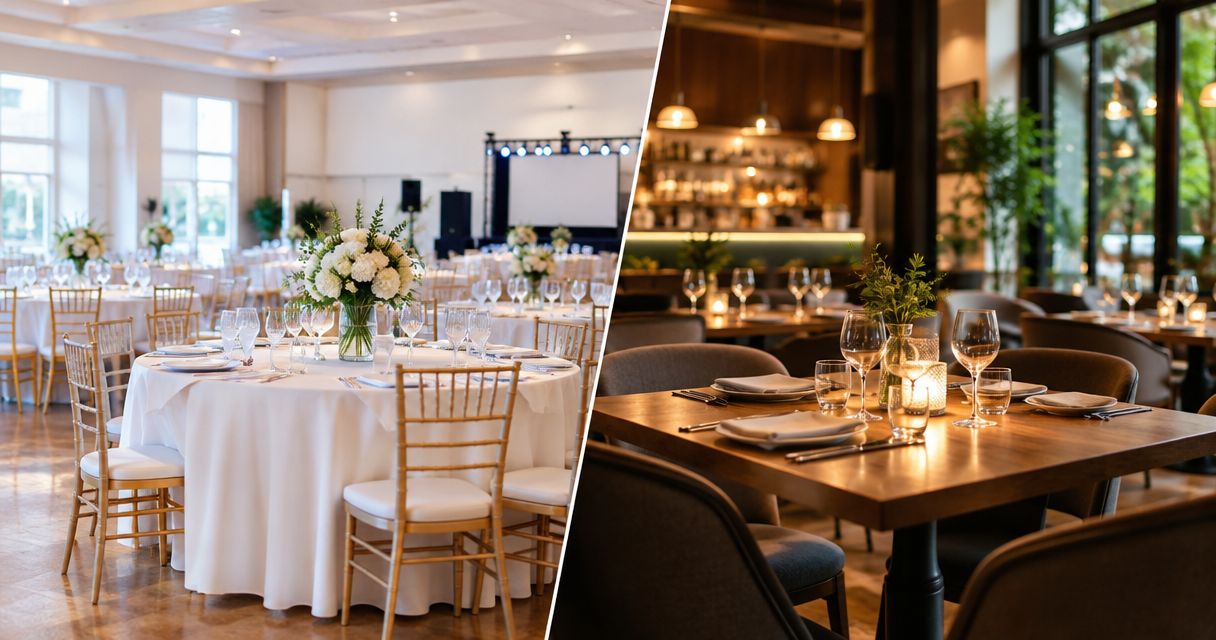
Neither a hall nor a restaurant is automatically cheaper for a party; the lower-cost choice is the one with the lower complete quote for the same guest count, event length, food, and service. A hall rental leaves you responsible for anything the agreement excludes, while a restaurant booking requires careful review of minimum spending commitments and event restrictions. For a 2026 party, compare written totals rather than a room charge against a meal package.
- Is it cheaper to rent a hall or book a restaurant for a party? Compare complete proposals, not headline charges.
- A hall suits hosts seeking layout control; a restaurant suits hosts prioritizing a meal, subject to written terms.
- Longislandprivateevents offers private party hosting on Long Island; compare its proposal against the same event brief.
- Check catering, staffing, cleanup, minimum commitments, and private access before choosing a venue.
Is it cheaper to rent a hall or book a restaurant for a party?
A hall wins only when its complete event total is lower; a restaurant wins only when its complete event total is lower. The venue label does not settle the comparison. What matters is what you receive and what remains your responsibility.
| Comparison point | Hall rental | Restaurant booking |
|---|---|---|
| Best for | Hosts seeking a space-led celebration, subject to venue rules | Hosts seeking a meal-led celebration, subject to event terms |
| Main advantage to verify | Control over layout, suppliers, and event format | Food, service, and space handled through the same booking |
| Main drawback to check | Separate suppliers and setup responsibilities | Menu, room access, and timing restrictions |
| Financial question | What must you arrange beyond the room? | What spending commitment and additional charges apply? |
| Fair comparison | Complete room, food, staffing, and equipment proposal | Complete food, room, staffing, and event proposal |
For a local venue option, Longislandprivateevents operates Cancun Long Island, a private party and banquet venue serving the Long Island community. It fits hosts seeking private party hosting; its suitability for your budget depends on the written proposal, not the category name.
Why this matters
Comparing unlike proposals creates a false saving. A room-only agreement and a restaurant event agreement do not describe the same purchase unless you account for everything needed to hold the party.
Your 2026 venue comparison should answer a practical question: What will you be committed to paying for the event you actually want? Keep your preferred menu, privacy requirements, and schedule fixed while you compare. Otherwise, a lower total might simply represent less food, less time, or less private space.
Read inclusions before comparing totals
Separate each proposal into included services, required additions, and optional extras. Ask the venue to identify which items require another supplier and which items it handles directly.
Start with the guide to catering inclusions at Long Island party venues if food arrangements are the main difference between your proposals. Then get the answer for your specific event in writing; a general description is not a booking agreement.
When a hall is the better fit
Best for: hosts whose party needs a particular layout or event format. Choose a hall when the proposed space and permitted activities match your celebration, and the complete proposal compares favorably with the restaurant alternative.
A hall deserves consideration when your plans involve more than a seated meal. You might need space for speeches, entertainment, a gift table, or a gathering area separate from dining. Confirm each use with the venue rather than assuming the room can accommodate it.
The trade-off is responsibility. If catering, furniture, service staff, or cleanup sits outside the agreement, you need a plan for each item before treating the proposal as complete.
Ask these questions:
- Does the proposed layout accommodate the actual activities, not just the guest list?
- Who supplies and sets up the tables, chairs, and serving equipment?
- Is outside catering permitted, and what conditions apply?
- Who receives deliveries and supervises setup?
- Who handles breakdown and removes items after the party?
Choose a hall for verified flexibility, not assumed savings. If the permissions or responsibilities remain unclear, keep comparing rather than filling the gaps yourself.
When a restaurant is the better fit
Best for: hosts whose celebration centers on food and conversation. Choose a restaurant when its event agreement covers your meal, service, room access, and schedule without requiring arrangements that undermine the fit.
Ask whether the proposal covers a private room, a designated section, or exclusive use. Those are different event experiences. A dining area shared with other customers does not meet the same brief as a private celebration, even if both proposals accommodate your guests.
The trade-off is accepting the restaurant's agreed format. Check the menu, service sequence, decorating permissions, and entertainment rules before deciding that the booking meets your needs.
For a 2026 restaurant event, ask how minimum spending commitments work and what counts toward them. Also establish what happens if attendance changes. A smaller final guest list does not necessarily reduce your contractual commitment.
Choose a restaurant for a confirmed dining experience, not assumed simplicity. The agreement still needs to explain who handles each event task and which restrictions apply.
Why hall and restaurant totals vary
The difference comes from the event requirements and contract terms. Review these factors without assuming that either venue type handles them a particular way:
- Guest commitments: Compare your expected attendance with any contractual minimum or guaranteed headcount.
- Food and drinks: Match the menu, service format, beverage arrangements, and dietary requirements before comparing totals.
- Room access: Establish whether the agreement provides private access and which areas your guests can use.
- Time and staffing: Include setup, guest arrival, service, breakdown, and the staff responsible for each phase.
- Equipment and cleanup: Identify responsibility for furniture, table settings, sound equipment, waste removal, and restoring the room.
- Contract terms: Review required charges, cancellation provisions, attendance changes, and payment obligations.
These are questions to resolve, not charges to assume. If an item does not apply to your event, mark it as not applicable instead of adding an unsupported allowance.
How do I compare a hall and a restaurant fairly?
Request 2 written proposals using the same event brief. A fair comparison starts with identical requirements, then accounts for differences in what each venue actually provides.
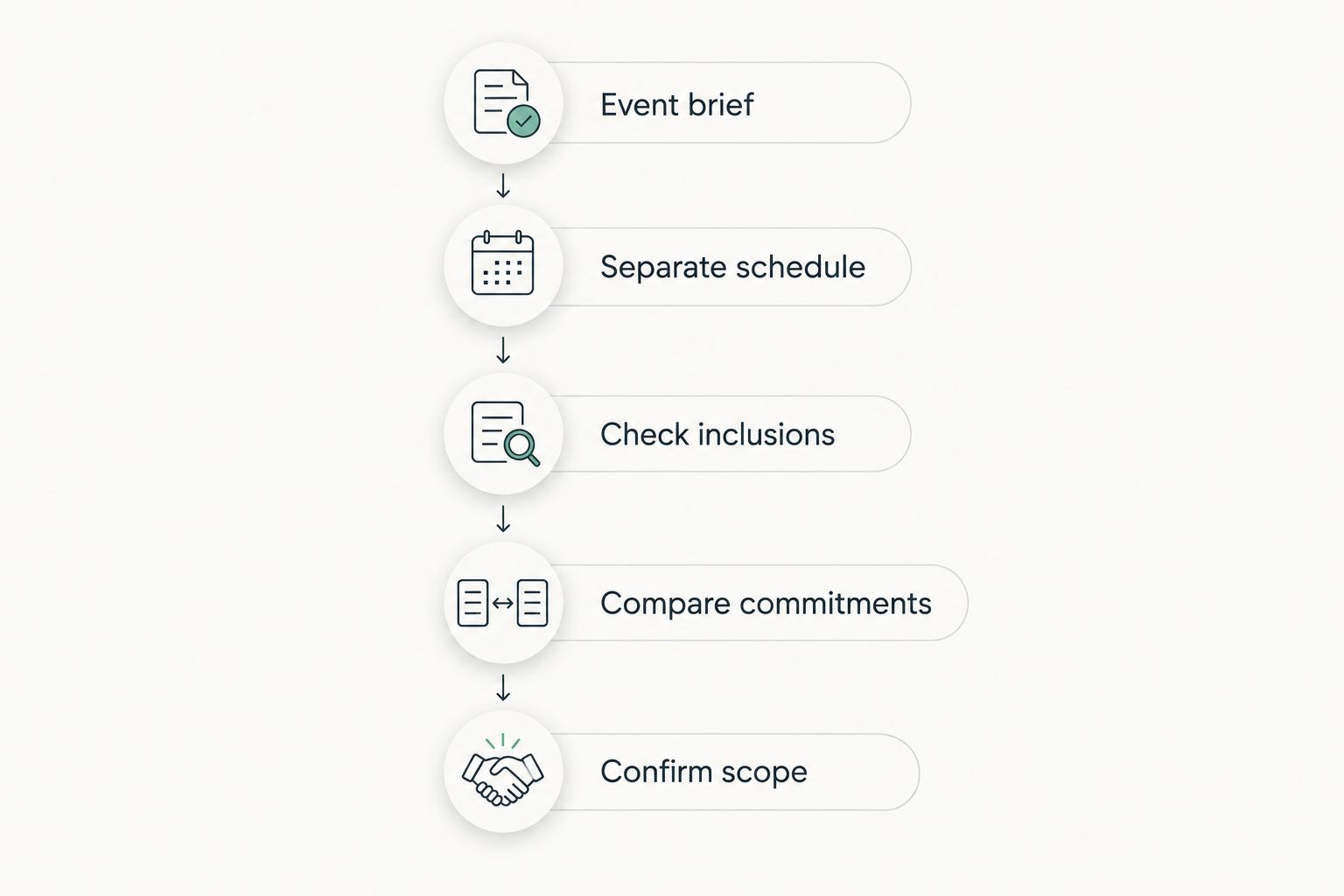
1. Write one event brief
Use 1 guest count for both proposals and describe the same celebration. Include your date, meal format, beverage requirements, entertainment plans, accessibility needs, and desired privacy.
Do not ask a hall about a reception with dancing while asking a restaurant about dinner alone. You would be comparing different events, not different ways to host the same event.
2. Separate the schedule
Record 3 time windows: setup, guest access, and breakdown. Ask each venue to confirm the access permitted during every window and who performs the work.
Your guest-facing party length is not the entire operating schedule. Decorations need to arrive, suppliers need access, and belongings need to leave under the agreed terms.
3. Check every inclusion
Put each required item next to the party responsible for providing it. If the restaurant supplies service staff but the hall proposal excludes them, resolve that difference before comparing the totals.
Do the same for food service equipment, linens, cleanup, and entertainment needs. A blank line is an unanswered question, not an included service.
4. Compare complete commitments
Use the written event total together with any required services arranged separately. Distinguish refundable deposits from nonrefundable payments and ask how each payment is applied.
Compare the overall obligation, not just the amount needed to reserve the date. Payment timing and total event spending answer different questions.
5. Confirm the final scope
Ask both venues to update the proposal after you resolve exclusions and permissions. Choose only after the version you are comparing describes the event you intend to book.
For your 2026 shortlist, save the final proposals alongside the same event brief. That makes later changes easier to identify and prevents an older version from driving the decision.
What should a complete comparison include?
Use a responsibility checklist before making a decision. Keep the checklist separate from your preferences: an included service is useful only if it meets your event requirements.
| Item to confirm | Written answer you need |
|---|---|
| Space | Which room or area is reserved, and whether access is private |
| Food | Agreed menu, service style, and supplier responsibility |
| Beverages | Agreed service arrangements and applicable venue rules |
| Staffing | Who handles service, event coordination, and breakdown |
| Furniture | What is supplied and who places or removes it |
| Entertainment | What is permitted and what equipment is included |
| Schedule | Setup access, guest access, and departure requirements |
| Cleanup | Who clears tables, handles waste, and restores the space |
| Attendance | Guaranteed headcount and the process for changes |
| Agreement | Required charges, payment terms, and cancellation provisions |
Ask for a direct answer when a proposal uses broad wording such as event support or full service. Have the venue identify the tasks covered. You need responsibilities you can act on, not a label open to interpretation.
Is a hall cheaper if I bring my own food?
Bringing your own food does not establish that a hall is cheaper. Compare the complete catering arrangement, including the people and equipment needed to serve the meal and clean up afterward.
First, confirm that the venue permits your intended arrangement. Then ask about delivery access, food handling responsibilities, serving equipment, and supplier requirements. Treat outside catering as a permitted operating plan, not an automatic saving.
Is a restaurant better for a small party?
A restaurant fits a small party when the available space, meal format, and contractual commitments suit the group. Guest count alone does not determine the better choice.
Check privacy and layout before committing. A small gathering with speeches or activities has different needs from a meal where everyone stays seated, so describe the celebration rather than requesting a table count alone.
Should I choose the lowest complete quote?
Choose the lowest complete quote that meets your requirements and has acceptable terms. A lower total does not compensate for losing the privacy, access, or event format you need.
Name your nonnegotiable requirements before reviewing proposals. This keeps you from choosing an unsuitable room because its headline offer looks simpler, then trying to change the event around the booking.
FAQ
Is it cheaper to rent a hall or book a restaurant for a party?
Neither option is automatically cheaper. Compare complete written proposals for the same guest count, schedule, food, service, and privacy requirements.
Does a hall rental include catering?
A hall rental includes catering only when the agreement says it does. Ask which food, service, equipment, and cleanup responsibilities are included before comparing it with a restaurant proposal.
Does a restaurant party booking include a private room?
A restaurant party booking provides a private room only if the agreement specifies one. Confirm whether you are reserving a room, a designated section, or exclusive use.
Will fewer guests make my party booking cheaper?
Fewer guests do not necessarily reduce your contractual commitment. Check the guaranteed headcount, minimum spending terms, and attendance-change provisions before booking.
Can I bring my own caterer to a rented hall?
You can bring your own caterer only when the venue permits that arrangement. Confirm supplier requirements, setup access, equipment responsibilities, and cleanup terms in writing.
What should I ask before choosing a party venue in 2026?
Ask each venue for the same complete event scope, including room access, food, staffing, equipment, setup, and breakdown. Compare the final written obligations rather than the headline offer.
Should I compare the deposit or the total event commitment?
Compare the total event commitment when deciding which venue costs less. Review the deposit separately to understand reservation requirements, refund terms, and how the payment is applied.
One last thing
Ask who performs each task, not just whether the item is included. Furniture listed in an agreement does not answer who arranges it; permission to decorate does not answer who removes decorations.
Before booking, walk through the event from supplier arrival to the final departure. Assign every required task to a named party in the agreement or your own plan. That final check exposes unfinished arrangements more clearly than comparing venue labels.